Tuesday, August 13, 2019

Coming Soon - MYRDDIN/MERLIN: A CONFLATED VERSION OF PAST ESSAYS

Willow Pool on the River Esk

It's time (now that I'm writing my novel on Merlin) to present here my up-to-date findings on this fascinating personage.  This piece will likely form the nucleus of a chapter in an upcoming radical revision of THE MYSTERIES OF AVALON.  'Radical' in the sense that I intend to strip the book of its more technical elements so as to produce a more viable popular title.  As  my research on the various aspects of Welsh, Celtic and Arthurian myth and legend has been completed, it had occurred to me that the original edition of MYSTERIES was simply no longer a satisfactory representation of the material.  Although I have not scheduled the book rewrite, my readers can expect it to be available sometime in the next year.


Sunday, August 11, 2019

THE REAL NAME OF ARTHUR'S FATHER, THE TERRIBLE CHIEF-DRAGON

Julian solidus, c. 361. The obverse shows a bearded Julian with an inscription, FL(AVIVS) CL(AVDIVS) IVLIANVS PP AVG (PP=Pater Patriae, "father of the nation"; AVG=Augustus). The reverse depicts an armed Roman soldier bearing a military standard in one hand and subduing a captive with the other, a reference to the military strength of the Roman Empire, and spells out VIRTVS EXERCITVS ROMANORVM, "the bravery/virtue of the Roman army". Under the soldier one reads SIRM indicating the coin was minted in Sirmium, the home of Constantine's family.
(Courtesy Wikipedia)

***

Quite some time ago, I wrote the following two pieces:

https://mistshadows.blogspot.com/2017/10/julian-dragon-and-his-draco-standard.html

http://mistshadows.blogspot.com/2017/08/a-new-paradigm-for-vortigern-and-uther_24.html

The conclusion I had reached in these blog articles was that Geoffrey of Monmouth had for some reason associated Uther Pendragon with Julian, the son of Constantine III.  This Julian had been named for the famous emperor, Julian the Apostate.  The latter was literally called 'the Dragon.'  He was crowned by a draconarius. Finally, his eyes are described as terrible, and the frightening dragon standards of the dragon corp constantly accompanied him.

While this was an interesting comparison, it really did nothing to help more fully flesh-out the real man lurking behind the title of Uther Pendragon.  But that is merely because I missed something critical.

Only just today I happened to be thinking of the parents of St. Patrick (see https://mistshadows.blogspot.com/2019/02/banna-as-home-of-st-patrick-repost.html).  Both bore names found along the Wall in the Roman period.  On a whim, therefore, I went to the Roman Inscriptions of Britain database and plugged the name 'Julian' into the search bar.  What I found was nothing short of amazing!

For the name Julian is found at Banna!

Here are the relevant dedicatory stones:

https://romaninscriptionsofbritain.org/inscriptions/1919


https://romaninscriptionsofbritain.org/inscriptions/1909#RIB


The Julian of Roman Banna was a tribune. According to the NOTITIA DIGNITATUM, the garrison of Banna, the Cohors prima Aelia Dacorum or First Cohort of Aelian Dacians, was commanded by a tribune.  This Julian was the commander in question.  As I've mentioned many times, the Dacians are believed to be the people who introduced the draco standard into the Roman army, and the Aelius Draco on the Ilam Pan was almost certainly a Dacian attached in some way to the Banna fort.

Julian the Tribune was in charge of building a granary. The Birdoswald granaries became the site of the sub-Roman and Dark Age halls, one of which, presumably, belonged to Arthur’s father.

What I would propose, then, is the following: Arthur's father at Banna had inherited the name Julian from descendants of the Roman period tribune Julian, who himself had been stationed at the same fort.  This Dark Age Julian had adopted the traditional use of the draco standard and so became known as the Terrible Chief-dragon.  Geoffrey of Monmouth or his source(s), knowing that Arthur's father was named Julian, had naturally misidentified him with Julian son of Constantine III.

I will add one last interesting detail to all of this.  We have an inscription from the 5th century (401 to 450 or 451 to 500) in Rome of a senator named Artorius Julianus Megethius:

http://db.edcs.eu/epigr/epi_einzel.php?s_sprache=en&p_belegstelle=CIL+06%2C+30130&r_sortierung=Belegstelle

This example shows that the name Julian was found in the Artoria gens during the floruit of Uther Pendragon.  Obviously, we can't make too much of this, given that for some time Britain had been cut off from the Continent.  But it is at least an intriguing coincidence.


Saturday, August 10, 2019

THE CAMLAN STONE: MY READING OF A DARK AGE MEMORIAL INSCRIPTION


A carved stone dated roughly 466-599 CE was found at Castlesteads, Arthur's Camlan. Because in the past the inscription has been read wrongly, i.e. upside down as ‘BEDALTOEDBOS’, this has been considered a corrupt attempt at the divine name BELATUCADROS, altars to whom were found here in a Roman context.

However, I have parsed the inscription as actually reading ‘SUB DEO LAUDIB[US]’, which according to Professor David Howlett of Oxford can be translated as ‘with the accompaniment of praises of God’. Therefore, this stone clearly denotes a Christian presence at Castlesteads during the time of Arthur.

Thursday, August 1, 2019

UFFIN AND THE SON OF CEIDIO/ARTHUR

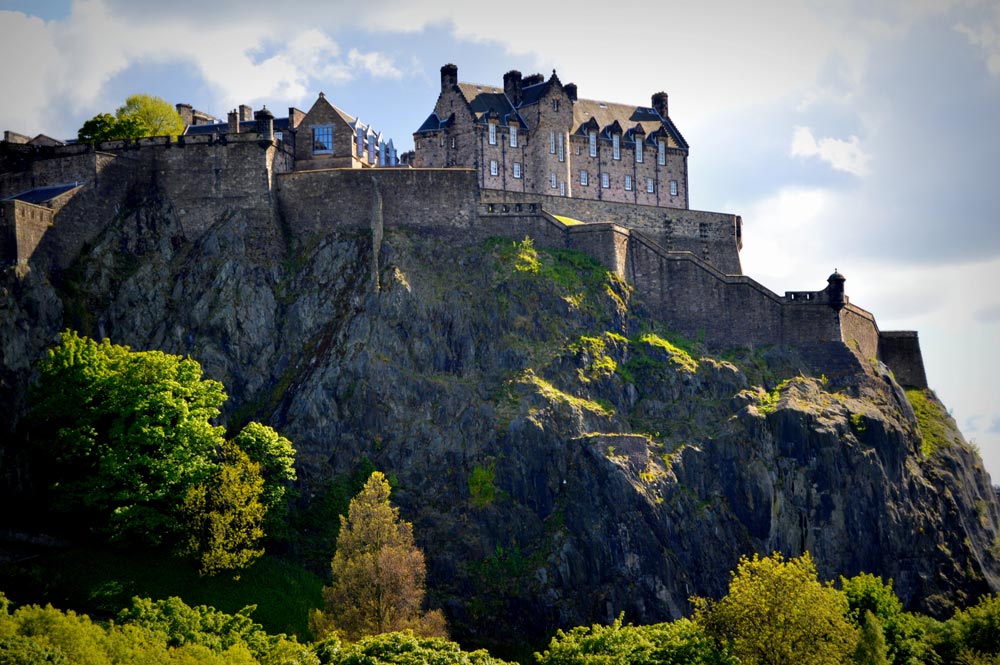
Castle Rock, Edinburgh

In Aneurin's GODODDIN, the son of Ceidio (my candidate for Arthur) is said to be at a place called "(g)las uffin" or "verdant Uffin."  To date, I've not found anyone who do anything with the Uffin place-name.  Recent scholars and translators treat it as "Germanic." According to Dr. Simon Rodway, 

"Specifically they mention OE Wuffa and Yffi (cf. OE hosa > hosan). Cf. the notes by Marged Haycock, Legendary Poems from the Book of Taliesin, second ed. (Aberystwyth, 2015), pp. 381-82."

Now, the reference to Taliesin is important, as the place-name is used in one of his poem's as well:

"I have drunk wine
in the hall of Uffin
on the estuary [Firth of Forth] of Gododdin."

- Canu y Cwrwf

Thus given that all the champions of the Gododdin who perish at Catraeth are said to have feasted and drunk at Din Eidyn prior to the battle, we must assume Uffin is a reference to that same place or someplace nearby.

Oddly enough, scholars seem have missed an earlier identification offered for Uffin:

https://www.jstor.org/stable/30070021?read-now=1&seq=14#page_scan_tab_contents

The idea is that as Welsh uffern, "hell", comes from Latin inferna, so does Uffin come from in fine, 'at the border.'  I find this derivation for uffin especially appealing, as in the PA GUR poem we are told of  'Din Eidyn on the border' (Line 28, Patrick sims-Williams translation). The term 'at the border' came to mean 'border place', in this case Din Eidyn.

This seems to me a much better solution to the problem than proposing a Germanic name for a place utilized by the Gododdin champions.

When I asked Brythonic place-name expert Alan James about this, he replied:

"Now that is an interesting idea. Phonetically it could work. 

As you say, Uffin is very odd, very hard to see a Celtic origin. Uffern is indeed the one word that comes to mind. According to Jackson LHEB 276, the development is inferno > Br Lat (indeed, Vernacular Lat from early, ibid 496) *i:fern- > uffern because of a 'tendency for Br Lat u, i: before a labial to becom u' - so presumably you could be looking for something, maybe Latin, like *inBin-, *i:Bin- or *uBin- where B is a labial /b,p,v,f/.

It would entail in fine > *infine > *i:fine in British Latin, and I've never come across such compounding, but if it did happen the outcome could well have been uffin.

Uffin in this context would be a locative. But where you locate the border depends on extra-linguistic considerations outwith my ken."


Tuesday, July 30, 2019

A NEW IDENTIFICATION FOR 'VICTOR' OF THE ARTHURIAN NORTH

UPDATE October 3, 2019:

Buadach, 'the Victorious', was an epithet often applied to St. Brigit of Kildare.  See http://www.smo.uhi.ac.uk/gaeilge/corpus/danta/brigit_buadach.html and other sources.  As the story of Creiddylad seems to have to do with Brigit of Kildare, it may well be that 'Victor' is just a ghost character created from the saint's epithet.  

NOTE: Since writing this piece, I've become aware of another tradition which may have something to do with Nwython the Pictish king and 'Victor.'

Nechtan was associated with a place called Kirkbuddo, supposedly named for a saint Buite.  This Buite was called  búadaig, 'the Victorious.'  See


There is a Roman camp at Kirkbuddo near Dunnichen, the Fort of Nechtan.  In going back to my earlier idea for Victor, could it be that 'the Victorious' saint next to this Roman fort is a folk memory of the Roman camp of Victoria?

Roman Camp and Buddo Place-Names Just South of Dunnichen


***


In the following article -

https://mistshadows.blogspot.com/2019/07/gwythyrvictor-nwythonnechton-and-pen.html

- I tried to make a case for the Gwythur of Arthurian story being a dim recollection of the Roman period Victoria fort in Highland Scotland.  I remained unsatisfied with this identification, however, and have since had an idea that may be vastly preferable.  For it is incredibly unlikely that the fort in question would have been remembered this way in heroic legend, must less personified.

In Welsh, budd- with various terminals came to mean 'victorious.'  The Irish cognate is buiad.  What Welsh does not possess, however, is anything akin to Irish buide, 'yellow.'

Here is the breakdown of these words from the Proto-Celtic:

victory *boudi-, SEMANTIC CLASS: action, OBrit.; Galatian Boudicca; Boudo-ris ‘victorious; victorious king’, Gaulish boudi-, Boudi- ‘profit, advantage, victory’, Early Irish búaid ‘victory’, Scottish Gaelic buaidh ‘victory, virtue’, Welsh budd ‘profit, gain, booty, riches, wealth; blessing, favour, advantage, emolument, benefit, usefulness’, Breton bud (Old Breton) ‘gl. bradium i.e. bravium ‘gain, profit’

yellow *badjo-, SEMANTIC CLASS: sensation, Gaulish Bodio-casses ‘yellow-haired people (?)’, Early Irish buide ‘yellow’, Scottish Gaelic buidhe ‘yellow’

Now, as it happens, Artur son of the Dalriadan king Aedan had two brothers named Eochaid Buide and Eochaid Find.  Find here is the exact Irish cognate of Welsh gwyn, which we find in the person of Gwyn son of Nudd in the CULHWCH AND OLWEN story about Gwythur and Arthur.  What I propose happened in this literary context is that Buide was confused for buaid and the latter "translated" into Victor/Gwythur.

As it happens, Artur and his brother Eochaid Find died in battle together.

https://celt.ucc.ie/published/T201040/text008.html

https://celt.ucc.ie//published/T100002A/index.html

The Irish sources vary as to where this happened.  One places the fateful battle in the territory of the Miathi/Maeatae, while another says they perished in Circenn.  The different accounts have been discussed by scholars such as John Bannerman (in STUDIES IN THE HISTORY OF DALRIADA).  See https://www.heroicage.org/issues/1/haaad.htm for a brief discussion of the problem.

Artur's brother Domangart is also present in the CULHWCH AND OLWEN story as Dyfnarth (there wrongly made son of Fergus Mor/Gwrwst).    From the Life of St. Columba:

"For Artur and Eochoid Find were not long after killed in the above-mentioned battle of the Miathi; Domingart was also defeated and slain in battle in Saxonia; while Eochoid Buide succeeded his father on the throne."

And from the Annals of Tigernach:

"The killing of the sns of Aedán i.e. Bran and Domangort and Eochaid Fionn and Artur, in the battle of Circhenn, in which Aodhán was overcome..."

I'm fairly certain that this new theory is valid.  If it is, then the idea that Penn son of Nethawc should be identified with Uther Pen[dragon] is simply an imaginary linking of the two personages in the fiction of the MABINOGION and the "Marwnat Vthyr Pen".  And the story in no way has any bearing on the historical nature of the 6th century British Arthur.  Instead, it represents an incorporation of material derived from the traditions of Scottish Dalriada.

Still, there could be some relatively unknown Buadach or similar in the region.  A few of these names are attested in the later medieval period near St. Andrews in Fife.  See https://books.google.com/books?id=L7Q4DwAAQBAJ&pg=PA166&lpg=PA166&dq=St.+Buadach%2BScotland&source=bl&ots=5ZVKJ6bind&sig=ACfU3U23VZQk3FeH9QuCigIhS5D1ua2CGw&hl=en&sa=X&ved=2ahUKEwiz6-aMvezkAhXRo54KHUNSDk0Q6AEwC3oECAcQAQ#v=onepage&q=St.%20Buadach%2BScotland&f=false.

We should also not forget that Uther is linked in Welsh tradition (at least subsequent to Geoffrey of Monmouth) to Budic I of Brittany, whos name is the Breton equivalent of Gaelic Buadach.  For Budic, see  
https://www.wales.ac.uk/Resources/Documents/Research/BretonPatronymsBritishHeroicAge.pdf.  The Emyr Llydaw or 'Emperor of Brittany' is given a son Madog, as is Uther Pendragon.  The Welsh identified Emyr with Budic.

A similar name is found on the Margam Stone in Wales.  I wrote an article on this quite some time ago, which can be found here: https://mistshadows.blogspot.com/2016/10/the-hiberno-british-vortigern-or.html.  We also have Bodvoc on coins of the Dobunni tribe.  

CREIDDYLAD

I've shown that the Cyledyr [1] of the CULHWCH AND OLWEN story is Kildare as found in the Irish sources.  The Pictish king Nechton is said to have established a St. Brigid religious house at Abernethy.  If we may derive Creiddylad from craidd, 'heart', which accounts for Cyledyr being forced to eat his father Nwython's heart, then might not this goddess be Brigid herself?[2]

Her friendship with Saint Patrick is noted in the following paragraph from the Book of Armagh:

"inter sanctum Patricium Brigitanque Hibernesium columpnas amicitia caritatis inerat tanta, ut unum cor consiliumque haberent unum. Christus per illum illamque virtutes multas peregit" (Between St Patrick and St Brigid, the pillars of the Irish people, there was so great a friendship of charity that they had but one heart and one mind. Through him and through her Christ performed many great works.)

In other words, Creiddylad is merely a designation for Brigid.

According to Scottish tradition, Brigid's relics were installed at Abernethy.  As relics can be composed of the physical remains of a saint, the story of Nwython/Nechton and Cyledyr/Kildare may be a confused account of a supposed translation of Brigid's heart from one institution to the other. 

[1] Cyledyr is said to be from *Culidorix < *Con-slii-o-riks 'seizing king' or something, if not from *Culo-dor- 'postern-gate' (figuratively 'defender' vel sim). See Sims-Williams, Celtic Inscriptions of Britain, pp. 46-47, with further references.  However, I don't believe the context of the story supports this etymology.  This is a rare case of my disagreeing with the linguists.

[2] As the story is set in the extreme North, Creiddylad could be a Welsh version of an Irish heroine whose name was spelled Creid, Crede, Credh, Credhe, Creidhe, Creide.  A Cred features in the Battle of Fionntragha or Ventry, the 'White Strand.' Another is the mistress of Cano son of Gartnain, a King of Scotland.

Sunday, July 28, 2019

AELIUS DRACO THE DACIAN AND THE BANNA/BIRDOSWALD ROMAN FORT OF UTHER PENDRAGON (A Repost)

NOTE: Since publishing this piece, I have had the following response on the matter from Professor Roger Tomlin:

"I don't really have anything to add to my original publication of the bowl in Britannia 35 (2004). I cite the imperial freedman Aelius Draco there. He would be an important bureaucrat, but Rome-based and unlikely to visit Hadrian's Wall, then commission the Pan and lose it in Staffordshire. Also, as you know, he is 'Antonine', so rather late for the building of the Wall.

The Pan is published by the British Museum on their site (Inv. no. 2005, 1204.1) – britishmuseum.org/collection/object/H_2005-1204-1 – which cites the full publication and discussion by Flügel and Breeze. I don't have this – I only read a draft of it – but they argue that Aelius Draco was a military surveyor, hence the emphasis on rigore.

As I say in my Britannia entry, the name 'Aelius Draco' might well identify an auxiliary soldier called Draco who served on Hadrian's Wall, of which he commissioned a souvenir after being discharged as a veteran in the reign of Hadrian. You can go further if you like, and argue that the name Draco is exclusively Dacian, and thus that he served in the cohors I Dacorum. Since the name is quite widespread, and other people used the draco, I am not entirely happy with this idea. But it is quite possible."

http://mistshadows.blogspot.com/2019/02/aelius-draco-dacian-and-bannabirdoswald.html

AELIUS DRACO THE DACIAN AND THE BANNA/BIRDOSWALD ROMAN FORT OF UTHER PENDRAGON


Ilam or Staffordshire Moorlands Pan

A few weeks ago I posted an article about the 'aeli draconis' found on a Roman bronze bowl called the Ilam or Staffordshire Moorlands Pan (see https://www.britishmuseum.org/research/collection_online/collection_object_details.aspx?objectId=1577008&partId=1).  I had pointed out what to me appeared to be a remarkable coincidence.  For this name- Aelius Draco - was found in place of the Banna listed on both the Amiens Patera and the Rudge Cup.  As Banna was garrisoned by the Aelian Dacians, who sported the draco standard and were the only Aelian regiment serving on the Wall, it seemed to me that the presence of this "Dragon" at Banna might have some bearing on Arthur's father, Uther Pendragon.  Unfortunately, at the time I had not gathered sufficient supporting material to make a really strong case.  As a result, I pulled the piece and embarked on additional research in order to prepare it for republishing at an unknown future date.  

Having since engaged in extensive correspondence with Dr. Mark Hassall, a noted expert on things Roman, I'm happy to say that I'm able to put this post forward once again - secure in the knowledge that it can stand up to scholarly scrutiny. I had initially contacted Dr. Hassall because he is listed as co-author of the following study on the Ilam Pan: http://discovery.ucl.ac.uk/35459/1/4128635.pdf (pp. 344-45, including the lengthy notes). This article is taken from Britannia Vol 35 92004 and, according to Dr. Hassall, was actually written entirely by Professor Roger Tomlin, perhaps the world's top Roman epigrapher. 

The conventional view, as expressed by Tomlin, is that either 1) ael is for Aelian, and is meant to be connected with the previous word, vallum, giving an otherwise unattested 'Aelian Wall' for what we routinely refer to as Hadrian's Wall or 2) ael is for Aelius, and is part of the fuller personal name-form Aelius Draco.  In support of the first idea is the presence of Pons Aelius, a fort at the eastern end of the Wall.  However, No. 2 is thought to be the more likely reading for this portion of the bowl's inscription.

Without my prompting, and merely out of his own curiosity and desire to help me in my own efforts, Dr. Hassall set about actually trying to identify a known Aelius Draco who fits the bill.  And he succeeded in locating an excellent candidate.  I am pasting below his discussion regarding this man, and will follow that with a statement by his esteemed colleague, Dr. John Nandris, who agrees with Hassall's assessment.

"I agree that it is interesting that Dracones - dragons - are a Dacian symbol (and as such appear on the Column of Trajan - the emperor who preceded Hadrian and defeated the Dacians) ,  and it is an interesting coincidence that there was a unit of Dacians  stationed at Banna.  Perhaps it is not after all a coincidence!  Even if as an imperial freedman Aelius Draco lived under Antoninus Pius, it is possible that he originated as a man called Draco in Dacia - perhaps a nickname  - where he was a slave and that he retained this name as his cognomen - Draco - when made free by Antoninus Pius. As an imperial slave he could have come to Britain under Hadrian in the company of the Dacian auxiliaries - all themselves free men -  But what was he himself or his master doing on Hadrian's Wall? Could Draco or his master have been a military surveyor?  And does the phrase rigore Valli Aeli(i) Draconis refer to a survey of forts at the west end of the wall?

Yesterday I went into the Institute of Classical Studies Library to check one or two things raised by your interesting arguments. Basically I still think Aelius Draco was the name of a  person. Roman citizens as you are no doubt aware, regularly had three names  as for example Gaius Julius Caesar where Gaius is the praenomen or forename, Julius is the nomen or family name /surname, and Caesar is the cognomen, or additional given name. In the case of Aelius Draco the prenomen has been omitted - not unusual. Aelius is the nomen and was the nomen of the emperor Hadrian's family  from whom on this interpretation, Draco or an ancestor received Roman Citizenship, and Draco is the cognomen, so there are no problems about Aelius Draco being the name of the man who had commissioned the construction of the vessel and was its owner - especially as the names are in the genitive case. But could Aelius Draco rather be the name of a place as you suggest? Here as again you are no doubt aware, one thinks of the Roman name of Pons Aelius, Newcastle-upon-Tyne 'the Bridge (Pons) of Aelius (=Hadrian). Draco would then be the equivalent of Pons. But why Draco?   I take your point abut there possible being a Dacian connection for Banna - the name for the fort where Cohors I Aelia (!)  Dacorum was in garrison,  but it still seems odd - unless there was a giant statue of a Dacian Dragon there!!!  Doesn't seem likely, and IF it were a place name the equivalent of Banna, why in the genitive when the other place name are all in the nominative?

So much for this but I thought I would also investigate a little about Draco, the name itself. You point out that the name Draco is rare in the western Roman provinces but is found in Italy, Greece Africa and the Balkans.  This is not in itself a probIem because Aelius Draco could have come from outside Britain and either been stationed on Hadian's Wall or visited it.  thought I would look at the examples of the name from Rome in Vol VI of the Corpus of Latin Inscriptions  (CIL = Corpus Inscriptionum Latinarum.) There I found to my amazement an actual example of the name Aelius Draco!!! - though of course there could be other examples  of the two names together from elsewhere, so this Aelius Draco doesn't have to be the same as the one on the Staffordshire pan, though I personally think it quite likely! The inscription which mentions him was found 'in aedibus Antonini Phrygepani, regione Capitolini - 'in the residence on Antonino Phrygepani (=Frangipani)  in the ares of the Capitol'.

CIL  VI,  part 3 20505                           D  M
                                                     IVLIAE   HELPIDI
                                                   CONIVGI BM FECIT
                                              T. AELIV AVG LIB DRACO                                                    
                                                      ET SIBI ET SVIS
                                                   POSTERIS EORVM

D(is) (Manibus)  Iuliae Helpidi coniugi bene merenti fecit, T(itus) Aeliu(s), Augusti Lib(ertus), Draco et sibi et suis posteris eorum

'To the spirits of the departed of Julia Elpis, well deserving wife, Titus Aelius Draco, freedman of the emperor made this, and for himself  and for their posterity'

Incidentally if he was an actual freedman of Hadrian and got Roman citizenship from him, this would date the vessel to the reign of that emperor - or in theory that of his successor but Hadrian's Wall - or part of it - is  unlikely to have been commemorated on souvenirs after the move to the Antonine Wall.   

If this Aelius Draco is our man what was doing up on Hadrian's Wall? Perhaps acting as some sort of military bureaucrat? And how come that his souvenir ended up in Staffordshire and didn't return to Rome with him?

I realise I made a slip in the email I sent. At the very end I wrote that Ti(tus) Aelius Draco received Roman  citizenship either from the Emperor Hadrian or his successor - Antoninus Pius. In fact it has to be Antoninus Pius because the praenomen of Draco was Ti(tus). The praenomen of Hadrian was P(ublius), and the imperial freedman Draco will have used the praenomen of the emperor from whom he received  Roman Citizenship. The praenomen of Antoninus Pius was Ti(tus) and he was emperor from 138-161.

One thing I can agree on: he may well have been - probably was - a Dacian." [Emphasis mine.]

The following was published in THE TELEGRAPH on 3 October 2003 and was written by Dr. John Nandris:

"I have not handled the fine second-century AD enamelled bronze bowl shown in your report of Oct 1, but it is most unlikely that its owner, Aelius Draco, was a Greek. His Latin name, the link to service on Hadrian's Wall, the date of the bowl and the Celtic style of its decoration all suggest that he was a Dacian. [Again, emphasis mine.]

After the conquest of Dacia by Trajan (103-106), many Dacians served with distinction in the Roman legions on the Wall. Their admiration for Roman culture helped to transmit late provincial Latin into today's Romanian language. Dacians had been in close symbiotic contact with Celts since the fourth century BC, while "Draco" is an allusion to the Dacian battle standard." 

So, what we appear to have here is a Dacian, operating out of Banna, where a Dacian garrison was stationed, who was given the name Draco because of the special significance that monster had for the Dacians in general, and the Dacians at Banna in particular.  

We need only postulate, not at all unrealistically or implausibly, that the dragon and what it represented - both as a Dacian religious/mythological symbol and a Roman battle standard - continued to hold power for the inhabitants of the Banna fort into the sub-Roman period.  This would allow us, ultimately, to trace Uther Pendragon to this military station on the Wall.  I've suggested before that Pendragon may be a literal translation into Welsh of the late Roman military rank of magister draconum.  While this remains possible, and is highly attractive, we could just as easily opt for 'Chief Dragon' as simply an honorific for the leader of the sub-Roman martial elite at Banna.

It was from this Dragon that the famous Dark Age Arthur sprung.  His name, a Roman decknamen, was chosen because Artorius, made famous by the 2nd century dux of York, was likened to the *Arto-/"Bear" name of the river upon which Banna (and Camboglanna) sat.  I've not yet decided where Arthur's power center may have lain.  It could have been one of these two forts in the Irthing Valley or, as I've argued before, at Uxellodunum/Stanwix, the largest cavalry fort in Britain and the command center of the Wall.  Relatively late tradition records an 'Arthur's Burg' at Stanwix (actually, adjoining Etterby, which has no fort or camp).  And given that Pedr/Petrus of Dyfed named a son Arthur, it is tempting to say he did so because the garrison of Stanwix was the Ala Petriana.  The NOTITIA DIGNITATUM calls Uxellodunum "Petrianis".  This has been assumed to be an error, but it may also be a nickname for the fort.  In any case, Stanwix is roughly equidistant between the Irthing Valley, the Carwinley of Gwenddolau and the Aballava/Avalana/"Avalon" Roman fort at Burgh-By-Sands.  My candidate for the Northern Arthur is Ceidio son of Arthwys ('man of the Arth', an eponym for the River Irthing), father of Gwenddolau. Ceidio's hypocoristic name almost certainly originally meant 'Battle-leader', a Cumbric version of the dux bellorum title used to describe Arthur in the HISTORIA BRITTONUM.  So if Ceidio = Arthur, his ruling center should probably be sought at Uxellodunum.  

Dacian or Sarmatian rider with draco from Deva Victrix. In display at Grosvenor Museum.
Photo Courtesy Wikipedia.

NOTE:  In Geoffrey of Monmouth, Uther places one of his dragon standard's in Winchester, the Roman period Venta Belgarum.  I would suggest this might be a reflection of BannaVENTA Bernia, a designation for the Banna Roman fort of the Dacians on Hadrian's Wall.  


A LOGICAL PLACEMENT OF CEIDIO/ARTHUR ON HADRIAN'S WALL (A REPOST)

http://mistshadows.blogspot.com/2019/02/a-logical-placement-of-ceidioarthur-on.html

A LOGICAL PLACEMENT OF CEIDIO/ARTHUR ON HADRIAN'S WALL

Birdoswald (Banna) Roman Fort, Irthing Valley, Hadrian's Wall

As most of my readers knows by now, my favorite candidate for the famous Dark Age Arthur is Ceidio son of Arthwys.  But I've bounced Ceidio around a bit trying to settle on his primary court.  Three possibilities have been explored: 1) Banna/Birdoswald Roman fort, the birthplace of St. Patrick and site of a sub-Roman and early medieval hall 2) Camboglanna/Castlesteads, where our hero perished along with Modred/Moderatus and 3) Uxellodunum/Stanwix, the largest cavalry fort in all of Britain and the command center of at least the western side of the Wall. It appears to have been known in local tradition as Arthur's Burg.  

To try and narrow these options down,  I've discussed the significance of the name Arthwys in some detail. This is an eponym for a place, in this instance the Irthing River in Cumbria.  Both Banna and Camboglanna are in the Irthing Valley. Arthwys may be compared with Glywys, the eponymous founder of Glwysing in south Wales, from the Romano-British period Glevum used for Gloucester.  It is not, therefore, the name of a real chieftain.  Nonetheless, Arthwys is claimed as the father of both Ceidio and Eliffer of York (who is elsewhere made the son of Gwrwst Ledlum/Fergus Mor of Dalriada, an intrusion into the early portions of some of the genealogical lines of the Men of the North).

While is thus tempting to simply say, "Well, if Eliffer of York can be son of Arthwys of the Irthing, then why can't Ceidio son of the same man/place be of Stanwix?"  But this isn't a simple parallel.  For Ceidio (whose hypocoristic name originally meant 'Battle-leader' or 'Battle-ruler' or the like, which is what doubtless produced the dux bellorum title given to Arthur in the HISTORIA BRITTONUM) would have also born the name Arthur (from Artorius).  And Arthur was associated by the Britons with their word for bear, 'arth'.  So the question we must ask is this: if he were named Arthur because he was born in the Irthing Valley - almost certainly at Banna, where his father's Pendragon title may be a reference to the draco of the Dacians who were garrisoned there - did he also rule from there?  Or was his headquarters located outside of the Irthing Valley?  And, if so, where exactly?

Ceidio is made the father of Gwenddolau, the lord of Myrddin (Merlin).  His name is preserved in Carwinley, i.e. Caer Gwenddolau.  However, even here there is a problem, for Gwenddolau means, literally, 'White dales', and is, therefore, almost certainly yet another personified place-name.  Still, if we allow for Ceidio having been born at Banna and look towards Carwinley, and then triangulate to Aballava/Avalana/"Avalon" at Burgh-by-Marsh, and imagine traveling via the Roman road from, say, Camboglanna to Stanwix and then north to the Roman fort at Netherby hard by Carwinley, that Stanwix really is at the hub of this grouping of forts.  


Stanwix was garrisoned by the Ala Petriana, named for a certain Petra.  Either by mistake or as a sort of nickname, the NOTITIA DIGNITATUM calls Uxellodunum 'Petrianis.' Once again, this was the largest cavalry unit in all of Britain.  I have before very tentatively put forward the idea that the reason Pedr (Petrus) of Dyfed in southwest Wales names a son Arthur was because the earlier, much more famous one had become linked to the descendants of the Ala Petriana of Stanwix.  In considering this possibility a second time, it does not seem so untenable a theory after all.  We might assume that a cavalry force under Arthur had assumed the name of the earlier ala or that a newly raised force patterned after that ala inherited the Petriana designation.  Had Arthur and his horsemen became famous, a prince of Dyfed named Petrus may well have named his son after this great Northern leader of  'the Petriana.'  

While none of the above may seem particularly compelling to someone who wishes to find Arthur elsewhere, I believe that both my placement of his battles as well as the archaeological evidence discussed by the likes of Dr. Ken Dark of Reading (see https://mistshadows.blogspot.com/2018/12/dr-ken-dark-on-fifth-sixth-century.html [1]) make for a valid, and perhaps, strong and convincing argument. 


[1]

In this section I will be discussing the case that has been recently made by Ken Dark of the University of Reading for the sub-Roman (i.e. 5th-6th century CE) re-use of Hadrian’s Wall, as well as of forts along the Wall and in the adjacent tribal territory of the ancient Brigantian kingdom.

According to Dark, from whose paper I will liberally quote:

“… eight fourth-century fort sites on, or close to, the line of Hadrian’s Wall have produced, albeit sometimes slight, evidence of fifth -sixth-century use. Nor is this simply a reflection of a pattern found father north; for no Roman fort site in what is now Scotland has any plausible evidence of immediately post-Roman use. Thus the situation to the north of the Wall is similar to that found in Wales.

What is more surprising still is the character of the reuse found on the line of the Wall. Two sites, Housesteads and Corbridge, have evidence not only of internal occupation, but of refortification; at Birdoswald there are the well known ‘halls’, while at Chesterholma Class-I inscribed stone of the late fifth or early sixth century come from the immediate vicinity of the fort. At South Shields there is also evidence of re-fortification, and there is an external inhumation cemetery. Another Class-I stone was identified by C.A.R. Radford at Castlesteads [I have rendered the inscription of this stone above in Chapter 3].

At Binchester immediately to the south of the Wall, and at Carvoran, Benwell and Housesteads on its line, there are early Anglo- Saxon burials or finds, while at Chestersand Chesterholm (perhaps sixth century) Anglo - Saxon annular brooches come from within the forts, although these may be somewhat later in date than the other material so far mentioned.

At the western terminal of the Wall, a town-site,
Carlisle, though not necessarily primarily military in the Late Roman period, has also produced substantial evidence of sub-Roman occupation, with continued use of Roman-period buildings into the fifth, if not sixth, century.

Many scholars accept that Carlisle was part of the late fourth-century Wall-system, perhaps even its headquarters, and at Corbridge, the other town-site intimately connected with the
Wall, fifth -and sixth century material has also been found, including, perhaps, evidence of continuing British and Anglo-Saxon use. In the North as a whole, fifth- or sixth-century evidence from what had been Late Roman towns is not common. York, Aldborough, Malton, and Catterick are our only other examples. Two of these sites (York and Malton) were part of the same Late Roman military command as Hadrian’s Wall: that of the Dux Britanniarum.

It is interesting that, of the sites at Manchester and Ribchester– between the Mersey and Carlislethe only fort-sites known to have possible fifth or sixth -century evidence – Ribchester was not only part of the command of the Dux Britanniarum, but also listed as per lineum ualli in the Notitia Dignitatum. It is, therefore, remarkable that out of the twelve fourth-century Roman military sites in northern and western Britain to have produced convincingly datable structural, artefactual, or stratigraphic evidence of fifth-or sixth-century occupation, eleven were, almost certainly, part of the Late Roman military command.

Eight of these were probably within the same part of that command, and eight comprise a linear group (the only regional group) which stretches along the whole line of Hadrian’s Wall from east to west. The two more substantial late fourth- century settlements adjacent to the Wall – Carlisle and Corbridge– have also produced fifth- and sixth-century evidence and two of the other towns with such evidence were also late fourth-century strategic centres under the military command of the Dux.”

After setting forth these facts, and discussing them, Dr. Dark offers a rather revolutionary idea:

“Although it is difficult, therefore, to ascertain whether the military project which I have described was the work of an alliance or a north British kingdom or over-kingdom, there does seem to be reason to suppose that it may have represented a post-Roman form of the command of the Dux Britanniarum…

This archaeological pattern, however it is interpreted, is of the greatest interest not only to the study of the fifth-and sixth- century north of
Britain, but to that of the end of Roman Britain and the end of the Western Roman Empire as a whole. It may provide evidence for the latest functioning military command of Roman derivation in the West, outside the areas of Eastern Imperial control, and could be testimony to the largest Insular Celtic kingdom known to us.”

In another paper, Ken and S.P. Dark rebut P.J. Casey’s argument for a re -interpretation of the reuse and re-fortification of the Wall and its associated forts. His conclusion for this paper reads as follows:

“If one adopts the interpretation that the Wall forts were reused in the later fifth-early sixth century for a series of sub-Roman secular elite settlements, then the associated problems involved in explaining this new evidence of occupation at that time disappear…

So, the interpretation that the Wall became a series of secular elite settlements, discontinuous from the Late Roman activity at the forts within which they were sited, is compatible with the evidence of pollen analysis, while the alternative interpretations are both rendered unlikely by it. This does not, of course, make the suggestion that this reoccupation represents the sub- Roman reconstruction of the Command of the Dux Britanniarum any more likely, but the pattern on which that interpretation is based has been strengthened, rather than weakened, by the new archaeological data, whilst the evidence also hints at a similar reoccupation with regard to the signal stations of the Yorkshire coast and their headquarters at Malton.

Perhaps, then, at last one is able to see answers to many of the most pressing questions regarding what happened in north Britain, and more specifically on Hadrian’s Wall, in the fifth and sixth centuries…

The answer to all of these questions may lie in the rise and fall of a reconstructed Late Roman military command, unique in Britain, which was organized in a sub-Roman fashion reliant upon the loyal warbands of warrior aristocrats (and Anglo-Saxon mercenaries) rather than paid regular soldiers. The organizing authority of this system, probably a king of the sub-Roman Brigantes, assigned a politico-military role to the defended homesteads of these elites, and (as in the location of churches at disused forts, through land-grants?) positioned these at what had been Roman fort sites, but which were (at least substantially) deserted by the time when they were reused in this way. Thus, the ‘Late Roman’ Wall communities dispersed during the first half of the fifth century, but the Wall – andperhaps the north generally – was redefended inthe later fifth and early-mid sixth century onvery different lines, yet not completely without regard for the Late Roman past.”

I would add only that it is my belief this ‘king’ of the sub-Roman Brigantes whom Dr. Dark proposes was none other than the dux bellorum Arthur.

Here is yet another summary of sub-Roman findings at the Wall, prepared by the man who was the director of the archaeological group conducting the Stanwix Primary School dig, Dr. Mike McCarthy. The selection may be found in his book ROMAN CARLISLE AND THE LANDS OF THE SOLWAY:

"At Stanwix, Carlisle, little of the fort, the largest on Hadrian's Wall, has been investigated under modern conditions, and it is certain that much will have been destroyed. Excavations in the school playground, however, have provided tantalising hints that activities continued [past the Roman period], with the discovery of at least two phases of buildings represented by substantial post-pits cutting through earlier Roman deposits...

To summarize, modern investigations at several forts have yielded evidence for sub-Roman activity in key buildings. They include the granaries at Birdoswald, the commanding officers' houses at South Shields and Vindolanda, the bath-house at Binchester and the headquarters building at Carlisle.  The conclusion one might draw is that important buildings in important locations (forts) continud to have a function at the point where the old-style Roman military command structure no longer had any real force, and the pay chests needed for the soldiery had ceased to arrive; and we can see this at Carlisle where the barracks fell from use. Nevertheless, the continued use of formerly key buildings, as we can see in several forts, might allow us to infer that this is an element in the archaeology of lordship. If so, it is lordship in transition from a Roman command structure to one of sub-Roman leaders emerging as local chiefs or kings with military titles and authority derived from that of the late fourth century. They doubtless formed small private armies or warbands, and established territoria which could supply their provisions and over which they exercised a quasi-leadership role. They were not yet kings or princes, but neither were they members of the Roman army linked into a wide-ranging command structure.  Their authority was derived from the former prestige attached to the place, and their dwelings may, as is hinted in the late phases of the Commanding Officer's house at South Shields, be large and imposing, as the central range location of their buildings at Carlisle and Birdoswald may also suggest."

Dr. Frank Giecco, who was also involved with the same excavation at Stanwix, has informed me that,
“Dating is very hard, but a 5th century date seems likely if I had to choose based on evidence. Stanwix had very large stone post pads. A similar building is recorded at Birdoswald.  The Stanwix structure was built over the old Roman barracks.”