Wednesday, January 1, 2025

ARMORICA RISES?: PROFESSOR JOHN DRINKWATER ON THE L. ARTORIUS CASTUS INSCRIPTION

[NOTE: Since writing this piece, I've added another on the same subject.


Armorica and Armenia compared with the two long-range British missions in the extant epigraphic record

"Some have interpreted this as Castus leading British troops across the empire
to Roman Armenia; clearly this is not logical as greater concentrations of troops
would be far nearer and the province of Britain was suffering unrest itself."

- John S. McHugh, THE EMPEROR COMMODUS: GOD AND GLADIATOR

In the past, I explored the possible reading ARMORICOS for the LAC memorial stone. Having shown for the first time the reading could fit properly in the lacuna 
(see https://mistshadows.blogspot.com/2021/06/the-lucius-artorius-castus-stone-with_14.html), I then set about trying to establish its historical validity. Many articles were produced. Two of the more comprehensive can be found here:


I abandoned the reading - despite my gut telling me all along that Castus' three British legionary detachments perfectly matched the 1500 British spearmen sent to Rome at the time if the Deserters' War in Gaul - for chiefly three reasons.

One, evidence seems to suggest that Castus' Liburnia was founded c. 168-170 at the onset of the Marcomannic Wars. The ius gladii power invested in him during his procuratorship  represented something done on an emergency basis and thus only seems possible early on. Not after the Marcomannic Wars had been ended by Commodus.

Two, the Roman governor of Britain, Statius Priscus, was sent to command the army in Armenia. As troops were drawn from the Rhine and Danube, some could easily have accompanied Priscus.

Three, Professor Roger Tomlin did not believe the Armorica could be present on the stone because if it were there we were talking about a full-scale Armorican rebellion, not just a action launched against some deserters and assorted riffraff. In his opinion, several other terms would have been used instead.

Well, recently I was discussing tge matter with Professor Lawrence Keppie. He kindly referred me to his colleague, Professor John Drinkwater, whom Keppie described as THE expert on Imperial Roman Gaul.

I wrote the following query to Prof. Drinkwater:

Dear Professor Drinkwater:

I have been very kindly referred to you by your colleague Professor Lawrence Keppie. He and I have been discussing the ARM[...]S lacuna in the Lucius Artorius Castus stone.

The debate regarding this lacuna involves the two possible readings that have been proposed: ARMENIOS and ARMORICOS. Both fit nicely on the stone when allowable ligatures are employed.

Castus was prefect of the Sixth Legion who was apppointed dux and led three British legions (vexillations are implied) ADVERSUS ARM[...]S.

For Armenia, Tomlin points to the emergency sending of the Roman governor of Britain to Armenia in the 160s. As troops for the Armenian war were pulled from the Rhine and the Danube, it is thought reasonable that Priscus might have brought some British soldiers with him. As Castus' next appointment was procurator of Liburnia with ius gladii, and Liburnia seems to have been created on an emergency basis at the onset of the Marcomannic Wars, this reading would seem to make sense.

However, those preferring the ARMORICOS reading can point to the Deserters' War under Commodus in Gallia Lugdunensis and the 1500 British spearmen who at this time escorted the removed legates to Rome and who brought about the execution of Perennis. 1500 nicely divides into three legionary detachments of 500 each. The coincidence is rather striking.

Now, I have read Picard and others on the disturbances and destruction in Armorica at this time. I've also consulted the various treatments of the Deserters' War. Some think this was a major event. But Roger Tomlin says that the deserters were composed of assorted riffraff and that to say ADVERSUS ARMORICOS would mean that all of Armorica would have had to be in open rebellion. For that reason he favors Armenia. He thinks any number of more appropriate and accurate terms would have been used to describe the deserters, just not ARMORICOS.

As you are the expert on Gaulish matters, I'm hoping you could please share your thoughts with me on the Deserters' War and whether this event could, in your opinion, have been designated as an Armorican rebellion.

Thank you, best of New Year's wishes, and respectfully,

Daniel Hunt

To which he responded:

Dear Daniel,

I've just finished putting my first thoughts down on paper.

These are:

1.    Although I never went deeply into the issue, I was always instinctively inclined to follow Mommsen in believing that ILS 2770 relates to northern Gaul.

2.    That ‘Ar[e]morica’ was a long accepted designation of that large and important strategic area of northern coastal Gaul which stretched from Brittany to the Seine estuary is clear from Caesar’s civitates qui Aremoricae appellantur (BG 5.3, 7.75, 8.31) and the Notitia Dignitatum’s tractus Armoricanus et Nervicanus.

3.    That the inhabitants of the civitates of Ar[e]morica could cause trouble for Rome is similarly evident in events of the fifth century (unrest c. 410-c. 449: Zosimus, Rutilius Namatianus De red. suo, the Querolus etc.) and also, I believe, in those of the late-third century (the first Bagaudic revolt, which took full imperial intervention to suppress, and had a huge effect on subsequent imperial and world history).

4.    The extent and precise details ‘Deserters’ War’ of the mid-/late-180s may well have been exaggerated and distorted by the sources, but there can be no doubt that the fact that it receives mention indicates that, like the first Bagaudic revolt, it was a very serious affair. Although it probably began in and remained centred on the Rhine-area, I believe that it could well have sparked off significant disruption further afield, including outright rebellion in Ar[e]morica.

Yrs,

John

J. F. Drinkwater, M.A., D.Phil., F.S.A.,
Emeritus Professor of Roman Imperial History,
Department of Classics and Archaeology,
University of Nottingham,
NOTTINGHAM, NG7 2RD,
U.K.

As a follow-up question, I sent this to Prof. Drinkwater:

Thank you, John, for taking your time to help with this.

A related question, if you don't mind.

These 1500 British spearmen who went to Rome to get rid of Perennis... again, this force could well have been composed of 500 men each drawn from each of the three British legions. Past scholars have seen in this force Castus' vexillations sent against the Armoricans.

McHugh in his book The Emperor Commodus suggests that this was an unusually large escort for the removed legates, made necessary by the need to pass through territory adversely affected by the Deserters' War. The author makes an excellent argument for 500 lanciarii being selected from each legion as escorts for the three legates.

Dio tells us the force reached Rome without encountering any resistance.

But is it plausible to propose the following:

Castus is sent to Armorica with troops to quell an uprising. At or shortly after this time, Perennis removes the legates due to the attempt by the troops in Britain to raise Priscus to the purple. Having put down the rebellion, Castus' force is tasked with conveying the removed legates back to Rome. Possibly other parts of Europe were still dealing with unrest.

I can also see Dio confusing accounts of 1500 British soldiers sent to Armorica with a British escort of legates to Rome. It is even possible that a small group was separated from Castus' troops to act as an escort.

Your thoughts?

D.

And his reply:

1.    For the reasons I stated in my email of 30th December, I see no problem in principle to believing that there could have been serious trouble in Ar[e]morica in the later-second century resulting in military intervention from Britain.  (And Ockham’s razor needs to be deployed: why bring in the complexity of Armenia?)

2.    In addition, I think that one may conjecture that this was in some way related to the ‘Deserters’ War’.

3.    I suggested that this war was probably focused on the Rhine because, from the later-third to the early-fifth century, this was where most trouble in Gaul originate – because of the presence of the army and, presumably deserters.

4.    However, the Augustan History (Pesc. Nig. 4.4) has Pescennius Niger dealing with deserters in Lugdunensis.

5.    I have to say that I am always suspicious of the HA, and although its earlier ‘Lives’ are more reliable than its later, this reference occurs in a section of Pescennius Niger’s where – with the supposed letter from Severus to Ragonius Celsus -- it begins to drift into fiction.

5.    Furthermore, even accepting what it says about Niger’s command as reliable, I would still locate the focus of the war on the Rhine both because this was a traditional hotbed of trouble and because, according to the account Maternus moved into Italy - so probably from the upper Rhine.  

6.    Yet Herodian (1.10.2 also reports that there was trouble further much afield, in Gaul and Spain;  and one could  speculate that the ‘Deserters’ war’ in southern Lugdunensis may have sparked off regional revolt in Ar[e]morica, i.e. that these were two elements in a continuum of severe unrest that may have continued whatever Maternus was up to.

7.    I concede, therefore, that an alternative explanation may be that Niger defeated the main body of the deserters in Gaul and that only then did Maternus and the survivors flee into Italy, but I don’t think that this fits the scale of Maternus’ ambitions as described by Herodian (2.10.3).

8.    But historical speculation about unproven probabilities/non-probabilities aside, the fundamental issue remains epigraphic.  Which reading of ARME… do experts believe better fits both the available space and contemporary epigraphic style and conventions?  Anthony Birley, whose epigraphic skills were second to none, specifically accepted Armenios over Amoricanos:  The Roman Government of Britain (2nd edition), 2005, 355.  This was a problem for supporters of the  Ar[e]morican reconstruction. But you have sent me the ARMORICOS reconstruction image and it would appear to work just fine.

9.    The question as to whether the British forces gathered for the Ar[e]morican (if such it was) expedition may in some way be linked to Dio’s (72.9-10) 1,500 spearmen sent to Rome who initiated the fall of Perennis – a sort of ancient ‘Wagner’ force – is a wholly distinct issue.

10.   I must say that I have my doubts about such a link.  We need to know much more, otherwise there is too high a degree of speculation.  A huge problem here is that ‘Dio’s’ text here is not his but that of the epitomators, and therefore not wholly reliable.  My reading of what we have is that the 1,500 were sent, independently of other events, by their commanders (I can’t find any mention of the legates being arrested and conveyed to Rome by this force) as a sort of military embassy to the emperor, presumably to obtain his forgiveness for their part in the recent political unrest in Britain.

I would make a final point about an Armorican expedition for Castus and his serving as procurator of Liburnia with ius gladii.  In the past I argued rather forcefully for the foundation of Liburnia c, 168-170, when we know Marcus Aurelius and Lucius Verus militarily reorganized Illyricum and Dalmatia.  For Castus to have been given the right of the sword meant that something of an emergency situation was going on and this is the only event we know of where actions were taken that sound a lot like the foundation of Liburnia at the outset of the Marcomannic Wars.

However, after the Deserters' War we had a significant action in the East that has not received much attention: another war against the Sarmatians. In 185 A.D. Commodus' coins have the legend  VO DE SARMATIS, and the HISTORIA AUGUSTA tells us that generals of the Illyrian army won victories in Sarmatia. The Marcomannic Wars were ended by Commodus c. 180, but it is possible, I suppose, that the war against the Sarmatians was accompanied by Castus being made procurator of Liburnia (whether formed at this time or earlier) with unusual judicial power.  

Another theory holds to danger coming from the direction of Pannonia.  There a certain Plotianus is thought to have schemed against Commodus.  See https://mistshadows.blogspot.com/2023/11/a-british-named-cavalry-unit-and-son-of.html.

It could also be that brigands were still a problem in Liburnia, as they had been under Marcus Aurelius, and that Castus was given ius gladii for this reason.

And, of course, the position could simply have been a reward for good service.

This is the best we can do for ARMORICOS on Castus' stone.


Sunday, December 29, 2024

SOME FUN WITH THE ARM.GENTES READING FOR THE LAC STONE

A few days ago I wrote this post:


After thinking about the ARM[...]S lacuna, I turned my attention to another later gap:

PROC CENTENARIO PROVINCIAE loo
LI [...] GLADI loo

It has always been assumed that LI- had to represent Liburnia, as no other entity beginning with LI- fulfilled the requirement of the procurator rank. The Libyan provinces formed under Diocletian were each governed by a praeses. 

Yet, it is also true that the LAC stone is our only evidence for the actual existence of a Liburnian province. The possibility that such a province was real is suggested by the presence of LAC's estate in Dalmatia, as well as Artorii in Salona. Still, neither his estate nor Salona are in Liburnia.

What if LAC were merely born in Dalmatia (something several leading scholars hold to be a distinct possibility) and then retired there after his service was completed? What if he was never a procurator of Liburnia because such a province never existed?

Suppose we did this with the LI[...] GLADI lacuna instead... Allowing for standard abbreviations, we substitute  for LIB(URNIAE) IURE GLADII the following:

LIBERAT(AE) GLADIO

"freed by the sword"

The LAC inscription would then say something like this:

LAC was prefect of the Sixth Legion when he was appointed dux. He led British legions (or legionary troops) against armed tribes. As we are not told these armed tribes are external to the province of Britain, we are to assume they are northern British tribes (as is usual for the Sixth, and as fits the context of northern campaigns against tribes under Commodus and Severus). LAC is then made procurator of the province he has just freed by the sword.

Now, before anyone gets too excited (or outraged) by this, let me quickly say that scholars find the whole thing objectionable for any number of reasons. Dr. Benet Salway, for instance, has told me that

"Very unlikely, not least because one would have to assume a one-letter abbreviation of gladio to gladi."

Professor Lawrence Keppie on the same proposed phrase:

"The inscription is filled with official jargon, so I can't imagine unofficial or colloquial phrases will feature."

And as for Tomlin:

"I am not convinced by your 'province freed by the sword' (LIBERTO GLADI!). Libertus doesn't mean this – you need liberatus, and you need it to be feminine and genitive; i.e. LI[BERATAE], which won't fit in the space available. And you can't make genitive GLADI into ablative gladio. And I don't think this is an expression the Romans would have used any way: they would refer to a province being 'recovered' or 'redeemed' (compare the somewhat fanciful restoration of RIB 1051). And in this very explicit inscription, it is suddenly obscure what province is meant."

Prof. Roger Tomlin has no problem with Liburnia for LI-:

"PROVINCIAE spelt out surely requires that the next word will be that of the 'province', and abbreviation isn't much of a problem, since it would adjoin that of the province in which the stone was read. Most US inhabitants would know what was meant by STATE OF CAL.

Certainly LIB IVRE GLADII suggests nothing else to me."

The most critical flaw in seeing Castus as procurator of Britain is that procurators were chosen by the Emperor for smaller provinces. Larger provinces, such as Britain, had governors elected by the Senate. So to have Castus, of the equine class, made Procurator of Britain, something very unusual would have had to have happened. What that would be I can't say. With the execution of Perennis, it is believed the senatorial legates were restored to their positions. And, in any case, Castus would have referred to himself as governor or acting governor, given that Britain was not a procuratorial province.

Having said this, however, it is true that we have some instances of procurators being appointed to assist governors. These procurators were responsible for fiscal matters. For example, Sextus Varius Marcellus was sent as procurator to help the governor Virius Lupus.

As per my previous post, for Castus to be in command of the Sixth and leading other legionary troops within Britain we must account for the absence of the legionary legate. We cannot have him merely removed by Perennis, as Castus is a prefect when appointed dux. Dux at this stage in Roman military history is merely a temporary position given to a junior officer.

Thus we must assume the legate is dead or incapacitated, and thus I feel scholars are right in identifying the general who perished c. 180 on the Wall at the hands of invading tribes as the legate of the Sixth legion.

As second in command, Castus is put in charge of the legionary forces sent north under Ulpius Marcellus. There was simply no time in this emergency situation to find another legate for the Sixth. 

At some point thereafter Castus becomes procurator under a British governor. Castus does not refer to himself as an acting governor (vice-legate).

Really, my only reason for putting this outlandish idea out there is to demonstrate just how ambiguous inscriptions with major lacunae can be. Given that the Romans were particularly adept at condensing texts, often each lacuna can be subjected to several possible reconstructions.

The goal of the epigrapher is to look at possible readings in the hope of eventually settling on what is the most probable one.  The most probable - and the simplest - for the LAC stone is that we have a career Roman officer who served with distinction under Statius Priscus in Armenia. This officer was then made a procurator with the right of the sword for the newly formed and short-lived province of Liburnia, an emergency measure taken at the onset of the Marcomannic Wars.

Wednesday, December 25, 2024

A NEW READING FOR THE 'ARM[...]S' LACUNA OF THE L. ARTORIUS CASTUS INSCRIPTION


***

New information has become available to me that might make this reading more palatable.

When I shared it with Dr. Benet Salway, he responded:

"You have now assembled a convincing body of parallels to argue for your restoration of this lacuna on the epitaph for Artorius Castus.

Well done."

Firstly,  I have found a phrase, armato milites, 'armed soldiers', in Virgil's Aeneid (ii.20). However, as Benet Salway has pointed out, "[Virgil's]
 as verse is not probative." But it does show again the adjective in front of the noun, as in my proposed armatas gentes for the LAC lacuna "ARM[...]S."  'armatis militibus', "armed soldiers", occurs in HISTORIA AUGUSTA Septimius Severus 7 and in the same source's Antoninus Caracalla 2. HA Maximus and Balbinus 8 has 'armatos hostes', "armed enemies".


In Suetonius's Twelve Caesers, I found 'armata praesidii' (Julius), "armed guard."  Also 'armatis cohortibus', "armed cohorts" (Nero). 

This as well -

armatum concilium "armed council"

armatum tribunum "armed tribunes" Cic. Pis. 77

armatus hostis  armed enemy Sallust  Bellum Catilinae

armatis hominibus  armed men Sallust BC

armata milia armed thousands Caeser Gallic Wars 2

armatum hostem an armed enemy Caeser Gallic Wars 5

armata civitas an armed city Caeser Civil Wars 3 

armatos castris "armed camp" Tacitus Annals 2

armatis cohortibus "armed cohorts" Tacitus Annals 3

armatorum milia "armed thousands" Tacitus History 3

armati exercitus "armed army" Tacitus History 3

armatorum Romanorum "armed Romans" History 4

And even in later historical sources, like Ammianus Marcellinus (Book XX; V):

armatarum cohortium "armed cohorts"

Or here:


armatos hostes "armed enemies"


armatae militiae "armed forces"


 armatorum turbae "armed crowd" 

I'm sure other examples could be found - perhaps many such. 

Prior to this I had located armatas gentes in two instances from the historian Livy.

But more importantly, Roger Tomlin had reservations about armatas being found in inscriptions abbreviated to ARM.  Well, I have found it.

publication: CIL 03, 14320,02 (p 2328,159) = AHB p 605
dating: 201 to 300         EDCS-ID: EDCS-32300027
province: Dalmatia         place: Tomislavgrad / Duvno / Zupanjac / Delminium
Arm(ato) Aug(usto) s(acrum) / Mattonia / Tertia li/be(n)s posuit
inscription genus / personal status: mulieres;  tituli sacri;  tria nomina
material: lapis


ARMATUS AS 'ARM'

We may compare this inscription with another found dedicated to the same god in Dalmatia:

publication: CIL 03, 14320,01 (p 2328,159) = D 04880 = AHB p 604
dating: 101 to 250         EDCS-ID: EDCS-31300289
province: Dalmatia         place: Tomislavgrad / Duvno / Zupanjac / Delminium
Armato s(acrum) / Sest(ia) One/sime ex / voto pos(uit) / l(ibens)
inscription genus / personal status: mulieres;  tituli sacri;  tria nomina
material: lapis

Armatus is discussed in detail in željka pandža - Sveučilište u Mostaru, Filozofski fakultet, Odjel za arheologiju, University of Mostar, Faculty of Humanities, Department of Archaeology - BOG ARMATUS NA NATPISIMA S DUVANJSKOG POLJA/GOD ARMATUS IN THE INSCRIPTIONS FROM DUVANJSKO POLJE.

Yes, this is a proper name, and of a deity in Dalmatia who they think was originally
a native "Mars".

BUT... armatus, just the word itself, means 'armed', of course, and a person or
deity named such would be 'the armed one.'

So here we do have an instance of ARM being used for 'armed.'

Arm- words are abbreviated as ARM dozens of times in the inscriptions:

There are dozens of Arm- words abbreviated ARM on stones.  From Trismegistos:

 Abbreviated word Frequency

ARM armorum 54
ARM Armini 26
ARM Armeniaco 16
ARM Armeniaci 12
ARM Arma 6
ARM Armilustrium 5
ARM Armeniae 4
ARM Armenico 4
ARM Arm 3
ARM armatura 3
ARM Armeniacus 3
ARM armamentarii 2
ARM armamentarius 2
ARM armillis 2
ARM Armato 1
ARM Armemiaco 1
ARM Armeni 1
ARM Armenicus 1
ARM armillae 1
ARM armis 1
ARM Armogio 1
ARM armorum 1

I have also found a use of armatus as an adjective fronting another noun IN THE INSCRIPTIONS, 'armatam statuam', "armed statue":

publication: CIL 06, 41142 = CIL 06, 01377 (p 3141, 3805, 4948) = CIL 06, 31640 = D 01098 = IDRE-01, 00010 = AE 2013, +00013 
dating: 171 to 180         EDCS-ID: EDCS-01000261
province: Roma         place: Roma
M(arco) Claudio [Ti(beri)] f(ilio) Q[uir(ina)] / Frontoni co(n)s(uli) / leg(ato) Aug(usti) pr(o) pr(aetore) provinciarum Daciarum et [Moesiae] / super(ioris) simul leg(ato) Aug(usti) pr(o) pr(aetore) provincia[rum III] / Daciar(um) leg(ato) Augg(ustorum) pr(o) pr(aetore) Moesiae super(ioris) [et] / Daciae Apule(n)sis simul leg(ato) Augg(ustorum) pr(o) pr(aetore) pro/vinciae Moesiae super(ioris) comiti divi Veri / Aug(usti) donato donis militarib(us) bello Ar/meniaco et Parthico ab Imperatore An/tonino Aug(usto) et a divo Vero Aug(usto) corona / murali item vallari item classica item / aurea item hastis puris IIII item vexillis / IIII curatori operum locorumq(ue) publicor(um) / misso ad iuventutem per Italiam legen/dam leg(ato) Augg(ustorum) pr(o) pr(aetore) exercitus legionarii / et auxilior(um) per Orientem in Armeniam / et Osrhoenam et Anthemusiam ducto/rum leg(ato) Augg(ustorum) legioni(s) primae Minervi/ae in ex{s}peditionem Parthicam deducen/dae leg(ato) divi Antonini Aug(usti) leg(ionis) XI Cl(audiae) prae/tori aedili curuli ab actis senatus quaes/tori urbano Xviro stlitibus iudicandis / huic senatus auctore Imperatore M(arco) Au/relio Antonino Aug(usto) Armeniaco Medico / Parthico maximo quod post aliquo<d=T> se/cunda proelia adversus Germanos / et Iazyges ad postremum pro r(e) p(ublica) fortiter / pugnans ceciderit armatam statuam [poni] / in foro divi Traiani pecunia publica cen[suit]
inscription genus / personal status: Augusti/Augustae;  milites;  ordo senatorius;  tituli honorarii;  tituli sacri;  tria nomina;  viri
material: lapis

Nations (gentibus) found fronted by an adjective, diversis, 'different':

publication: CIL 13, 05954 (4, p 77) = CLE 01942 = AE 2013, 01106 = Vipard-2013, 00014
dating: 1 to 300         EDCS-ID: EDCS-10801366
province: Belgica | Germania superior         place: Grand / Grannum / Leuci
[In co]nubio iuncti diversis gentibu[s orti(?)] / Gallae cum Parthis mon<u=I>me[ntum 3] / [3]um statuerunt Basilidae [3] / [3 n]unc(?) et sibi non dubitantes / [n]omina noscentur satum c[
inscription genus / personal status: carmina;  mulieres;  tituli operum;  tituli sepulcrales;  viri
material: lapis

And nations fronted by another adjective, bellicosissimis, "warlike":

publication: CIL 06, 01014 (p 842, 3070, 3777, 4316, 4340) = CIL 06, 31225 = D 00374 
dating: 176 to 176         EDCS-ID: EDCS-17400014
province: Roma         place: Roma
S(enatus) p(opulus)q(ue) R(omanus) / Imp(eratori) Caes(ari) divi Antonini f[i]l(io) divi Veri Parth(ici) max(imi) fratr(i) / divi Hadriani nep(oti) divi Traiani Parth(ici) [pro]nep(oti) divi Nervae abnep(oti) / M(arco) Aurelio Antonino Aug(usto) Germ(anico) Sarm(atico) / pontif(ici) maxim(o) tribunic(ia) pot(estate) XXX imp(eratori) VIII co(n)s(uli) III p(atri) p(atriae) / quod omnes omnium ante se maximorum Imperatorum glorias / supergressus bellicosissimis gentibus deletis et subactis / [
inscription genus / personal status: Augusti/Augustae;  tituli honorarii;  viri
material: lapis

And still more nations fronted by adjectives, in these two cases devictarum and maxsimis:

publication: CILA-02-03, 00927 = IUtrera 00001 = TabSiar = Espectaculos-01, 00004 = Crawford-1996, 00037 = HEp 1995, 00734 = HEp 1999, 00524 = HEp 2011, 00447 = AE 1983, +00515 = AE 1984, 00508 = AE 1986, 00275 = AE 1986, 00308 = AE 1988, 00703 = AE 1989, +00358 = AE 1989, 00408 = AE 1991, 00020 = AE 1999, 00031 = AE 1999, 00891 = AE 2001, +00033 = AE 2001, +00039 = AE 2001, +00087 = AE 2002, +00043 = AE 2002, +00044 = AE 2002, +00045 = AE 2002, +00046 = AE 2003, +00047 = AE 2003, +00048 = AE 2003, +00049 = AE 2003, +00050 = AE 2008, +00651 = AE 2014, +00070
dating: 19 to 20         EDCS-ID: EDCS-45500034
province: Baetica         place: La Canada / Siarum
[Quod M(arcus) Silanus L(ucius)] Nor[banus Balbus co(n)s(ules) v(erba) f(ecerunt) de memoria honoranda Germanici Caesaris qui] / [mortem obire nu]<m=N>quam debuit [3 uti de] / [honoribus m]eritis Germanici Caesar[is 3 ageretur] /[atque de] ea re consilio Ti(beri) Caesaris Aug(usti) prin[cipis nostri ageretur et cognoscendarum] / copia sententiarum ipsi fieret atque is adsu[e]ta sibi [moderatione ex omnibus iis] / honoribus quos habendos esse censebat senatus legerit eo[s quos ipse vellet et Iulia] / Augusta mater eius et Drusus Caesar materque Germanici Ca[esaris Antonia consilio] / adhibita ab eis et deliberationi satis apte posse haberi exist<i=U>[marent d(e) e(a) r(e) i(ta) c(ensuere)] / placere uti ianus marmoreus extrueretur in circo Flaminio pe[cunia publica posi]/tus ad eum locum in quo statuae divo Augusto domuique Augus[tae publice positae es]/sent ab C(aio) Norbano Flacco cum signis devictarum gentium

publication: CIL 11, 01421 (p 1263) = InscrIt-07-01, 00007 = D 00140 = DecretaPisana 00002 = Freis 00017 = Questori 00328 = Segenni = Bergemann 00036 = Epigraphica-2007-99 = AE 1991, +00021 = AE 2000, +00037 = AE 2002, +00451 = AE 2003, +00626 = AE 2007, +00070 = AE 2007, +00539 = AE 2009, +00014 = AE 2010, +00037
dating: 4 to 14         EDCS-ID: EDCS-20402891
province: Etruria / Regio VII         place: Pisa / Pisae
scrib(endo) ad]/fu[e]r(unt) Q(uintus) Sertorius Q(uinti) f(ilius) Atilius Tacitus P(ublius) Rasinius L(uci) f(ilius) Bassus L(ucius) Lappius / P(ubli) [f(ilius) G]allus Q(uintus) Sertorius Q(uinti) f(ilius) Alpius Pica C(aius) Vettius L(uci) f(ilius) Virgula M(arcus) Herius / M(arci) [f(ilius) P]riscus A(ulus) Albius A(uli) f(ilius) Gutta Ti(berius) Petronius Ti(beri) f(ilius) Pollio L(ucius) Fabius L(uci) f(ilius) Bassus / Sex(tus) [A]ponius Sex(ti) f(ilius) Creticus C(aius) Canius C(ai) <f=E>(ilius) Saturninus L(ucius) Otacilius Q(uinti) f(ilius) Panthera / quod [v(erba) f(acta)] sunt cum in colonia nostra propter contentiones candidato/ru[m m]agistratuus non essent ea acta essent quae infra scripta sunt / cum a(nte) [d(iem) II]II Nonas Apriles allatus esset nuntius C(aium) Caesarem Augusti patris patri/ae [po]ntif(icis) max{s}<i=U>mi custodis imperi(i) Romani totiusque orbis terrarum prae/si[dis f]ilium divi nepotem post consulatum quem ultra finis extremas popu/li [Ro]mani bellum gerens feliciter peregerat bene gesta re publica devicteis aut / in [fid]em receptis bellicosissimis ac max{s}imis gentibus

While not an exhaustive search of the databases, these examples are enough to demonstrate that a phrase such as ARMATAS GENTES is certainly possible on an inscription.  And, furthermore, that it could be abbreviated and ligatured as I had earlier proposed.  The only question really remaining is whether this reading should be preferred over ARMENIOS.  

I'm split on this, personally.  While ARMENIOS has a lot going for it, it is still true that the Sixth Legion was always oriented towards the North.  It's job, literally, in the time period we are considering, was to guard the northern limes and to strike back at tribes invading from the North.  That task was its primary - and one might go so far as to say - exclusive role in Britain.  Yes, we can argue that its prefect took vexillations of his own legion and of the other two legions with him somewhere outside of Britain, it's make more sense to see him moving his entire legion with generous detachments from the other two against a Northern foe.

I have promoted the idea that this could have happened during the reign of Commodus, when a legate of the Sixth was killed on the Wall. This emergency was dealt with by the Roman governor of Britain, Ulpius Marcellus, who is credited with a victory in the North. Commodus celebrated this victory on his coin issue.  It is entirely conceivable that Castus led this force because there was no time to find a senator to fill the vacant role of legate.  This would be normal procedure for a legion whose legate had just fallen in battle.  Castus might well have been preferred over the legates of the other two legions precisely because he was more knowledgeable about the situation and because he had already gained valuable military experience in the North.  Ulpius may have thought him the best candidate for the mission.

'Armed tribes' doesn't suffer from the ambiguity of ARMATOS.  Anyone reading a stone about a prefect of the Sixth Legion stationed at York leading British legionary forces against armed tribes would automatically assume the said tribes were in Britain. Otherwise, Castus would have said on his stone that they were elsewhere. 

[Since writing this piece, I've heard back from several leading epigraphers. Roger Tomlin does not like it, for several reasons, although he did admit "ARMATAS GENTES is an acceptable phrase." Gwyn Davies still favors ARMENIOS, saying -

"I have to say that I prefer the identification of Armenia as the destination for the Castus expeditionary force. To me, the work done identifying our man with other principals of Dalmatian origin and the network of interests that connected them seems very plausible.  

And I would also prefer the simplestof interpretations for the missing text in the inscription with 'Armenios' better fitting both the space and likely context for the conflicts of the period.   Also, given that after this posting he becomes procurator of Prov. Lib (which is a short-lived admin entity), it seems unlikely to me that he was still in Britain during the trouble in 180-184."

I continue to hold with Armenia because I cannot square anything else with the probable foundation date of Liburnia.

But Lawrence Keppie says -

"Your restoration of 'armatas gentes' strikes me, a one-time Latinist, as improbably vague. Usually one expects the name of a town, a tribe, a province etc. So I opt for Armorica, though I couldn't find any epigraphic attestation for this word. I assume you have long since looked at the Clauss-Slaby and Heidelberg epigraphic databases. I wondered if there was any archaeological support for destruction in Armorica at this time. My contemporary and old friend John Drinkwater, the top expert on Gaul, would be the person to consult." [I've just written to Drinkwater on this matter.]

However, on this supposed vagueness, see:


I once made a strong case for Armorica:


Benet Salway still insists on a date from AD 193-235 or up to a decade or so later, but remains noncommital as to the proper reconstruction for the ARM[...]S lacuna.

As I hear from more scholars on the issue, I will post their comments here.]
"... AGAINST ARMED TRIBES"

When I first read the fragmentary memorial inscription of L. Artorius Castus, I assumed the action described by this man as dux must have occurred in Northern Britain.  

Why did I assume that?

Because during the period we are talking about (the stone, based upon the consensus of leading scholars, is dated from the late Antonine to early Severan) the Sixth legion, based at York, was a northward-oriented force.  Essentially, it was the job of the Sixth to keep back the tribes of the North. Given that Castus was the prefect of this legion, it was difficult for me to imagine him leading legionary forces anywhere but to Northern Britain.

Indeed, other than the temporary transfer of the legion to the Continent by Albinus in 169 A.D., and its permanent withdrawalfrom the privince in the early 5th century, there is no evidence the legion or even a part of it had ever left Britain.

However, various scholars had proposed readings for "ARM[...]S" that led us quite far from a British military mission. 

First, there was the possibility that ARMORICOS (which I was the first to show could actually fit on the stone with allowable ligatures) should be inserted.  People pointed to the Deserters' War in Gallia Lugdunensis.  The problem with this solution is that there is no evidence whatsoever that all of Armorica was rebelling from Rome.  Instead, we had a mix of deserters, bandits, other criminals, runaway slaves, gladiators, peasant farmers and the like.  These were a public enemy or latrones; they were not an Armorican uprising.

Second - and this is still an excellent possibility - is ARMENIOS.  We know the Roman governor of Britain Statius Priscus was sent to command the army in Armenia in the 160s.  Research also appears to show that the province of Liburnia, over which Castus was made procurator, was founded not long after the successful completion of the Armenian War.  The fact that Castus was provided with ius gladii suggests an emergency situation and that seems to only fit this early proposed foundation of Liburnia.    The problem with the Armenia idea is that the country is question is, indeed, distant from Britain.  In fact, it lies at the opposite end of the Roman world.  While it does not seem unreasonable to have Priscus take some troops with him (as troops were drawn from the Rhine and the Danube), we might wonder why the leader of those troops was the prefect of the legion in charge of defending the north of the British province.  We are told that at this time problems were brewing in Britain. Still, Dalmatian connections for Castus and his superiors continues to point rather strongly to Armenia. I personally continue to favor this reading for ARM[...]S.

Other readings for ARM[...]S have failed.  ARMATOS in isolation, for instance, is considered unsatisfactory.  As 'armed men', it does not tell us who these armed men are or where they are to be found.  Professor Roger Tomlin thinks no Roman military officer would state that he had led forces against armed men.  That his enemy was armed would be assumed and not need to be stated. So the term is too vague, ambiguous, nonspecific, etc.  

The funny thing about the human brain is that it tends to shut itself up in a box.  In looking at ARM[...]S again the other day, I decided to ask a rather simple, obvious question: why are we restricting ourselves to just one word in the lacuna?  Might there not be two words here, one perhaps being abbreviated?

With that thought in mind, I began looking for words that might fit and make sense in the context of the inscription.  Again and again I struck out.  I had almost given up when I realized I had missed something.  I had initially dispensed with gentes, 'tribes', because it wouldn't fit.  And then I saw the splendid NTE ligature used for CENT just a little farther along in the same line as ARM[...]S.

Guess what?  Allowing for ARMATAS GENTES, 'armed tribes', written as ARM/GENTES with the NTE ligature, fit perfectly!

I could not find armatas abbreviated, but I did find quite a few other arm- words abbreviated as ARM:


Armatas gentes itself could be found in Classical sources:


I then needed to ask the professionals whether this formation might work.

This from Dr. Benet Salway:

"Armatas gentes” means “armed tribes” (accusative). The more natural word order would indeed be “gentes armatas” (noun followed by adjective) and I have found that order in some medieval Latin texts. But, as shown by the examples in Livy, in literary Latin it is acceptable to reverse the order. And, as a result of the possible familiarity of the Livian usage, the rather unusual adjective-noun order in this phrase may have had some recognition."

From Professor Roger Tomlin:

"ARMATAS GENTES is an acceptable phrase, of course."

Having established that ARMATAS GENTES was possible for the inscription, the next step was to see if I could figure out what historically known event could be identified with the action Castus describes on his stone.

We can begin by going back to what I believed at the very beginning: his dux mission was in Britain.  An armatas gentes, 'armed tribes' reading, involving a prefect of the Sixth leading legionary forces (probably the entire Sixth legion plus generous vexillations of the other two), could only refer to tribes in the North of Britain.  

We know of two major campaigns in the North for the period under discussion.  In the second, Emperor Severus launched a huge war against the confederated tribes of the Caledonii and the Maeatae. While Dio claims 50,000 Romans died in this war, Simon Elliot (in his SEPTIMIUS SEVERUS IN SCOTLAND: THE NORTHERN CAMPAIGNS OF THE FIRST HAMMER OF THE SCOTS) has shown that this is an error.  Instead, 50,000 is the total number of soldiers Severus assembled for the invasion.  

Nothing in the account describing Severus's war mentions the deaths of legates, etc.  For Castus to have led such a force north suggests the legate of the Sixth was dead or otherwise incapacitated.  

If we go instead to the British victory in the North under Commodus, we have a reference to a general who fell before tribesmen at the Wall (which wall is meant is still being debated; it is now generally thought to be Hadrian's). The debate as to whether this general was a governor or a legate of the Sixth continued for some time, but scholarly consensus now holds to the notion that it was a legate who perished.

From Anthony Birley's THE ROMAN GOVERNMENT OF BRITAIN, pp. 166-7:


And from Patricia Southern's Hadrian's Wall: Everyday Life on a Roman Frontier, Amberley Publishing Limited, Feb 15, 2016:


Way back in 2021, I had floated the idea that Castus as camp prefect had replaced the fallen legate:

https://mistshadows.blogspot.com/2021/05/the-strategos-and-lucius-artorius.html?m=1

Unfortunately, I had not come up with a reading for ARM[...]S that would allow such an interpretation of Castus's dux mission.  

I now have a reading that will do just that.

After the victory against the Northern tribes under the governorship of Ulpius Marcellus, matters got out of hand in Britain.  Mutiny occurred and Ulpius was removed.  He seems to have been in some danger of being punished, but escaped that fate.  We know that eventually things were so bad that the legions tried to raise a certain Priscus to the purple.  He refused, but their attempt caused the Praetorian Prefect Perennis to remove the senatorial legates and replace them with knights (like Castus).  The British soldiers didn't like this and sent a large escort (possibly because they had to pass through territory convulsed by the Deserters' War) with the removed senators to Rome.  There they demanded an end to Perennis and Commodus obliged them.

What we must ask at this juncture is what happened to Castus after the great northern victory that permitted Commodus to assume the Britannicus title.  If this prefect of the Sixth really was the officer who replaced the fallen legate of the Sixth, then his next appointment as procurator with ius gladii looks very much like a reward posting.  It does not look like a position granted to a mutinous soldier.  

I would guess that the new posting came immediately after Castus led the legionary forces to victory in the North.  Certainly, there is nothing whatsoever on the stone to suggest that Castus fought against mutinous troops. Had he done so we would have a phrase in the inscription with the word seditiosos, 'mutineers', or seditionem, 'mutiny'. Rebellles would have been used of rebellious tribes within the province, while hostes would have been used for those outside of it. A proclamation of Hostes publicus, 'public enemy', was used for the deserters of the Deserters' War. 

It is sad that we lack details of the successful British campaign under Commodus.  We only know it was declared a great victory.  Had Castus been a major part of that victory, we might understand how the Artorius name became imprinted on the North.  

We can also say that he did not replace the legionary legate under Perennis's decree.  Had he done so, he would have mentioned that on his stone (see https://mistshadows.blogspot.com/2025/01/why-l-artorius-castus-stone-is-logic.html).

NOTE:

Some examples of gentis/gentes used with adjectives in inscriptions.  This is NOT an exhaustive list by any means, as if one searches for merely gent there are thousands of hits in the database to look at.  Frankly, I lacked the patience for that exercise!

barbaras gentes

EDCS-22300504


CIL iii 247 

Domino totius orbis /
Iuliano Augusto /
ex Oceano Bri/
tannico vi(i)s per /
barbaras gentes /
strage resistenti/
um patefactis adus/
que Tigridem una /
aestate transvec/
to Saturninius /
Secundus v(ir) c(larissimus) praef(ectus) /
praet(orio) [d(evotus)] N(umini) m(aiestati)q(ue) [ei(us)]

publication: CIL 03, 00247 = D 00754 = IIulian 00020 = BritRom-14, 00017 = AE 2019, +01631 = GLIA-02, 00332
dating: 362 to 362         EDCS-ID: EDCS-22300504
province: Galatia         place: Ankara / Ancyra
Domino totius orbis / Iuliano Augusto / ex Oceano Bri/tannico vi(i)s per / barbaras gentes / strage resistenti/um patefactis adus/que Tigridem una / aestate transvec/to Saturninius / Secundus v(ir) c(larissimus) praef(ectus) / praet(orio) [d(evotus)] N(umini) m(aiestati)q(ue) [ei(us)]
inscription genus / personal status: Augusti/Augustae;  ordo senatorius;  tituli honorarii;  tituli sacri;  tria nomina;  viri
material: lapis

publication: CIL 03, p 0774 (p 1054, 2328,57) = IGRRP-03, 00159 = IDRE-02, 00394 = Scheid = Cooley-2012a = GLIA-01, 00001 = AE 2007, +00036 = AE 2007, +00037 = AE 2009, +00035 = AE 2013, +00004 = AE 2013, +00005 = AE 2014, +00010 = ZPE-220-281 = AE 2021, 012097
dating: 14 to 14         EDCS-ID: EDCS-20200013
province: Galatia         place: Ankara / Ancyra
Rerum gestarum divi Augusti quibus orbem terra[rum] imperio populi Rom(ani) / subiecit et i<m=N>pensarum quas in rem publicam populumque Romanum fecit incisarum / in duabus aheneis pilis quae su[n]t Romae positae exemplar sub[i]ectum // [1] Annos undeviginti natus exercitum privato consilio et privata impensa / comparavi per quem rem publicam a dominatione factionis oppressam / in libertatem vindicavi eo [nomi]ne senatus decretis honorif[i]ci(i)s in / ordinem suum m[e adlegit C(aio) Pansa et C(aio) Hirt]io consulibus consula/rem locum s[ententiae dicendae simu]l [dans et i]mperium mihi dedit / res publica n[e quid detrimenti caperet] me pro praetore simul cum / consulibus pro[videre iussit p]opulus autem eodem anno me / consulem cum [consul uterqu]e in bel[lo ceci]disset et triumvirum rei publi/cae constituend[ae creavit] / [2] qui parentem meum [trucidaver]un[t eo]s in exilium expuli iudiciis legi/timis ultus eorum [fa]cin[us] et postea bellum inferentis rei publicae / vici b[is a]cie / [3] [b]ella terra et mari c[ivilia ex]ternaque toto in orbe terrarum s[aepe gessi] / victorque omnibus v[eniam petentib]us civibus peperci exter[nas] / gentes

 publication: CIL 03, p 0774 (p 1054, 2328,57) = IGRRP-03, 00159 = IDRE-02, 00394 = Scheid = Cooley-2012a = GLIA-01, 00001 = AE 2007, +00036 = AE 2007, +00037 = AE 2009, +00035 = AE 2013, +00004 = AE 2013, +00005 = AE 2014, +00010 = ZPE-220-281 = AE 2021, 012097
dating: 14 to 14         EDCS-ID: EDCS-20200013
province: Galatia         place: Ankara / Ancyra

exter[nas] / gentes

 publication: D 09351 = CLE 01916 = ILCV 00779 (add) = BCTH-1976/78-152 = BCTH-1990/92-160 = CLEAfr-01, p 120 = CLENuovo p 138 = Hamdoune-2016, p 169 = AfrRom-19-1000 = AE 1901, 00150 = AE 1993, +01780 = AE 2016, +01832
dating: 370 to 370         EDCS-ID: EDCS-16800401
province: Mauretania Caesariensis         place: Ighzer Amokrane / Fundus Petrensis
Praesidium aeternae firmat prudentia pacis / rem quoque Romanam fida tutat undique dextra / amni praepositum firmans munimine montem / e cuius nomen vocitavit nomine Petram / denique finitimae gentes

publication: ASAE-1934-22,2 
dating: 308 to 310         EDCS-ID: EDCS-72000104
province: Aegyptus         place: Luxor / Al Uqsur / Karnak / Al Karnak / Theben / Thebai / Thebae / Iounou-Shema / Diospolis Magna
Pietatis auctor[e]m et barbara/rum gentium extinctorem / d(ominum) n(ostrum) Val(erium) Licinium P(ium) F(elicem) Invictum / Aug(ustum) Aur(elius) Maximinus v(ir) p(erfectissimus) du[x] / Aeg(ypti) et Theb(aidos) utrarumq(ue) Libb(yarum) / devotus N(umini) m(aiestati)q(ue) eorum(!)
inscription genus / personal status: Augusti/Augustae;  ordo equester;  tituli honorarii;  tituli sacri;  tria nomina;  viri

publication: IK-12, 00313a = IIulian 00026
dating: 361 to 363         EDCS-ID: EDCS-00400018
province: Asia         place: Ephesus
D(omino) n(ostro) Fl(avio) Cl(audio) Iuliano / virtutum omnium magistro / philosophiae principi / venerando et / Piissimo Imperatori / victoriosissimo Augusto / omnium barbararum / gentium debellatori / Ael(ius) Cl(audius) Dulcitius / v(ir) c(larissimus) procons(ul) Asiae / vice sacra cog(noscens) / d(evotus) N(umini) maiestatiq(ue) eius
inscription genus / personal status: Augusti/Augustae;  ordo senatorius;  tituli honorarii;  tituli sacri;  tria nomina;  viri
material: lapis


Monday, December 16, 2024

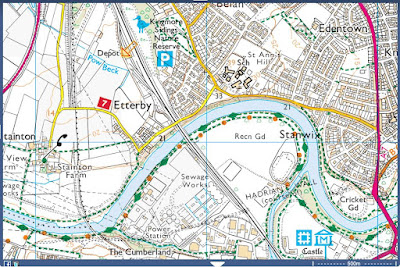
A REEXAMINATION OF 'ARTHURIBURGUM' AT STANWIX IN LIGHT OF ARTHUR'S PLACEMENT ON THE WALL

[Could Arthur have descended from the remnant of the Petriana garrison? Did the Dalriadans take the Arthur name from the Britons of Alclud, Adamnan's Petra Cloithe, because of the Petriana connection?  Did the Dyfed prince Pedr/Petrus name his son Arthur because of the same Petriana link?]


Now that I have finally decided to be satisfied with an Arthur based on Hadrian's Wall, with a prime candidate for his ruling center being Banna/Birdoswald, it is important that I once again discuss the other possible capital: Stanwix, where there was a Roman fort called Uxellodunum (nicknamed Petriana).

Many years ago I wrote a series of blog posts on the site, and it's apparent identification in sources heralding from the 1600-1700s as 'Arthur's Burg':

On Stanwix (Arthuriburgum?):

https://mistshadows.blogspot.com/2018/10/an-early-piece-on-arthur-and-stanwix.html

On the Ala Petriana the late period garrison of the fort:

https://mistshadows.blogspot.com/2017/09/more-on-ala-petriana-of-stanwix-roman.html

https://mistshadows.blogspot.com/2017/09/a-selection-from-mike-mccarthys-roman.html

https://mistshadows.blogspot.com/2017/10/a-nice-article-on-roman-cavalry-in.html

I never really took Stanwix as Arthur's Fort very seriously.  Why?  Well, the lateness of the reference to the tradition for one.  Still, there were a number of things I liked a lot about Uxellodunum/Petriana.  To begin, there was this from Roman scholar Shepherd Frere:

“The western sector of the Wall was the most dangerous… both on account of the nature of the ground and because of the hostile population beyond it. It is not surprising to find, then, that at Stanwix near Carlisle was stationed the Ala Petriana… Such regiments are always found on the post of danger; and the prefect of this Ala was the senior officer in the whole of the wall garrison. Here, then, lay Command headquarters, and it has been shown that a signaling system existed along the road from Carlisle to
York, which would enable the prefect at Stanwix to communicate with the legionary legate at York in a matter of minutes.”

I recently wrote to Professor Roger Tomlin about this, and he replied:

"I would agree with Frere on anything – and indeed, I often did. I even dug for him once, on an excavation. 

Stanwix was certainly the base of the ala Petriana, the only milliary ala in Britain, so its prefect would have been senior to the other prefects and tribunes on the Wall. Its geographical location also is significant, as Frere says."

That analysis by Tomlin made me realize that I should not so hastily dispense with the Arthuriburgum idea.

I suppose the question I should have asked myself, all those years ago, is this:

WHY WAS STANWIX (FOR ETTERBY IN STANWIX PARISH) THOUGHT BY SOMEONE IN THE REGION TO BE ARTHUR'S FORT?  

It's a reasonable line of inquiry.  I mean, presumably by the time of Joseph Nicolson and Richard Burn there were already no signs of the Stanwix fort hard by Etterby.  Given that it is hard to account for the place-name element Etter- (from Etardeby 1246, Etard being a French name from OHG Eidhart) having been somehow miscontrued as representing the name Arthur, we are left scratching our heads when seeking a plausible connection. 

Authorities in Stanwix and Carlisle, in response to my queries, have failed to produce any evidence of the Etterby = Arthur's Burg tradition prior to the time of Nicolson and Burn. Yet these same parties were insistent on defending the integrity of Nicolson's 2 volume compilation "The history and antiquities of the counties of Westmorland and Cumberland". 

In other words, this man is believed to have faithfully recorded traditions that were in his uncle's collection. He does not seem to have created or promulgated forgeries in the manner of Iolo Morganwg in Wales.

And then there was this... the Petriana cavalry group at Stanwix had been named for a Roman Titus Pomponius Petra.  When seeking to explain why Pedr (from L. Petrus) of Dyfed had named his son Arthur, I dared entertain the following notion:

Could Pedr had called his son Arthur because the famous Arthur, just a generation earlier, had hismelf descended from the Petriana at Stanwix?

As anyone with even a rudimentary knowledge of Latin knows, the relationship of Petra and Petrus is extremely close.  Here are the relevant entries from the Lewis and Short Dictionary at Perseus:

pē^tra , ae, f., = πέτρα,
I.a rock, a crag, stone (pure Lat. saxum; cf.: rupes, scopulus): petrarum genera sunt duo, quorum alterum naturale saxum prominens in mare; “alterum manufactum ut docet Aelius Gallus: Petra est, qui locus dextrā ac sinistrā fornicem expletur usque ad libramentum summi fornicis,” Fest. p. 206 Müll. (of the latter signif. there is no other example known): petris ingentibus tecta, Enn. ap. Fest. 1. 1. (Ann. v. 366); Sen. Herc. Oet. 804: “aquam de petrā produxit,” Vulg. Isa. 48, 21 et saep.: “gaviae in petris nidificant,” Plin. 10, 32, 48, § 91: “alga, quae juxta terram in petris nascitur,” id. 32, 6, 22, § 66; 34, 12, 29, § 117; Curt. 7, 11, 1.

πέτρα , Ion. and Ep. πέτρη , ἡ,
A.rock; freq. of cliffs, ledges, etc. by the sea, “λισσὴ αἰπεῖά τε εἰς ἅλα πέτρη” Od.3.293, cf. 4.501, etc.; χῶρος λεῖος πετράων free from rocks, of a beach, 5.443 ; “π. ἠλίβατος . . ἁλὸς ἐγγὺς ἐοῦσα” Il.15.618, etc.; χοιρὰς π. Pi.P.10.52; also, rocky peak or ridge, αἰγίλιψ π. Il.9.15, etc.; “ἠλίβατος” 16.35, etc.; λιττὰς π. Corinn.Supp.1.30, cf.A.Supp.796 (lyr.); π. Λενκάς, ?ωλενίη, etc., Od.24.11, Il.11.757, etc.; π. σύνδρομοι, Συμπληγάδες, Pi.P.4.209, E.Med.1264(lyr.); πρὸς πέτραις ὑψηλοκρήμνοις, of Caucasus, A.Pr.4, cf. 31, 56, al.; π. Δελφίς, π. δίλοφος, of Parnassus, S.OT464(lyr.), Ant.1126(lyr.); “π. Κωρυκίς” A.Eu.22; π. Κεκροπία, of the Acropolis, E.Ion936.
2. π. γλαφυρή a hollow rock, i.e. a cave, Il.2.88, cf. 4.107; σπέος κοιλῇ ὑπὸ π. Hes. Th.301; δίστομος π. cave in the rock with a double entrance, S.Ph.16, cf. 937; κατηρεφεῖς αὐτῇ τῇ π. Pl.Criti.116b; “π. ἀντρώδης” X.An.4.3.11; “τόπος κύκλῳ πέτραις περιεχόμενος” IG42(1).122.21 (Epid.); ἕως τῆς π. down to virgin rock, PCair.Zen.172.14 (iii B.C.), OGI672 (Egypt, i A. D.), cf. Ev.Matt.16.18.
3. mass of rock or boulder, Od.9.243, 484, Hes.Th.675 ; “πέτρας κυλινδομένα φλόξ” Pi.P.1.23 ; “ἐκυλίνδουν πέτρας” X.An.4.2.20, cf. Plb.3.53.4.
4. stone as material, π. λαρτία, Τηΐα, SIG581.97 (Crete, iii/ii B. C.), 996.13 (Smyrna, i A. D.): distd. from πέτρος (q. v.), which is v.l. in X.l.c.; πέτρᾳ shd. be read in S.Ph.272 ; the distn. is minimized by Gal.12.194.
II. prov., οὐκ ἀπὸ δρυὸς οὐδ᾽ ἀπὸ πέτρης, etc. (v. δρῦς); as a symbol of firmness, “ὁ δ᾽ ἐστάθη ἠΰτε π. ἔμπεδον” Od.17.463; of hard-heartedness, “ἐκ πέτρας εἰργασμένος” A.Pr.244; “ἁλίαν π. ἢ κῦμα λιταῖς ὢς ἱκετεύων” E.Andr. 537 (anap.); cf. “πέτρος” 1.2 . (Written πε-τε-ρα in a text with musical accompaniment, Pae.Delph.5.)

πέτρος , ὁ (in later Poets ἡ, AP7.274 (Honest.), 479 (Theodorid.)),
A.stone (distd. from πέτρα, q. v.); in Hom., used by warriors, “λάζετο πέτρον μάρμαρον ὀκριόεντα” Il.16.734 ; “βαλὼν μυλοειδέϊ πέτρῳ” 7.270, cf. 20.288, E.Andr.1128 (never in Od.); “ἔδικε πέτρῳ” Pi.O.10(11).72; “ἄγαλμ᾽ Ἀΐδα ξεστὸν π. ἔμβαλον στέρνῳ” Id.N.10.67; “νιφάδι γογγύλων πέτρων” A.Fr.199.7; “ἐκ χερῶν πέτροισιν ἠράσσοντο” Id.Pers.460; “λευσθῆναι πέτροις” S.OC435; “πέτρους ἐπεκυλίνδουν” X.HG3.5.20, etc.; ἐν πέτροισι πέτρον ἐκτρίβων, to produce fire, S.Ph.296; of a boulder forming a landmark, Id.OC1595; “τόνδ᾽ ἀνέθηκα π. ἀειράμενος” IG42(1).125 (Epid., iii B. C.).
2. prov., πάντα κινῆσαι πέτρον 'leave no stone unturned', E.Heracl.1002, cf. Pl.Lg.843a; of imperturbability, “καὶ γὰρ ἂν πέτρου φύσιν σύ γ᾽ ὀργάνειας” S.OT334, cf. E.Med.28.
II. a kind of reed, Peripl.M.Rubr.65.—The usual Prose word is λίθος.

I even went beyond this at one point - probably foolishly - when I also sought to explain how the name Arthur had reached Scottish Dalriada.  As I knew the Cenel nGabrain had intermarried with the British, doubtless of Strathclyde, I reminded my readers of the Latin Petra Cloithe rendering of Al Clut, the name of the capital of Strathclyde at Dumbarton Rock.  I then went even more crazy by pointing out that Arthur son of Bicoir had killed Mongan with a stone (although it now seems that stone is a folklore remnant based on the monolith at Dun Beachaire in Kintyre; see 
https://mistshadows.blogspot.com/2024/11/arthur-son-of-bicoir-of-kintyre.html).  Although I don't recall, I may even have ventured to float the Irish art- 'stone (?)', a word of dubious existence found only in early Irish glossaries. 

While it is certainly attractive to think of Arthur as a leader of cavalry based at Petriana, critics immediately pounced on that, citing the proximity of Stanwix to Carlisle, claiming (as one still finds in respectable Arthurian publications!) that Carlisle is the Carduel of Chretien de Troyes.  

Well, I can only say -

CARDUEL IS NOT CARLISLE!

Carduel is said to be in Wales (Gales). However, it has long been customary to identify this site with Carlisle, the Roman Luguvalium, in Cumbria. The "d" of Carduel is said to be due to dissimilation of the first "l" of Carlisle (Welsh Caerliwelydd). I have always thought this linguistic argument to be highly questionable.

Carduel is also hard by the Red Knight's Forest of Quinqueroy and not far from the castle of Gornemont of Goort. Goort is here definitely Gower. Quinqueroy is Welsh gwyn plus caer, a slight error for Caerwent.

While Kerduel in Brittany is derived from Caer + Tudwall (information courtesy Jean-Yves le Moing, personal correspondence; cf. Caer Dathyl in Arfon, from Irish Tuathal = Welsh Tudwall, possibly Caer-fawr or Caernarfon, information courtesy Brian Lile of The National Library of Wales, citing Ifor Williams' Pedair Keinc Ymabinogi, 1951), I think Carduel (Car-dyou-EL) probably derives from Caer +d'iwl, Iwl (pronounced similar to English 'yule', according to Dr. David Thorne of the Welsh Department at Lampeter) being the Welsh form of Julius, the name Geoffrey used for Aaron's partner, St. Julian.

When Perceval first comes to Arthur's court, it is at Carduel; but when Arthur sets off after Perceval when the latter sends the Haughty Knight of the Moor to the court, the king leaves Caerleon. In between the king's placement at Carduel and Caerleon, Anguingueron and Clamadeu find Arthur at Dinas d'Aaron, the Fort of Aaron/Caerleon. In other words, Caerleon and Carduel are the same. Indeed, Anguingueron and the Haughty Knight are sent to Arthur's court by Perceval, who knows only that Arthur is at Carduel. This means that Dinas d'Aaron and Carduel have to be Caerleon.

And Arthur's Quarrois? When Erec of Erec and Enide says he will not loiter anywhere until he has "come to the court of King Arthur, whom I wish to see either at Quarrois or Carduel", he seems to be implying that Carduel and Quarrois are near each other. Because Quarrois is mentioned only in conjunction with Carduel, it is more than likely the -queroy of Quinqueroy, i.e. Quarrois = the Caer that is Caerwent.

Carduel's relationship with Chrietien de Troyes' Camelot supplies us with additional reason for placing the former at Caerleon.
According to Chretien, Camelot is ‘in the region near Caerleon’. For some reason, most authorities have seen fit to ignore this statement, insisting that Camelot was placed near Caerleon simply because of Geoffrey of Monmouth’s glorified description of the latter site as a major Arthurian centre. If we do take
Chretien’s statement seriously, we can for the first time arrive at a satisfactory identification of this most magical of royal cities.

The second clue to the location of Camelot is from the later romance The Quest for the Holy Grail, wherein Arthur escorts the Grail questers from Camelot to a point just shy of Castle Vagan.

A third clue, from the prose Tristan, places Camelot either on or very near the sea. The last clue is from the Morte Artu; in this source, the castle of Camelot is on a river. It goes without saying that we need to look for a CASTLE or, at the very least, the site of an earlier hill-fort of some significance.

Castle Vagan is St. Fagan’s Castle (W. Ffagan) four or five miles west of Cardiff. 
According to the HB, Campus Elleti, the ‘Field or Plain of Elleti’, was said to be in Glywysing, the later Morgannwg/Glamorgan.  The same place-name is found in the Book of Llandaf as Palud Elleti (see https://mistshadows.blogspot.com/2020/06/the-red-herring-of-llanilid-uther.html).

In my opinion, Campus Elleti, with Latin Campus rendered as French Champ (the p of which eventually became silent), became Camelot:

Cham(p) ellet(i) > Camelot

So, if I'm right about all that (am I'm pretty sure I am), then we cannot look at Etterby (Stanwix) as Arthur's Fort as being a near-miss for Carlisle.  Instead, we must still look at Petriana/Uxellodunum in isolation as Arthuriburgum.

Once upon a time I put out there that the Arthur Penuchel mentioned in a corrupt Welsh Triad may be an oblique reference to Arthur having ruled from Uxellodunum, the 'High Fort'.  Uxello- becomes in Welsh uchel.  Dr. Simon Rodway of The University of Wales, a noted expert in the Welsh language, recently informed me that Uxellodunum in Welsh would have become *Uchelddin.  However, Welsh place-names show a shift in the order of components, so that one would expect a Din Uchel or Dinas Uchel. 

Welsh Uther is cognate with Irish uachtar.  Its original meaning was (citing Professor John Koch here) 'high, lofty.'

Is all of this sufficient for us to seriously consider Stanwix as THE Arthurian center?

I'm not sure.  Need to think on it some more.  


Thursday, December 12, 2024

Željko Miletić's "Lucius Artorius Castus and the borders of the province of Liburnia with Italy under Marcus Aurelius"

Fig. 5. Map with the ideal borders of the province of Liburnia. Prepared by Dora Štublin.

Professor Željko Miletić has recently made available his new study on L. Artorius Castus.  The link to the article is here:


I urge my readers to check out his piece, as it confirms the reading of ARMENIOS for the L. Artorius Castus memorial stone.


Friday, December 6, 2024

A NEW THEORY ON THE 'CONCAVATA' NAME FOR THE ROMAN FORT AT DRUMBURGH

Drumburgh Moss Looking North

Some time ago I discussed the Roman-period name of the Roman fort at Drumburgh:


My idea, in brief, was that we could go with this being a sort of Grail Castle, in so far as the Latin word gabata for a particular kind of service dish had been likened to a similar platter preserved in the word grail.  I acknowledged, of course, that such a name would imply some geographical characteristic was being referred to as Concavata, 'the hollowed-out' place or, according to Professor Roger Tomlin, the "dish-like" place.  Tomlin had already guessed this had to do with the hill the fort stood upon which could be imagined as an upside-down serving platter.

I now think that guess, though a good one, may not be correct.

Instead, my research of the immediate environs of the Concavata fort showed the Drumburgh Moss just to the south.  This is a very unusual and, indeed, unique landscape feature. 


Peat forms at the rate of about 10cms every 100 years and, because the raised mires are essentially ‘trapped’ within post-glacial depressions, they grow upwards to form a shallow dome, like an inverted saucer. But the growth of the Solway Mosses has not been a simple accumulation of peat. Cores show layers of peat separated by sand (watch the video of Alasdair Brock explaining this while taking a core sample on Wedholme Flow), indicating that in places there were several incursions by the sea, and there were regions that initially remained as ‘islands’. Nor did all the wetlands form in an empty bowl, because here and there melting glaciers had dumped their burden of rocks and till, leaving small, tear-drop-shaped hills or drumlins.

Frank Mawby throws more light on the Solway Mosses: “The classic image of a raised mire as a bog in a slight saucer-shaped depression doesn’t fit for Wedholme, Bowness and Glasson – they all have a glacial topography and all have grown over ridges and mounds. Bowness, of course, is a classic of glacial topography in that it never overwhelmed the Rogersceugh drumlin, although it did almost cover another lower, parallel ridge to the north. But Drumburgh Moss is in a saucer and probably fits the classic mire model.”

If I'm right about this, does the identification of the 'hollowed-out' place with the Moss take away our desired cauldron symbolism?

Not necessarily.  I had treated of the cauldron as itself being symbolic of a lake or marsh.  It is well-known that cauldrons are common votive deposits in bogs.  My argument for the Welsh Ceridwen's cauldron as being emblematic of Penllyn itself was detailed in my book THE MYSTERIES OF AVALON:

Ceridwen

Her name means the ‘Bent or Crooked Woman’ and she is the quintessential hag or crone, associated in this case with Llyn Tegid or Bala Lake in north-western Wales. The true nature of her magical cauldron will be revealed when we take a closer look at her son, Morfran Afagddu (q.v.).
Creirwy (or Creirfyw)

Crierwy, one of the three fair maidens/ladies or fair queens (gwenriein) of Welsh Triad 78, is the daughter of CERIDWEN.  Her name derives from creir, a common Welsh variant spelling for crair, ‘relic, holy thing, talisman, treasure, richly decorated article, object of admiration or love, darling, safe-guard, strength, hand-bell, church-bell’. -wy is merely a feminine suffix, as in Gwenonwy, while the alternate terminal –fyw (byw) means ‘lively’. This etymological analysis does not, however, shed much light on Creirwy’s character. We will see below that Ceridwen’s son MORFRAN, ‘Sea-raven’, is a black cormorant deity of Bala Lake/Llyn Tegid. The Welsh word for ‘lake-monster’ was afanc, actually the word for beaver, being derived from the word for river, afon, and meaning literally ‘water-dweller’. The Irish cognate word is abhac, meaning ‘dwarf, supernatural being’, but this last is also used for a beaver and even a small terrier. Beavers reside in streams, not large lakes, but otters (otter as a word is etymologically related to ‘water’) do live in lakes and are, in fact, found in Bala Lake. One of Ceridwen’s assumed forms when pursuing Taliesin is that of an otter. All of which brings us back, albeit rather circuitously, to Creirwy. It would seem reasonable to assume that this sister of Morfran the divine cormorant and daughter of Ceridwen the divine otter ought to be another submarine denizen of the same lake.  Fortunately, a saint’s life comes to our rescue: there is a 6th century Breton saint heralding from Wales of the same name (Chreirbia), and she isintimately associated with the goose. It is likely that the Llyn Tegid Creirwy is the same personage, and she should be paired as a divine lake bird with her brother Morfran.  Perhaps significantly, there is a Welsh folk belief in Caernarvonshire of geese on a lake at night being transformed witches.  This was especially true on the first Thursday night of the lunar month.  In Welsh Thursday is Ddydd Iou or the ‘Day of Jove’, i.e. Jupiter, the Classical counterpart of the Norse Thor of Thursday.  It is noteworthy, perhaps, the Jupiter’s consort Juno is known for her sacred geese.

Morfran

The son of the crone Ceridwen of Penllyn, the ‘Chief Lake’ that is now known as Lake Tegid or Bala Lake, was named Morfran Afagddu. This name means ‘Sea-Raven the Utterly Dark’. Because he is on Lake Tegid and we have Irish Fiach Mara or ‘Sea-Raven’ as a name for the cormorant, this tells us much about Ceridwen’s cauldron. Morfran was set at the cauldron to wait for the magical drops to come flying out. Gwiawn Bach, the first incarnation of the poet Taliesin, was set to tend the fire under the cauldron, while a blind man stirred it. Anyone who observes cormorants is aware of their peculiar habit of spreading their wings for several minutes to heat up in the sun before they begin their daily fishing in a lake or the sea. This is what Morfran is doing in front of the cauldron which is symbolic of Penllyn itself. The fire Gwiawn Bach keeps perpetually stoked is the sun, which warms the waters of the lake. The waters of the lake are stirred by the wind, and this accounts for the blind man of the story. Perhaps significantly, the Irish also call the cormorant the Cailleach Dubh, i.e. the ‘Black Hag’. So it is quite possible that the story-teller mistakenly assumed Morfran was a second character, when in reality the cormorant was Ceridwen herself in bird form. Lakes were possessed of great spiritual power for the ancient Celts as they were liminal places, in essence being portals to and from the Otherworld. This is why sacrificial victims were submerged in bogs and why weapons and other items, often first ritually destroyed, were deposited as votive items. We have recovered many cauldrons from bogs. A human figure is being submerged in a cauldron on the Gundestrup, which itself was found in a bog.  

Thus there may be a mythological link between the inverted saucer that was the Drumburgh Moss itself and any ritual cauldron that may have been constructed to represent the Moss. 

As for any goddess we can associate with the South Solway Mosses, I would point again to Dea Latis, whose altars were found at Birdoswald and Burgh-By-Sands (the 'Avalon' Roman fort only a half dozen kilometers or so east of Drumburgh).  As the preeminent 'Lake Goddess' of the region, Drumburgh Moss would not only have belonged to her, but would actually, by natural extension, be her. After all, the goddess, the lake and the cauldron were one. 

I did approach Professor Roger Tomlin with this idea. He had once discussed the hill as as possible gabata, but when I sent him the information on the moss and pointedly asked him

"Such hills are not at all unusual for forts.  No chance we could be talking about the saucer-shaped Drumburgh Moss, which would be a much more distinctive feature?"

He responded:

"Quite possibly.  It's many year since I was there (on foot from Newcastle), and I don't remember the topography, but I can accept the idea."