Wednesday, May 21, 2025

Saturday, May 17, 2025
Medraut Unveiled at Last or Camlan and Arthur of Dyfed
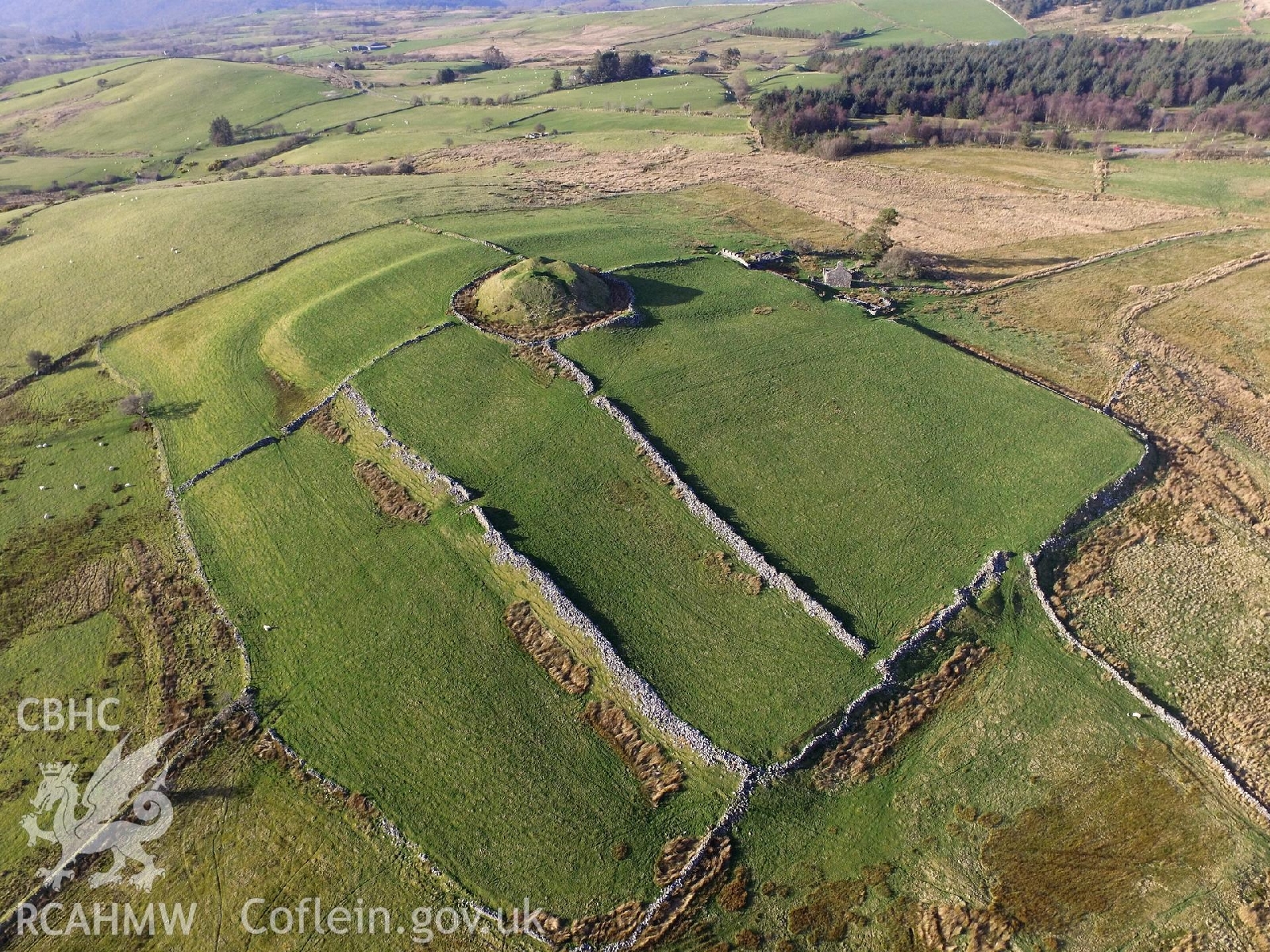
Tomen Y Mur Roman Fort
For decades now, I've stubbornly clung to my derivation of the W. name Medraut from the Latin Moderatus. This proposed etymology had the stamp of approval from none other than Professor Oliver J. Padel.
I've only recently come to realize that I'm only partially right.
Yes, Geoffrey of Monmouth's Modred, picked up from extreme southern Cornwall, does indeed appear to be from Moderatus. Although place-name scholars insist on a very similar name preserved at Moddershall in Staffordshire as being of English origin.
The Welsh, however, insist on giving precedence to their own form of the name. They are not happy about the Cornish scholar Padel's suggestion that Modr- was simply related by the Welsh to their word medr.
Instead, as Dr. Simon Rodway prefers, Medraut is, rsther transparently, from W. Medr plus the suffix -awd. The meaning of the name, in his opinion, means "Skilful vel sim."
Here is medr and medrus from the GPC:
medr1
[?cf. Gal. mataris ‘gwaywffon’, Gr. μέτρον ‘mesur’]
eg. ll. (diw.) medrau.
a Deheurwydd sy’n deillio o hyfforddiant neu o brofiad, sgìl, hyfedredd mewn crefft neu gelfyddyd neilltuol, medrusrwydd, gallu:
skill, proficiency, ability, capacity.
medrus
[medr1+-us]
a. ll. medrusion.
Celfydd, cywrain, deheuig, hyfedr, galluog, clyfar; moesgar, cwrtais, boneddigaidd, da ei foes, llednais, gweddaidd, ffurfiol, cywir:
skilful, dexterous, deft, adroit, able, clever; well-mannered, courteous, polite, well-behaved, decorous, formal, correct.
Hence, Medraut is "the Skilful One" or similar.
Such a meaning got me to thinking about the Welsh god Lleu Llaw Gyffes.
Gyffes or cyffes is defined as follows in the GPC:
cyffes2
[?cyffes < *cyf-hes < Clt. *kobo-sed-to-, sef cyfansoddair o’r gwr. *kob- ‘llwyddo’ (a welir yn yr e. prs. Gal. Vercobius a’r H. Wydd. cob ‘buggugoliaeth’) a ff. ar y gwr. *sed- ‘eistedd, aros’]
a.
Parod, celfydd, medrus, deheuig, cywrain, cyfarwydd:
ready, skilful, adroit, dexterous, proficient, conversant.
I also recalled a number of other curious facts about Lleu. When Gwydion in MATH SON OF MATHONWY tricks Arianrhod into giving the boy a name, she proclaims -
Ys llaw gyfes y medrwys y Lleu ef lit. 'It is a skilful hand (llaw gyffes) by which the fair one (lleu) strikes (medrwys).'
Medrwys is from the same medr:
medraf: medru
[bf. o’r e. medr1]
to hit, strike, shoots
We also find this listing in the GPC:
llawgyffes
[llaw1+cyffes2]
a.
Medrus ei law, deheuig:
deft(-handed), dextrous, adroit.
Submit
14g. WM 9714-15, ys llaw gyffes y medrwys y lleu ef.
Digwydd fel epithet yn yr e. prs. Lleu Llawgyffes.
The Irish cognate to Lleu is Lugh. He was a god of every skill. Two if his epithets, with definitions culled from the eDIL:
Samildánach
Samildánach as n. pr.: oglaech . . . Samhildánach a ainm-side, RC xii 74 § 53 `skilled in many arts together',
ildánach very gifted, skilled, accomplished, having many gifts or accomplishments (frequently used as subst.)
The Afon Gamlan, which the Welsh identify with Arthur's Camlan, is actually quite close to where the god Lleu had his chief fort and where he died.
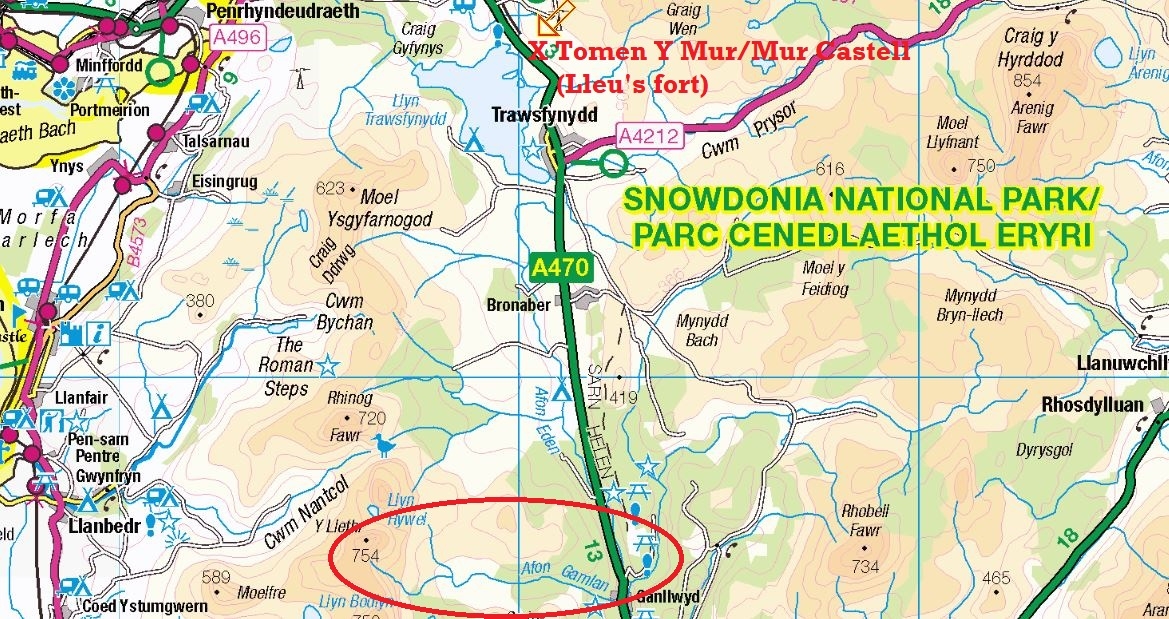

In addition, the ancient hero Pryderi of Dyfed, in a battle with Gwydion of Gwynedd, perished in the same area.

I was looking at the Roman road that ran south from Lleu's Tomen Y Mur fort and noticed that it either crossed the Afon Gamlan or ran past the mouth of that river on the other side of the Afon Mawddach.
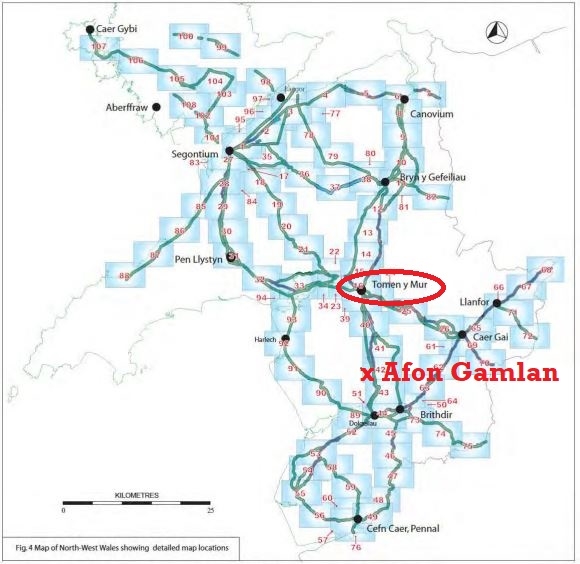

Before my readers try to anticipate what I'm going to conclude from this, let me quickly say that I'm not suggesting that Medraut the Skilful One should be identified with Lleu. Rather, I'm suggesting that the battle of Arthur and Medraut at the Afon Gamlan should be seen as a heroic parallel of the mythological Pryderi-Gwydion conflict.
Medraut would, in this case, be a sort of human avatar of Lleu, a chieftain who hailed from Tomen Y Mur or vicinity. He may have had an affinity with Lleu. Arthur is the son of Pedr of Dyfed, anachronistically placed in death at a time that accorded with his supposed victory at GIldas' Badon.
By doing this, the Welsh storytellers succeeded in using the tale of Pryderi and Lleu's foster-father Gwydion as a foreshadowing of the death of Arthur in the same way Old Testament events were utilized as prefiguiring Christ's deeds.
As I have discussed before -
- Medraut was given a Lleu (Loth of Lothian from the eponym for the "fort of Lleu" and Llew, doubtless a mispelling if Lleu) as a father in Geoffrey of Monmouth and in the Welsh version of the Galfridian "history." This is significant in the current context. In Welsh tradition, Lleu ruled Gwynedd. In addition to his chief fortress of Tomen Y Mur, he is associated with Dinas Dinlleu in Arfon.
I would be neglectful if I failed to mention in passing that Gwydion was fighting for Math, a name almost certainly drawn from the Irish word for bear. The Welsh saw in the name Arthur their own arth, 'bear.' Finally, the Afon Gamlan is in Ardudwy Is Artro or Ardudwy 'under [the Afon] Arthro'. While the derivation of Arthro is disputed, it may have been associated with the Arthur name.
One of the Dyffryn Ardudwy chambered tombs is named Arthur's Quoit. There is a strand of medieval tradition that identifies this pkace with Arthur's Avalon (see the second half of this blog: https://mistshadows.blogspot.com/2016/08/the-grave-of-king-arthur.html?m=1).
According to CULHWCH AND OLWEN, Uther had kin at Math's fortress of Caer Dathal in Arfon (= Dinas Emrys) and another Welsh source claims Arthur took a wife from there.
So, was there really a Medraut or should he be seen merely as a conjured character?
Well, there was a long tradition of warfare between Dyfed and Gwynedd. Part of that is enshrined in the MATH SON OF MATHONWY tale. But in the historical period we know that Dyfed took all of Ceredigion from Gwynedd, making it part of the new kingdom of
Seisyllwg.

I feel pretty confident that at least the Arthur of Camlan is Arthur of Dyfed. That is not to say he was properly associated with Badon. Nor do the HISTORIA BRITTONUM battles belong to him.
What we find in the HB is an anachronistically placed series of battles (or at least sites) that belong to L. Artorius Castus. It was this hero who gave his name to the royal sons of Irish-descended dynasties in Britain.
I would call attention to an excellent article written some time ago by Dr. Ken Dark. In this piece, the author explored what could be learned about the famous Arthur by looking at the later Irish examples.
Dark's conclusion regarding Castus is apt, given that he was going by information I now believe to be false:
"The alternative derivation of !he name from the Roman family
name 'Artorius' has serious problems. 'Artorius' is not an attested
Romano-British name, a1!hough it was, as is well-known, !hat of an
early Roman officer in Britain, Artorius Castus. Artorius Castus
definitely served in Britain, but most of his career was spent elsewhere
and he was not a high ranking officer when stationed at York. Nor is
he known to have done any!hing exceptional which is likely to have
made him revered by Britons as a hero. His only notable act in the
later 'Celtic' world was perhaps, and even !his is uncertain, to
command Roman forces in Armorica in 198. However, he was dead
and buried by about 200, and no trace of !he name' Artorius' is found
bereafter in Britain (althougb there were plenty of Artorii in the
Balk~s and Italy) until Arthur son of Pedr/Retheoir in the 570s.22
Consequently, despite the recent explication of bis career by Linda
Malcor, we may doubt whether he can be the basis of the later
Arthurian legend. This would require some memory of him being
preserved for almost 400 years before we have any trace of it and, as
already mentioned, there is no reason why he should have been any
more notable than any other middle-ranking Roman officer. But
without Artorius Castus there no Artorii known from Roman Britain
at all."
Note that Dark could have concluded the same thing had he opted for Armenia rather than Armorica.
As for Castus' rank, I would dispute the claim it was low. As an equestrian, his status as prefect of a legion represented the highest rank he would in ordinary circumstances be able to achieve.
If we then allow for Castus having taken three British legions north against armed tribes under Severus, the other part of Dark's negative argument also collapses.
Wednesday, May 14, 2025
THE DISCOVERY OF THE ANCIENT PICTISH KINGDOM OF CIRCINN


White Caterthun Hillfort with Artist Reconstruction
(Courtesy https://topofly.blogspot.com/2014/10/white-caterthun-hillfort-work-in.html)
(Courtesy https://topofly.blogspot.com/2014/10/white-caterthun-hillfort-work-in.html)
Tigernach Annals Year Entry752.4
Cath Asreith in terra Circin inter Pictones inuicem, in quo cecidit Bruidhi mac Maelchon.
Where is Asreith? Find that place and we solve the riddle of Circin(n)'s location. How?
Well, we know from the Second Life of St. Patrick that Fordoun in Strathmore was in Mag Gerginn. Unfortunately, the difference in spelling between Circinn and Gerginn has caused considerable debate. So much so that some scholars have sought to distinguish the two place-names and have attempted to place them in different locations. The best recent example of such an attempt is that of Dr. Nicholas Evans at The University of Aberdeen. His study may be read here:
I've always thought that the two names were, in fact, the same name, merely variant spellings. But noted Brittonic place-name expert Alan James thinks otherwise. He holds to Watson's opinion on the names, believing not that they are variant spellings, but due to scribal substitution of similar appearing/sounding names:
We may now take the districts separately. Cirech means
in Gaelic, ‘ crested,’ from cir, a comb, a crest ; Crus mac
Cirig, ‘Crus, son of Cirech,’ was the chief warrior of the
Cruithnigh.?, In the Pictish Chronicle the name is given
as Circinn and Circin, which is the genitive of Circenn,
‘Crest-headed’ (P.S., p. 4), and this corresponds to some of
the other old forms : Cath Chirchind, ‘ battle of Circhenn ’
(Tighern., 596); cath Maigi Circin, ‘battle of the plain of
Circen’ (YBL fes., 192 b 30) ; Magh Circinn i nAlbain (Mac
Firbis—Hogan). Alongside of these we have a form Gergenn :
Koganacht maigi Dergind (read Gergind) i nAlbae, ‘ the
1 Skene, P.S., p. 186. There are other variations. 2 Ib., p. 41.
TERRITORIAL DIVISIONS 109
Koganacht of the plain of Gergenn in Scotland’ (Rawl.,
B 502, 148); Eoganacht maigi Gergind i nAlpae (LL 319) ;
Koganacht maige Gerrghind a nAlbain (BB 172 b 4); Eo-
ghanacht mhuighe Geirrghinn (Keating, ii. 386); Cairbre
Cruthneachan a Muigh-gearrain, ‘Cairbre C. from Magh-
gearrain’ (Celt. Scot., iii. 475); defunctus est Palladius in
Campo Girgin in loco qui dicitur Fordun (Colgan). The
fact that Fordun was in ‘ the plain of Girgen’ shows that
Girgen was the name of the Mearns or rather that the
Mearns was in Girgen.
We have thus three forms of the name—Cirech, Circhenn,
Ger(r)genn, of which the first two go together. The last
form, Gerrgenn, suggests comparison with the Irish name
Gerrchenn, ‘ Short-head.’ In the Tain Bo Cualnge a man
of this name appears as father of the warrior Muinremur,
‘Thick-neck,’ who is styled Muinremur mac Gerrchinn,
with variants—all in the genitive—Gerginn, Gercinn,
Gerrcinn, Hirrginn, Erreinn; and nominative Cergend.
There is also Gerrchenn mac [lladain, with variants Gerchenn,
Gerrgen, Cerrcen, and, in the genitive, Gerrce, Errge.1_ Here
‘Cerrcen’ seems to be owing to confusion with the name
Cerrchenn, ‘Wry-head’ (Tighern., A.D. 662). This com-
parison leaves little doubt that the Irish writers who used
the form Mag Gergind, etc., understood it as ‘ Gerrchenn’s
Plain.” With regard to the other forms, the first 7 of
Cirig is long, and if as I have assumed, Circinn is the
genitive of Circhenn, ‘ Crest-headed,’ with its first 7 also
long, it is difficult, if not impossible, to correlate it with
Gerginn.
But if I were to prove this correct, I needed an Asreith somewhere in the vicinity of Fordoun. This seemed a futile quest.
That is, until I seemed to recall that in medieval Irish MSS. r could often be miscopied as s. I put this question to Professor Jurgen Uhlich, an expert in such matters. When asked if this happened, his response was:
"Yes, all the time basically! Especially when a Continental scribe was ignorant of Irish and the Irish script variety."
With that possibility in mind, I created a form ARRETH (as Asreith was in the genitive). Suddenly, I had a place-name that looked a lot more Gaelic. Of course, as Alan James pointed out, there could be a problem with a Gaelic name in Strathmore in the early period. "Gaelic wasn’t being spoken, still less naming places, in Angus before 600." But, the Tigernach Asreith battle is dated in the 8th century, and we know Fordoun of the Second Life of Patrick is a Gaelic name. It is also possible that a Gaelic name was substituted at a later date for an earlier Pictish one, perhaps even one with a similar or idential meaning.
"It's a difficult business, and I certainly don't claim to be within my depth with it. It's similar to the controversies around Nechtansmere/ Dunnichen (which may or may not have been in the same neck of the woods). Battles and other events mentioned in the Irish Annals and other early sources at places with apparently Gaelic names, but seemingly in locations where we wouldn't expect that language to have been current, and even less likely to have established place-names, at the time of the event. It's a problem that historians seem to me to skate over, but I'm reluctant to say anything firmly - there was a lot going on that's not at all easy to explain from the scanty documentary evidence, and as onomastic research and archaeology progress, the problem only seems to become more complicated."
However, proceeding with a hypothetical Arreth, it didn't take me long to find a viable candidate for Asreith: Arrat near Brechin.
A couple of different etymologies are offered for this place, but James finds one the most likely:
"I think the Arraty Burn [in Fife] is probably different, so there's only one *Airecht. But I don't think that's so improbable, as a name for what shows every sign of being an ancient territory that might well have been a territory governed by an assembly of heads of leading families (cf. DIL definitions). The only problem is, that it would presumably have had a different name in Pictish; it probably wouldn't have acquired a Gaelic one as early as ca.600, ca.750 would still be interestingly early, but perhaps."
Arrat is only 20 kilometers as the crow flies from Fordoun to the north.
If Arrat is Asreth, then Circinn = Mag Gerginn, and the latter would definitely be the ancient Gaelic name for Strathmore.
By, if so, why the Circinn name? What is that a reference to?
The etymology of Circinn is not really in doubt. It means 'Crest(ed?)-head'. One tends to think of some geological formation, like a hill or headland that has a crest-like summit, perhaps formed of a spine of crags.
It was only when I noticed the proximity of the Caterthun forts (to both Arrat and Fordoun) that I realized the 'crest' in question might well have been a man-made one.
The double fort complex at the Caterhuns represents one of the largest and most impressive such sites in Scotland. White Caterhun, especially, is noteworthy. Its very high walls were made of a whitish stone and the various ramparts would have been surmounted by palisades. Seen from a distance this would have resembled a crest on the rounded hilltop. I would propose that this fort represents the crest of Circinn.
Alan James' response to this idea was succinct, but encouraging:
"I think you can make a reasonable case."
And so here I am, doing so!
The question remains as to how far the Kingdom of Circinn extended. Natural boundaries are often important in such cases, and as the Caterthuns are approximately at the midpoint of Strathmore, I would suggest that the kingdom was composed of Strathmore itself.


Strathmore
"Strathmore (The Great Glen) forms a wide valley between the southern Grampians and the Sidlaw Hills, extending from Perth in the southwest to Stonehaven in the northeast and including the districts in the northeast known as the Mearns and the Howe of Angus.
Its principal rivers are the Tay, Isla, Dean Water, North Esk and South Esk.
It is approximately 50 miles (80 km) long and 10 miles (16 km) wide. Strathmore is underlain by Old Red Sandstone but this is largely obscured by glacial till, sands and gravels deposited during the ice age."
Before concluding, I should point out that the Roman fort of Stracathro was very near to Arrat.


Stracathro Roman Fort
Kair House Roman camp, just on the opposite of the Bervie Water from Fordoun, is believed to have been built by Severus (according to Simon Elliott), and we know of that emperor's presence at Ardoch on the south end of Strathmore. Thus we can be sure his forces were in the heartland of Circinn, although as yet archaeology has not confirmed this for us.
This fact may be important for Arthurian Studies. I have suggested that the Miathi of both the Dalriadan Artur and of the HISTORIA BRITTONUM Arthur (Bassas battle) and the Caledonian Wood battle of the latter may be reflections of the ghost of L. Artorius Castus, a man who might well have led legionary forces in the North under Severus. As the Severan campaign was against both the Maeatae and the Caledonii, the Tigernach reference to Artur son of Aedan's death in Circinn - where action against the Roman period Caledonii would certainly have been undertaken - in my opinion bolsters the likelihood that we are looking at Roman battles in the Arthurian tradition. Not Dark Ages ones.
Note: I've been asked if Arthur's City of the Legion might not be York, but the legionary fortress of Inchtuthil. I would answer no. To quote from Simon Elliott's SEPTIMIUS SEVERUS IN SCOTLAND: THE NORTHERN CAMPAIGNS OF THE FIRST HAMMER OF THE SCOTS:
"The fortress at Inchtuthil was occupied for only a short time, being evacuated in AD 86/87. It was never reused, even during the Severan incursions in the third century..."
Monday, May 12, 2025
Coming Soon: THE DISCOVERY OF THE ANCIENT PICTISH KINGDOM OF CIRCINN

White Caterthun hillfort as seen from Brown Caterthun

White Caterthun
For a long time now scholars have tried to figure out precisely where the ancient Pictish kingdom of Circinn lay. Their efforts have proven fruitless.
Although Circinn appears multiple times in the sources, its true location or extent is only revealed in two instances. First, we learn that Fordoun in Strathmore, Aberdeenshire, was in Mag Gerginn. Not particularly helpful, as there is an ongoing debate as to whether Circinn = Gerginn or whether these two names should be seen as different places. Second, an 8th century battle in Circinn is said to occur at a site named Asreith, an utterly opaque name that no one has successfully identified.
In a future article I will discuss my candidate for Asreith, one which will indicate that Circinn and Gerginn may, in fact, be the same kingdom. Furthermore, my Asreith candidate will allow me to pinpoint exactly what Circinn itself was as well as describe the extent of the plain (mag) it controlled.
The importance of Circinn for Arthurian research concerns the Irish Annals of Tigernach entry on the death of Artur son of Aedan in Circinn. This entry is contradicted by Adamnan's Life of St. Columba, in which Artur is said to perish fighting the Miathi.
Thursday, May 8, 2025
RECONSTRUCTION OF THE PROPOSED READING FOR THE L. ARTORIUS CASTUS LACUNA
Once again, the /G/ for GENTE was taken from the line immediately below the line of the lacuna. My measurement shows that this line is of exactly the same width as the line above it.
The /E/ plus triple ligature NTE was taken from the end of the same line, where we have CENTE.
The resulting reading would require an interpunct between the /M/ and the /G/. The inscription has quite a few interpuncts, and we can see one between the /S/ and the following ARM of the lacuna.
The sense of ARM.GENTES would be "arm(atas) gentes" or "armed tribes." Given the Arthurian battles as I have arranged them on the map, and the presence of the Caledonian Wood and the Maeatae/Miathi in both the HB and in the tradition regarding the Dalriadan Arthur, my best guess for the tribes in question are the Caledonii and Maeatae confederacies. These tribal groups were subject to two intensive, large-scale campaigns by the Emperor Severus.
Once Severus had died and Caracalla took over, the northern campaign was put to an end. Caracalla had to deal with new Germanic invasions north of Rome and it would have been at this time that Castus was appointed procurator of Liburnia with the right of the sword.
This reading and the chronology of the Severan campaign in Britain fits the age estimate for the Castus inscription according to Benet Salway and Abigail Graham, as well as other epigraphers.
As Castus was prefect of the Sixth Legion, a legion based at York whose task was to guard the North, reference to armed tribes is unlikely to refer to conflict in any other part of Britain. In addition, had the said tribes been outside of Britain Castus would have told us so.


MODRED/MEDROD THE SON OF LOTH OF LOTHIAN: ANOTHER ARGUMENT IN FAVOR OF A MAEATAE/MIATHI CONNECTION FOR CAMLAN
[I've detected some weird things about the Camlann entry of c. 537 in the AC. First, that the Mawdd place-name of the Camlans in NW Wales appears to have the same semantic meaning as the main element of the Maeatae tribal name.
In the Irish Annals, the Dalriadan king Comgall son of Domangart dies in 537. The same death notice is found in 545, where Tigernach links it with the plague in Ireland. That reference to plague is in the Camlan year entry.
A later Domangart is said to be brother to Artur of Dalriada and in Tigernach falls in battle with Artur.
A St. Comgall appears with Columba in Adamnan (who mentions Artur's death fighting the Miathi). They visit each other after the latter has seen Aedan father of Artur. The meeting place is Cambus or "river bend" on the River Bann in NE Ireland.
There are Cambus place-names on the pronounced loops of the River Forth right below Dumyat, the "Fort of the Miathi."
Thus it seems to me that there is something very fishy going on with the Camlan entry. It looks more and more like a temporally displaced reference to Artur of Dalriada against the Miathi.
Oh - and if Bassas of the HB Arthur is Dunipace by Arthur's Oven and between the 2 Miathi forts - within only a couple kilometers of Myot Hill, in fact - then add another "coincidence."]

While no one should rely on Geoffrey of Monmouth for anything historical, in treating of Camlan of the ANNALES CAMBRIAE recently I totally neglected to mention that Modred (= W. Medraut) was said to be the son of the eponymous ruler of Lothian.
Lothian, part of the old Votadini kingdom, bordered on the lands of the Maeatae/Miathi (see
Cambus ('river-bend') is right below Dumyat, the Fort of the Miathi, on the River Forth. Just a little west on the Forth, closer to Stirling, is Cambuskenneth. The Forth meanders in large, pronounced loops at this point in its course.
This spot, rather than Geoffrey's Camblam in extreme SW Britain in Cornwall or the Camlans in NW Wales, makes sense in the context of a personage hailing from Lothian.
LOTH. (Fictitious).
A British king mentioned by Geoffrey of Monmouth as an elder contempoary of Arthur. He first
appears as ‘Loth of Lodonesia [Lodoneis] ... a most valiant soldier, mature in wisdom and age’ to whom
Uther in his last illness entrusted the British army in its wars against the Saxons, Octa and Eosa. He was
married to Anna daughter of Uther (HRB VIII.21). He was brother to Urianus [Urien], king of Mureif
[Rheged], and to Auguselus [Arawn], king of the Scots. Arthur, after his victories in Scotland, restored
the three brothers to their respective kingdoms. By Anna, the sister of Arthur, Loth was the father of
Gualguanus [Gwalchnmai] and Modred [Medrod] (HRB IX.9).
Loth was the nephew of Sichelinus (or Sichelmus), king of the Norwegians [of Llychlyn], who
had appointed Loth to succeed him on his death. But when Sichelin died the Norwegians refused to
accept Loth and advanced Riculfus to the sovereignty instead. Thereupon Arthur conquered Norway and
Dacia [Denmarc] and established Loth upon the Norwegian throne (IX.11). Loth is mentioned again as
king of Norway, who came to Arthur's special coronation (IX.12).
The authors of Brut y Brenhinedd consistently mis-name Geoffrey's Loth ‘Llew ap Cynfarch’,
who, like Urien, could not have been a contemporary of Arthur. See s.n. Llew ap Cynfarch. Other
corresponding names in the Brut are shown in [ ].
Loth was evidently intended to be the eponym of Lothian, which is elsewhere apparently
represented by Lleuddun Luyddog (q.v.). See TYP p.422. But the authors of the Brut did not recognize
the fact.
ARTHURIAN ROMANCE
Chrétien de Troyes mentions him only as a name, king Lot, in Erec et Enide, and as father of
Gawain in Yvain. In the ‘Vulgate’ Merlin and Merlin-continuation he is described as Loth or Lot, king
of Orcanie. His wife, the sister of Arthur, is variously named in these romances. See s.n. Morgen. In the
‘Estoire’ of the ‘Vulgate’ cycle he is given a pedigree which makes him son of Hector, a descendant of
Pierre, who was a kinsman of Joseph of Arimathea (Sommer I.280). The genealogy was copied by John
of Glastonbury in Historia de Rebus Glastoniensibus, ed. Thomas Hearne, 1726, pp.56 and 73.
SCOTTISH FICTIONS
John Fordun in his Scotichronicon (c.1385), III.24, said that Loth, lord of Laudonia, was
descended from Fulgentius. This Fulgentius is mentioned in II.31, evidently copying HRB V.2. See s.n.
Sulien (1). Later Fordun (III.25) accused Geoffrey of Monmouth of inconsistency in making Loth's wife
Anna to be a sister of Aurelius Ambrosius [not Arthur], while he describes Gualguanus and Modred,
sons of Loth, as Arthur's nephews (HRB X.4, X.2); but Fordun misinterpreted sororem ipsius in HRB
IX.9, where ‘ipsius’ refers to Arthur not Aurelius Ambrosius.
Hector Boece made the same mistake in his Scotorum Historia (1527). He called Lothus a king
of the Picts, who married Anna, a sister of Aurelius Ambrosius, by whom he was the father of Modred,
Valuane [Gawain], and Thametes or Thenew (IX.5). Thenew became the mother of St.Mungo [i.e.
Kentigern] (IX.13). By this, Boece is seen to be identifying Loth with Lleuddun Luyddog, whose
daughter Denw was the mother of Kentigern according to Bonedd y Saint. John Major had anticipated
Boece in this respect (Historia Maioris Britanniae, 1521, fos.28v-29).
Also from Bartrum on Lleuddun, the eponym for Lothian:
LLEUDDUN LUYDDOG. (500)
The anonymous fragmentary Life of St.Kentigern, says (§1) ‘A certain king, Leudonus, from
which the province over which he ruled obtained the name Leudonia had a daughter ... Thaney.’ She
became the mother of Kentigern [Cyndeyrn Garthwys]. Leudonus, described as half-pagan, was killed
by his swineherd. The place where he was buried was marked by a stone about one mile south of
Dunpelder (§7). See below. See further s.n. Denw.
In the earliest version of Bonedd y Saint his name is spelt Lewdwn lluydawc and it is very
variable in the later manuscripts, but Lleuddun is the preferred modern spelling. He was of Dinas Eidyn
and was the father of Denw (wife of Owain and mother of Cyndeyrn Garthwys), Tenoi (wife of Dingad
and mother of Lleuddad and others), and Peren (wife of Bugi and mother of Beuno) (ByS §§14, 18. 30
in EWGT pp.56, 57, 59). He is evidently the same as Ludun mentioned in the Life of St.Kea as father of
that saint, and Lidin in the genealogy of St.Gurtheirn.
His place of burial is said to be Dunpender Law in East Lothian (LBS III.375). Lleuddun's seat
was Traprain Law, then named Dunpelder, an isolated hill in Haddingtonshire, four miles east of
Haddington which is 18 miles east of Edinburgh (DNB s.n. Kentigern). If he also possessed Dinas Eidyn
[Edinburgh] it is likely enough that the whole province belonged to him (H.M.Chadwick, Early
Scotland, p.146).
It is from Lleuddun that Lleuddunion [Lothian] receives its name. Welsh sources do not give
him any parentage. As eponym of Lothian he equates with Loth of Geoffrey of Monmouth's Historia
Regum Britanniae. Geoffrey says that Loth was a brother of Urien (HRB IX.9), i.e. Urien ap Cynfarch.
This is chronologically possible and suggests that Lleuddun was perhaps a son of Cynfarch (PCB).
Except for this doubtful point, however, Geoffrey seems to have had no authentic information about
Lleuddun/Loth. For example he wrongly makes Urien and Loth elder contemporaries of Arthur. For this
reason Loth is dealt with under another heading. See s.n. Loth.
Entry for Lothian in John Koch's CELTIC CULTURE: A HISTORICAL ENCYCLOPEDIA:
Lothian is a region of south-east Scotland (Alba).
In the present (post-1995) system of regional authorities
West Lothian, Mid Lothian, and East Lothian
(Scottish Gaelic Lodainn an Iar, Meadhan Lodainn,
Lodainn an Ear) make up a compact urbanized area
south of the Firth of Forth and either side of the
Scottish capital and south-eastern metropolis of
Edinburgh (Dùn Èideann). In the Middle Ages,
Lothian referred to a larger territory, which extended
from the present English border at the river Tweed
and Cheviot hills, to Stirling in the north-west, as well as
including Edinburgh itself. As a region suiting a prosperous
mix of pastoralism and arable agriculture,
this greater Lothian was naturally the richest and
probably the most densely populated area of preindustrial
Scotland. It is also historically the most
deeply Anglicized. As Jackson proposed, Anglian
Bernicia (Brynaich) under Oswald probably took
over Lothian as a result of obsesio Etin (the siege of
Edinburgh), noted in some annals at 638. The
evidence of Scottish place-names suggests a fairly
substantial Anglo-Saxon settlement in the area and contrastingly
slight Gaelic and Scandinavian influence.
Lothian was never ruled by the Norse. Thus, Lothian
may be characterized as the cradle of the non-Gaelic
Anglian Scots culture of the Scottish Lowlands. A
system of local organization in shires, as in England,
prevailed there in the central Middle Ages, and Lothian
has tended to represent a standard Scottish identity in
modern times, figuring centrally, for example, in the
influential fiction of Sir Walter Scott.
Nonetheless, Lothian is of interest to Celtic
studies for several reasons. First, prior to 638 it had
formed part of the northern Brythonic kingdom of
Gododdin. Brythonic place-names are as thick on
the ground there as anywhere outside Wales (Cymru),
Cornwall (Kernow), or Brittany (Breizh), indicating
a high level of survival and a less than overwhelming
Anglian settlement. The hagiography of the Celtic
St Kentigern of Glasgow (Glaschu) looks back to
Brythonic Lothian as his home country. It should also
be borne in mind that King Oswald himself and the
7th-century church of Bernicia were heavily influenced
by Gaelic culture by way of the island monastery of
Iona (Eilean Ì) and the cult of its founder, St Colum
Cille. The Bernician grip on Lothian was not all
that strong and seems to have been partly rolled back
in the north-west after the great Pictish victory of
Nechtanesmere in 685. A Pictish symbol stone found
at Edinburgh and a scatter of place-names of Pictish
type in Lothian may date to this period.
Northumbrian power never fully recovered. The
powerful Viking kingdom of York (867–954) stood
on what had been southern Northumbria (Deira/
Dewr), cutting off Lothian from Anglo-Saxon
England and setting the stage for permanent annexation
by Gaelic Scotland to the north after Viking power
waned. During the reign of King Illulb (Indulf, 954–
62) Edinburgh was occupied by the Scots. In 973 the
Anglo-Saxon King Edgar received the homage of
Cinaed mac Mael Choluim (Kenneth II of
Scotland) and granted Lothian in return, which was
probably merely a confirmation of the current political
reality. Scottish control over the region was permanently
consolidated at the battle of Carham on the Tweed in
1018, where Mael Coluim mac Cinaeda (Malcolm
II), with allies from Strathclyde (Ystrad Clud),
defeated the Northumbrian Earl Uhtred. While these
events brought Lothian under the Gaelic dynasty and
aristocracy of Alba and imparted an enduring Scottish
identity, the Gaelic language gained little ground there,
and Lothian’s cultural importance within Scotland
proved an important factor in the spreading de-
Gaelicization of subsequent centuries.
The name Lothian, attested as Welsh Lleuddiniawn,
is of Celtic origin, from *Luguduniana‘the country
of the fort of [the god] Lugus’; see further Lleu;
Lugudunon.
[1]
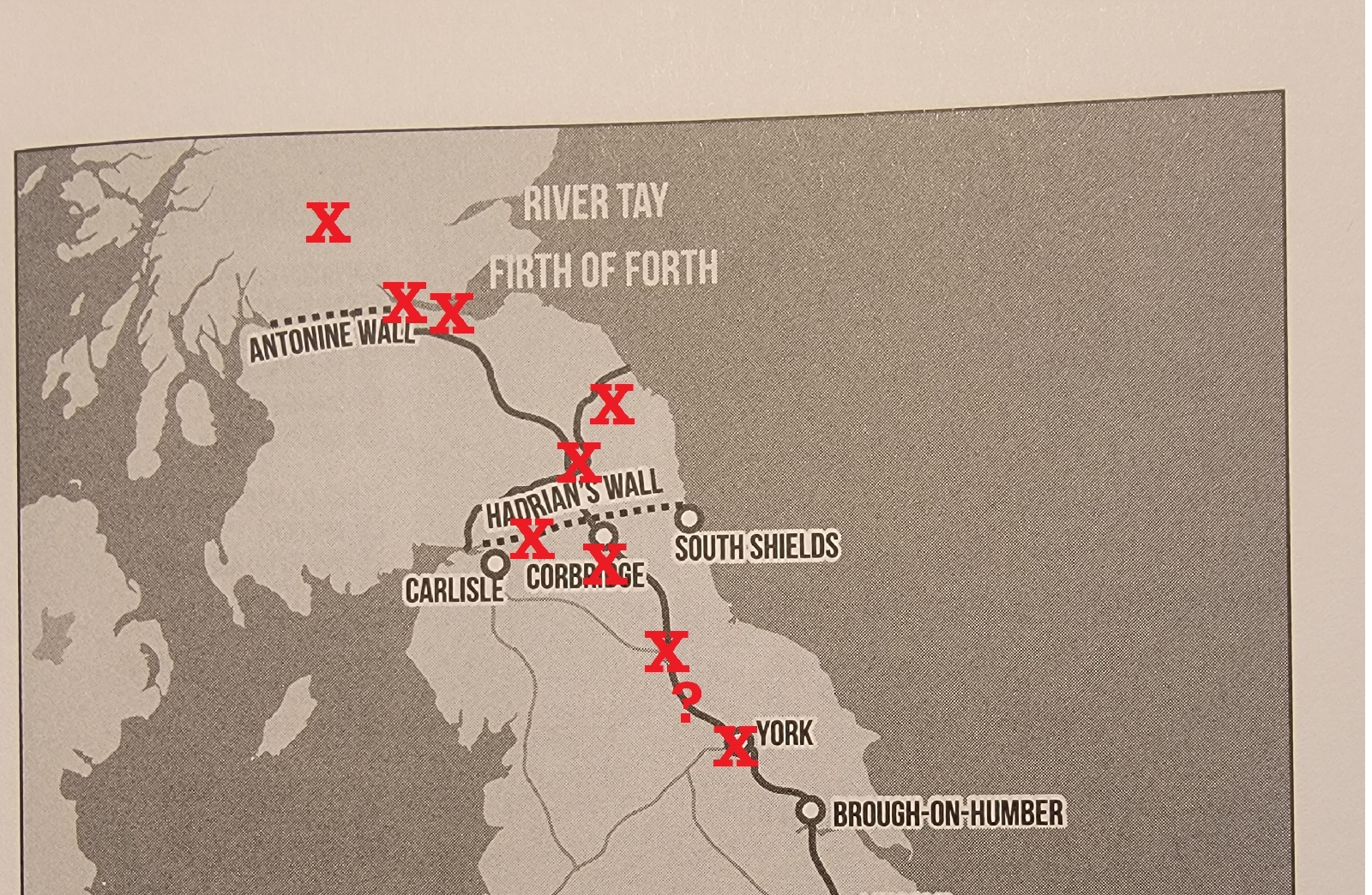
The account given in the Welsh version of Geoffrey, the Brut y Brenhinedd, substitutes for Loth one Llew [literally 'Lion', but probably an error for Lleu] ap CYNFARCH OER ap MEIRCHION GUL, father also of Urien of Rheged. Such a geographical fix transfers Medraut/Modred from the Antonine Wall to that of Hadrian - to the very region where we find the Camboglanna Roman fort. Llew/Lleu may point to Carlisle, ancient Luguvalium, the "Lugus-strong" fort rather than the personal name that had once been proposed for the site.
Once again, there is nothing here for a Medraut in the South.
Monday, May 5, 2025
ON CHOOSING L. ARTORIUS CASTUS

Reposting these two pieces. I've decided I can no longer hold to the belief that a Dark Age British Arthur died at Camlan. Instead, I now view the Camlan battle as a conjured annal entry based on a folk memory of Roman warfare against the Maeatae - a conflict which also intruded on Dalriadan tradition (the Miathi of Adamnan).
The Dunipace/Bassas battle of Arthur, directly between the two Miathi forts and near the Roman period monument of Arthur's Oven, is part of the same legendary development. This is confirmed by the presence in the HB list of the Caledonian Wood.
The Severan dating of the L. Artorius Castus stone, and my reading of "armed tribes" for its lacuna, confirms that Castus may well have led legionary forces under Severus against the Maeatae and Caledonian confederacies. In the words of Simon Elliot, author of Septimius Severus in Scotland, the expeditions of that emperor secured "peace in the north of the islands of Britain for four generations."
For those who maintain that Castus of the third century could not have been remembered in the 5th or 6th, I say that they have a very poor understanding of the lasting power of myth and heroic legend. A Roman officer with a name the native population connected with their own word for bear ('arth'), who led a massive force on a devastating campaign against the northern tribes, may well have achieved a heroic status sufficient for a later age to mine that tradition when searching for a great champion against the Saxons. The mere fact that the HB author padded out the Arthurian battle list by adding several Dubglas actions so that Arthur could have a proper Herculean 12 engagements is proof enough of this claim.
Professor Nicholas Higham (who does not see any historical value in the HB's Arthurian chapter) recently told me the following:
"The HB's author made up several British hero figures who he used to demonstrate the Britons were courageous and good at bashing foreigners. The best way to understand his technique is to focus on Dolabella/um, who is obviously a straight lift out of Roman history, specifically from Orosius, but who he converted to a British general fighting Caesar. Historical nonsense but of considerable propaganda value in 829."
If the author could do that, and concoct or relate other stories (like that of Ambrosius Aurelianus), then he could use Castus in the same way.
For awhile I was tripped up by the death of Artur/Arthur fighting the Miathi (as Castus died in Dalmatia), but as the Irish accounts differ, providing the Dalriadan Arthur with a death in Circenn as well, and as Medraut is the Roman name Moderatus, I no longer see any reason to allow the Camlan entry for 537 to influence my decision regarding Castus.
Badon, as I've already remarked, looks to have been an event in southern England. Arthur's name became attached to it simply because he was famous and Gildas made the battle of his own birthday famous.
Subscribe to:
Posts (Atom)