Friday, May 2, 2025

IS THE CAMLAN ENTRY IN THE ANNALES CAMBRIAE A HOAX?

MACOSQUIN, COLERAINE

I've already cast some doubt on the legitimacy of the Camlan location in NW Wales.  Please see


for details on that.

But I've recently found something else suspicious about the Camlan entry by comparing it with entries in the Irish Annals.  

First, a brief recap of what the Irish sources have to say on the death of Artur son of Aedan.

The Life of Adamnan has Artur and his brother Eochaid Find persih fighting the Miathi.  But the Annals of Tigernach has Artur die with several brothers in Circenn.  Domangart is one of those, said in Adamnan to have died fighting the Saxons.  Bannerman (in his STUDIES IN THE HISTORY OF DALRIADA) has placed the Miathi battle c. 590, and the Saxon battle c. 596.  

Caput 8: De Filiis Aidani Regis Sancti Columbae Prophetia

ALIO in tempore ante supra dictum bellum Sanctus Aidanum regem interrogat de regni successore. Illo se respondente nescire quis esset de tribus filiis suis regnaturus, Arturius, an Echodius Find, an Domingartus, Sanctus consequenter hoc profatur modo: Nullus ex his tribus erit regnator; nam in bellis cadent ab inimics trucidandi: sed nunc si alios juniores habes ad me veniant, et quem ex eis elegerit Dominus regem, subito super meum irruet gremium. Quibus accitis, secundum verbum Sancti Echodius Buide adveniens in sinu ejus recubuit. Statimque Sanctus eum osculatus benedixit, et ad patrem ait: Hic est sperstes, et rex post te regnaturus, et filii ejus post eum regnabunt. Sic omnia post, suis temporibus, plene adimpleta sunt. Nam Arturius et Echodius Find, non longo post temporis intervallo, Miatorum superius memorato in bello, trucidati sunt. Domingartus vero in Saxonia bellica in strage interfectus est: Echodius autem Buide post patrem in regnum successit.

T594.2
The killing of the sons of Aedán i.e. Bran and Domangort and Eochaid Fionn and Artur, in the battle of Circhenn, in which Aodhán was overcome, and the battle of Corann.

T594.2
Iugulacio filiorum Aedan .i. Bran & Domungort & Eochaid Fínd & Artur, i cath Chirchind in quo uictus est Aedhan, & cath Coraind.

When we look for the 537 Camlan date in the Irish Annals, we find this:

Tigernach

T537.2
Comgall son of Domongort, king of Scotland died in the 35th year of his reign.

I find it rather surprising that no know has seen fit to comment on the entry (so far as I am aware!). For Comgall was a king of Dalriada, and the Domongort here is the same name as the later one found dying in Tigernach along with Artur. 

There are some other pecularities that may or may not be significant.

The AC entry on Arthur at Camlan says that there was plague in Britain and Ireland in that same year. When we go to the Irish Annals, we find the plague paired with one of the several alternate fate for Comgell son of Domangart's death in 545:

Ulster

U545.1
The first mortality called bléfed, in which Mo-Bí Clárainech died.

U545.2
Death of Comgall son of Domangart, as some say.

This earliest recorded plague in Ireland is also found in 540:

T540.1

A great mortality called blefed, in which Mo-Bi Clarineach, whose name is Berchan, ... a poet, perished.

A good recent treatment of the various plagues to strike the islands can be found here:


Let us go now to another Comgell, this one the saint and contemporary of St. Columba and Aedan father of Artur of Dalriada.  This later Comgell had a monastery on the River Bann called Cambas, i.e. "The Bend".  Here are the relevant sections on him from Adamnan, in Latin and English translation: 

De Bello Quod In Munitione Cethirni Post Multo Commissum Est Tempora, Et De Quodam Fonticulo Ejusdem Terrulae Proximo Beati Praescentia Viri

ALIO in tempore vir beatus cum post regum in Dorso Cette condictum, Aidi videlicet filii Ainmurech, et Aidani filii Gabrani, ad campos reverteretur aequoreos, ipse et Comgellus abbas quadam serena aestivi temporis die, haud procul a supra memorata munitione resident. Tum proinde aqua de quodam proximo ad manus lavandas fonticulo ad Sanctos in aeneo defertur vasculo Quam cum sanctus Columba accepisset, ad abbatem Comgellum a latere sedentem sic profatur, Ille fonticulus, O comgelle, de quo haec effusa nobis allata est aqua, veniet dies quando nullis usibus humanis aptus erit. Qua causa, ait Comgellus, ejus fontana corrumpetur unda? Sanctus tum Columba, Quia humano, inquit, cruore replebitur: nam mei cognationales amici et tui secundum carnem cognati, hoc est, Nellis Nepotes et Cruthini populi, in hac vicina munitione Cethirni belligerantes committent bellum. Unde in supra memorata fonte aliquis de mea cognatione trucidabitur homuncio, cujus cum caeteris interfecti sanguine ejusdem fonticuli locus replebitur. Quae ejus veridica suo tempore post multos vaticinatio expleta est annos. In quo bello, ut multi norunt populi, Domnallus Aidi filius victor sublimatus est, et in eodem, secundum sancti vaticinium viri, fonticulo, quidam de parentela ejus interfectus est homo. Alius mihi Adamnano Christi miles, Finanus nomine, qui vitam multis anachoreticam annis juxta Roboreti monasterium Campi irreprehensibiliter ducebat, de eodem bello se praesente commisso aliqua enarrans, protestatus est in supradicto fonte truncum cadaverinum vidisse, eademque die ad monasterium sancti Comgelli quod Scotice dicitur Cambas commisso reversum bello quia inde prius venerat, ibidemque duos sancti Comgelli senes monachos reperisse: quibus cum de bello coram se acto, et de fonticulo humano cruore corrupto, aliquanta enarraret, illi consequenter, Verus propheta Columba, aiunt, qui haec omnia quae hodie de bello et de fonticulo expleta enarras, ante multos annos futura, nobis audientibus, coram sancto Comgello, juxta Cethirni sedens munitionem, praenunciaverat.

The blessed man's foreknowledge regarding the Battle fought many years after in the fortress of Cethirn, and regarding the Well near that place.

ANOTHER time, after the convention of the kings at the Ridge of Ceate (Druim Ceatt) that is, of Aidan, son of Gabran, and Aid, son of Ainmure the blessed man returned to the seacoast, and on a calm day in summer he and the Abbot Comgell sat down not far from the above-named fort. Then water was brought in a bronze vessel to the saints from a well that was close by to wash their hands. When St. Columba had received the water, he thus spoke to Abbot Comgell, who was sitting at his side, "A day shall come, O Comgell ! when the well whence this water now poured out for us was drawn will be no longer fit for man's use." "How?" said Comgell; "shall the water of this spring be defiled?" "From this," said St. Columba, "that it shall be filled with human blood; for thy relatives and mine that is, the people of the Cruithni and the race of Niall shall be at war in the neighbouring fortress of Cethirn (now called the Giant's Sconce, near Coleraine). Whence, at this same well, an unhappy relative of mine shall be slain, and his blood, mingling with that of many others, shall fill it up." This truthful prophecy was duly accomplished after many years, for in that battle, as is well known to many, Domnall, son of Aid, came off victorious, and at that well, according to the saint's word, a near kinsman of his was slain.

Another soldier of Christ, called Finan, who led the life of an anchorite blamelessly for many years near the monastery of the Oakwood Plain (Derry), and who was present at the battle, in relating these things to me, Adamnan, assured me that he saw a man's dead body lying in the well, and that on his return from the battlefield the same day to the monastery of St. Comgell, which is called in the Scotic tongue Cambas (on the river Bann, in diocese of Derry), and from which he had first set out, he found there two aged monks, of St. Comgell, who, when he told them of the battle he saw, and of the well defiled with human blood, at once said to him: "A true prophet is Columba, for he foretold all the circumstances you now mention today regarding the battle and the well, many years indeed before they occurred; this he did in our hearing to St. Comgell, as he sat by the fort Cethirn."

The following site discusses the forms and sources of the Cambas place-name:


camas
al. Cammas, Camus, Cambas, Cambos, Cambus Comhgaill; ¶  g. Camsa; ¶  al. Camus Macosquin in b. Coleraine, c. Derry, Fm. ii. 638; ¶  Camus-juxta-Bann, 3 m. below Coleraine, Pgi. i. 475; ¶  in d. Derry, and dry. Binnagh, Tax.; ¶  S. of Lecmag, Ch. 4; ¶  Cammas Comgail for brú Bandai, F. 161, Fg. 206, Bco. 21 a, Mt. 38; ¶  Comgell of Cambos, Ct. 349, C. 139, B. lx. 446; ¶  Cambas Comgill, Ad. 96; ¶  Mo-Cholmóc ab. Camsa, Ll. 364; ¶  the Ui Mic Uais and Fir Li ext. fr. Bior to Camos, Fir. 331.

And this site has a nice summary of the history of the place:


Cambas "The Bend" on the River Bann

There is a Cambus on the River Forth below the hill of Dumyat, as well as the 12th century monastery at Cambuskenneth.

I would add in passing, although it may not be significant, that there is an early occurring name Comgellain, a diminutive form of Comgell.  See the Annals of Tigernach:

T626.2
Áedhain mac Cumascaigh & Colman mac Comgellain ad Dominum migrant.

This name is found used early for the father of Colman in the Life of St. Columba:


While it may all be in my imagination, the apparent concurrence of Arthur's Camlan and an entry bearing names that are both found in Dalriadan contexts, one of which is the same name as that of Artur's brother, combined with an associated Cambas place-name and Comgellain personal name, seems to be a bit too coincidental.

In short, everything keeps coming up Dalriadan, and this fact points to Artur son of Aedan's Miathi battle.  As if the case with my suggestion that the Camlans at the Mawddach/Mawddwy place-names are a relocation of a battle fought in the kingdom of the Miathi.  

Of course, I would be remiss if I closed without reminding my reader that the placement of Artur at two death-sites - one in the Miathi kingdom and the other in Circenn - may prove that the Miathi battle is a dim folk memory of the presence of L. Artorius Castus in the region fighting the Maeatae with legionary troops under Severus and Caracalla.  This combines nicely with the claimed Caledonian Wood battle of Arthur in the HISTORIA BRITTONUM, along with my other HB battle placements as well as my new/y proposed reading for the Castus stone (ARM.GENTES/armatas gentes/"armed tribes").




Sunday, April 27, 2025

Could a Dark Age Commander Have Fought in These Places?: One Expert Says No


I've asked a sub-Roman/Dark Age and Arthurian expert - Professor Christopher Snyder - about the Arthurian battles.

Essentially, in order not to bias him, I'm sending the map of HB sites as I've laid those out. Not telling him, though, that these are my Arthurian site identifications. Instead asking if he thinks the arrangement reasonable or at least possible for a sub-Roman ruler. Or if they look instead like something we'd find under Ulpius Marcellus or Severus.

Included is a note to the Caledonian site, as well as the Miathi one (Arthur's Bassas appears to Dunipace, directly between the two Miathi/Maeatae forts, and Artur of Dalriada is said to have died fighting the Miathi). With no specific reference to Arthur, of course.

Basically, I want his honest take on whether it is possible for a man of the newly fractured, post-Roman Britain to have fought battles in these theaters, or whether the pattern instead looks decidedly Roman.

Will be interesting to find out what he has to say.

RESPONSE (7 April 2025):

"Looking at your map, I would say that they are more likely to represent campaigns of a Roman general.  We know practically nothing about campaigns of post-Roman British military commanders.  If these are conjectured locations of battles from the Historia Brittonum, I would not use them as evidence for the fifth or sixth centuries."

In my book THE BEAR KING OF THE NORTH, I stress that a Dark Age Arthur on the Wall fighting in the old Brigantian territory and perhaps just to the north of the Wall makes sense, but that the extreme northern battles may mark intrusions into the list of Dalriadan battles or even folk memories of Castus.


Tuesday, April 22, 2025

THE GEWISSEI BASE OF OPERATIONS or WHERE ARTHUR FITS INTO THE GEWISSEI EQUATION

[For what brought me to write the following piece, please see this link:


                The Gewissei Battles

I've discussed before the idea tentatively put forward by some top Anglo-Saxon historians (like Barbara Yorke) that the Gewissei may have been fighting against the Germanic invaders rather than for them. In other words, the supposed founders of the nucleus of the kingdom of Wessex had been co-opted by the conquerors.

For the sake of the current argument, let's go with this.

One thing needs to be said at the outset: if the Gewissei were defending the Britons, they didn't come up the Thames or the Hampshire Avon from the sea. They would have come from inland, and would have been pushing in the opposite direction.

I know Ceawlin of the Gewissei is Cunedda, and Ceawlin's son Cerdic is Ceredig son of Cunedda. And I know that Cunedda's son Cunorix, the Cynric of the ANGLO-SAXON CHRONICLE, was buried in honor at Viroconium/Wroxeter in what was the Roman period kingdom of the Cornovii. Cunedda himself came from Ireland (Drumanagh directly across the Irish Sea from Gwynedd, not Manau Gododdin) and his "sons" (read teulu) were Irish or Hiberno-British.

Now, switch to Arthur. His name, thought by the Welsh to contain their word for "bear", belonged at Barbury in Wiltshire. Arthur's father, Illtud, belonged at nearby Liddington Castle or the Roman settlement named for it at Wanborough, viz. Durocornovium.

Durocornovium, according to all the specialists I've consulted, contains an element which points to the Cornovii kingdom that was centered on Viroconium. To quote from Rivet and Smith (whom Simon Rodway agrees with):

"The two names Durocornovium (qq.v.) indicate the presence of Cornovii also in Cornwall and Wiltshire. In Cornwall (to which they ultimately gave its name) they were presumably either a subdivision or a client-tribe of the Dumnonii and the appearance of the place-namc in Ravenna suggests that they were there before any supposed migration from the Shropshire area in the fifth century (e.g. J. Morris, The Age of Arthur (London, 1973), 68-69). The name in Wiltshire is unexplained, but it might represent a group who settled there in the course of an early migration or the early garrison of a fort."

Let us suppose, then, some kind of relationship between the Cornovii at the Liddington Badbury, i.e. Mount Badon, and the Cornovii tribe in Shropshire.

Now let's allow for the Gewissei under Cunedda/Ceawlin, who should perhaps be viewed as federate mercenaries, being sent to fight the Saxons in southern England. Their forward force was situated at Liddington, which was centrally located, allowing quick response from threats coming from the east and south.

Welsh tradition tells us Uther had kin at Caer Dathal/Dinas Emrys in Arfon. This was the chief fort of Cunedda.  Arthur is said to have taken a wife from there. This connection would represent a series of alliances formed through marriage between the rulers of Durocornovium and the Gewissei.

Such an alliance may well have led to Arthur's intervention in a dynastic dispute in NW Wales. In the dispute he perished at the Afon Gamlan. A church dedicated to his saintly father was established there sometime later.

While this whole scenario is incredibly speculative, it does have the advantage of avoiding the problems attendant on my past attempt to identity Uther Pendragon with Cunedda. 


Am I Looking at the Arthurian Battles the Wrong Way? or What Happens When Badon is Given Precedence

   The first page of annals in Harleian                             MS 3859

What happens if I change the way I look at the Arthurian battles?

Suppose instead of saying that Arthur never had anything to do with Badon and that the famous battle was merely tagged onto the HISTORIA BRITTONUM list, what if we instead go with Badon as Arthurian and the battle list as a fictional construction whose purpose is to present the Badonic Arthur as having fought, super-hero style, all over Britain?

If that were the case, we can say we 1) know where Badon was (as we can show Welsh tradition places it 3 times at the Liddington Badbury)  and 2) the only other important battle - and, indeed, the only other battle we can be fairly certain actually happened - is that of Camlan.

In other words, we give precedence to the two ANNALES CAMBRIAE entries and, essentially, ignore the HB list.

In this context the only Camlan worth paying attention is the one at Afon Gamlan in Gwynedd, as that is identied by Welsh tradtion as Camlan. The Afon Gamlan is within the parish of Llanelltyd. Illtud looks to be Uther Pendragon (whether we accept Uther as Arthur's father or not!).

Once we free ourselves of the straitjacket of the HB battles list (if even just provisionally), we are free to investigate more closely who Arthur really was and why he ended up falling in battle in what was at his time the ancient kingdom of Meirionydd.

My wife, a professional coach, has often warned me against falling victm to assessments. An assessment, as she defines it, is as 

“An interpretation that we believe is true, but that cannot be proven in the same way a fact can.”

This concept is foundational in ontological coaching, which views human beings through three domains: language, emotions, and body.

The term “assessment” in this specific ontological context was coined and developed by Julio Olalla, the founder of the Newfield Network and one of the leading figures in ontological coaching. Olalla distinguishes between "assertions" (statements that can be proven true or false) and "assessments" (subjective interpretations), emphasizing that recognizing and shifting our assessments can lead to powerful personal and professional transformation.

This being the case, I'm going to step back from my insistence on the primacy of the HB battle list and instead see where a switch in assessments might take me. 

Rather than actively seeking to dismiss the significance (or even existence!) of Badon and Camlan, what happens if we embrace both battles as the linchpin of Arthurian history?

With this in mind, I've had a new thought about Uther, Arthur and the Gewissei. And this is something I will be exploring in my next blog post.


Sunday, April 20, 2025

THOSE PESKY IRISH-DESCENDED ARTHURS (WHO JUST REFUSE TO GO AWAY)


I keep trying to downplay the significance of the Dyfed and Dalriadan Arthurs, but that tactic isn't working.

We know of several Dark Age Arthurs in the North, and one in the South. 

Why did these Irish-descended dynasties in Britain give their royal sons the name Arthur?

Well, the Dalriadans came first. It is logical to assume they picked the name up from intermarriage with the Strathclyde Britons and we know, in fact, that such intermarriage did occur.

But here's the problem. We have to propose the following: there had been a famous Strathclyde Arthur the generation before. A man who had somehow fought from Caledonia in the Highlands down to York, and perhaps even to Buxton. 

I have failed to explain such a range of battles, actions that pretty much all follow the Roman Dere Street. And, indeed, such a military career in sub-Roman Britain seems impossible.

Is it not more probable that the Strathcylde Britons knew of a great legendary Artorius, a name that would have connoted a quasi-mythical, perhaps semi-divine Bear hero, who had led the legions of Rome along exactly the same path to his various victories?

If someone like L. Artorius Castus had not made himself famous in Lowland and Highland Scotland, how would the Strathclyde Britons have come to know the name? And why would it be important to them?

No, I'm afraid all my efforts to make someone other than Castus work have failed.

I must embrace ARM.GENTES for the Castus stone.

Camlan remains a problem, but could well belong to other temporally displaced Arthur, like the ones in Dyfed and Dalriada.  I will be concentrating future efforts on dealing with this issue.  Right now I'm leaning in the direction of connecting Castus with Camboglanna on Hadrian's Wall. 

Badon is pretty simple: the site is in the South and Arthur (whoever he was) never fought there.


Was I Wrong About Uther's Mount Damen (or Does a Strathclyde Arthur Work After All)?

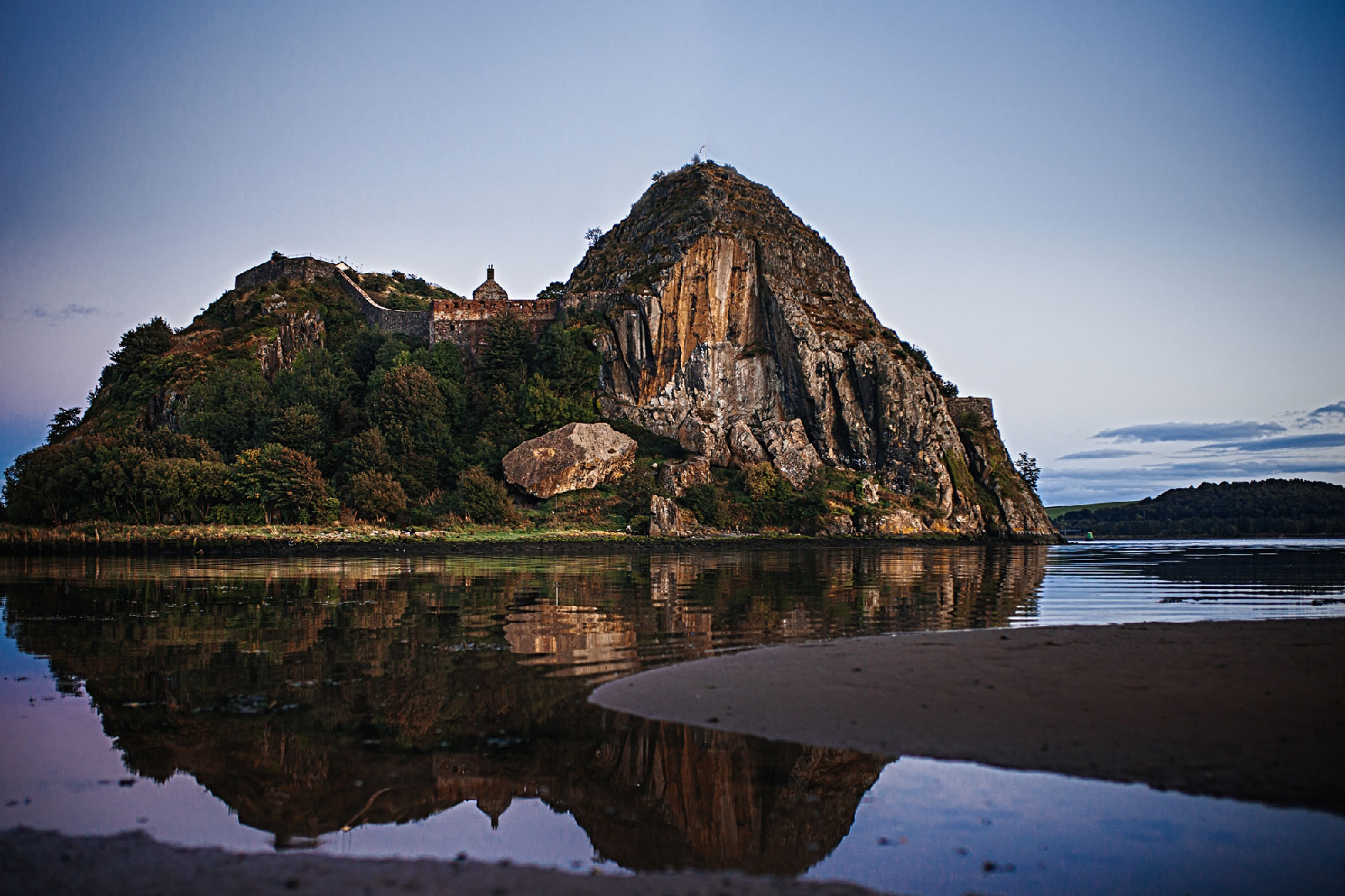
                 Dumbarton Rock

I once identified Geoffrey of Monmouth's Uther battle of Mount Damen with The Roaches:


While exploring the whereabouts of this battle, I noticed the context was purely northern, i.e. all of Uther's battles were confined to northern England and Scotland.

Mt. Damen was particularly important as it was at this site that Gorlois made his first appearance. Gorlois is a character Geoffrey conjured from Uther's gorlassar epithet.

One of the primary reasons for choosing The Roaches for Mt. Damen was Geoffrey's description of the place as being very steep, with jagged rocks well suited to be the lairs of wild animals.

But in looking over the Galfridian account of Mt. Damen again, I think I might have missed something very important: it is followed immediately by military action at Alclud.

Alclud is, of course, the Rock of Clyde or Dumbarton Rock. We find Alclud in the Irish account of Ceredig Wledig called 'Aloo' or, simply, 'the Rock.'

Could it possibly be that Damen is a distant echo of the Damnonii of Strathclyde? Ancient forms for the tribal names of both the northern and southern Dumnonii tribes can be found here:


If so, the "rock" of Alclud would nicely correspond to Geoffrey's rocks at Mt. Damen. 

Gorlois as Duke of Cornwall at Mt. Damen would then make eminent sense, as Cornwall was part of southern Dumnonia, which could be a mistake for northern Dumnonia.

The whole story of Igerna and Arthur's birth is copied from that of the begetting of Mongan (an Irish chieftain ultimately killed by Arthur son of Bicoir the Briton). Mongan's mother was Caintigerna, a name mistakenly or intentionally truncated as Igerna. The begetting of Mongan happens in the context of Aedan of Dalriada's Degsastan battle. Yes, the same Aedan who had a son or grandson named Artur.

CONCLUSION: 

Uther starts out at York, goes to the hill of the Damnonii, i.e. Alclud, then later goes to Lothian.  His death at St. Albans is an error for Albany, where he was said to have been just before going to St. Albans to die.  

Coming Soon: Was I Wrong About Uther's Mount Damen (or Does a Strathclyde Arthur Work After All)?