CHAPTER 3
THE BATTLES OF ARTHUR
The
best way to approach the Arthurian battles as they are found listed in the
HISTORIA BRITTONUM is to compare them with battles found in the ANGLO-SAXON
CHRONICLE.
The
HB (the usual abbreviation for the HISTORIA BRITTONUM) nicely brackets Arthur’s
military activities between the arrival of Cerdic in southern England in 495
A.D. and that chieftain’s death in 537.
I have argued in some detail in my book CEREDIG SON OF CUNEDDA AND THE
FOUNDING OF WESSEX (https://www.amazon.com/Ceredig-son-Cunedda-Founding-Wessex/dp/1976431492/ref=sr_1_1?keywords=CEREDIG+SON+OF+CUNEDDA+AND+THE+FOUNDING+OF+WESSEX&qid=1622581366&sr=8-1)
that Cerdic is, in fact, Ceredig son of Cunedda. Cunedda himself was from Drumanagh in
Ireland, not Manau Gododdin in the far north of Britain. Sites to be identified with Cerdic’s battles
were also discussed in my book.
Years ago I played around with trying to equate some
or all of the battles of Arthur and those of Cerdic of Wessex. Alas, my knowledge of place-name development
and of the languages involved was insufficient to the task. It occurred to
me that I should take a second look at the battles listed in the Historia
Brittonum and the Anglo-Saxon Chronicle.
First, those of Arthur:
Mouth of the river Glein
4 battles on the Dubglas River in the Linnuis region
River Bassas
Celyddon Wood
Castle Guinnion
City of the Legion
Tribruit river-bank
Mt. Agned/Mt. Breguoin (and other variants)
Mt. Badon c. 516
Camlann c. 537
And, secondly, those of Cerdic (interposed battles
by other Saxon chieftains are in brackets):
495 - Certicesora (Cerdic and Cynric arrive in
Britain)
[Bieda of Bedenham, Maegla, Port of Portsmouth]
Certicesford - Natanleod or Nazanleog killed
[Stuf, Wihtgar - Certicesora]
Cerdicesford - Cerdic and Cynric take the kingdom of
the West Saxons
Cerdicesford or Cerdicesleag
Wihtgarasburh
537 - Cerdic dies, Cynric takes the kingship, Isle
of Wight given to Stuf (of Stubbington near Port and opposite Wight) and
Wihtgar
As Celtic linguist Kenneth Hurlstone Jackson pointed
out long ago, 'Glein' means 'pure, clean.'
It is Welsh glân. However, there
is also a Welsh glan, river-bank, brink, edge; shore; slope, bank. This word would nicely match in meaning the
-ora of Certicesora, which is from AS. óra, a border, edge, margin, bank. If we allow for Glein/glân being an error or
substitution for glan, then the mouth of the Glein and Certicesora may be one
and the same place.
Ceredicesora or "Cerdic's shore" has been
thought to be the Ower near Calshot.
This is a very good possibility for a landing place. However, the Ower further north by
Southampton must be considered a leading contender, as it is quite close to
some of the other battles.
Natanleod or Nazanleog is Netley Marsh in
Hampshire. The parish is bounded by
Bartley Water to the south and the River Blackwater to the north. Dubglas is, of course,
'Black-stream/rivulet.' Kenneth Jackson
in his ‘Once Again Arthur’s Battles’ (Modern Philology, Vol. 43, No. 1, Aug.,
1945, pp. 44-57) says of the Dubglas:
"Br. *duboglasso-, 'blue-black' which seems
confused in place-names with Br. *duboglassio-, OW. *dubgleis, later OW.
Dugleis, 'black stream'..."
Linnuis contains the British root for lake or pool,
preserved in modern Welsh llyn. Netley
is believed now to mean 'wet wood or clearing', and this meaning combined with
the 'marsh' that was present probably accounts for the Linnuis region
descriptor of the Historia Brittonum.
W. bas, believed to underlie the supposed river-name
Bassas, meant a shallow, fordable place in a river. We can associate this easily with
Certicesford/Cerdicesford, modern Charford on the Avon. Just a little south of
North and South Charford is a stretch of the river called “The Shallows” at
Shallow Farm. These are also called the Breamore Shallows and can be as little
as a foot deep. An Anglo-Saxon cemetery was recently uncovered at Shallow Farm:
“A Byzantine pail, datable to the sixth century AD,
was discovered in 1999, in a field near the River Avon in Breamore, Hampshire.
Subsequent fieldwork confirmed the presence there of an early Anglo-Saxon
cemetery. In 2001, limited excavation located graves that were unusual, both
for their accompanying goods and for the number of double and triple burials.
This evidence suggests that Breamore was the location of a well-supplied
‘frontier’ community which may have had a relatively brief existence during the
sixth century. It seems likely to have had strong connections with the Isle of
Wight and Kent to the south and south-east, rather than with communities
up-river to the north and north-east.” [An Early Anglo-Saxon Cemetery and
Archaeological Survey at Breamore, Hampshire, 1999–2006, The Archaeological
Journal
Volume 174, 2017 - Issue 1, David A. Hinton and
Sally Worrell]
Cerdicesleag contains -leag, a word which originally
designated a wood or a woodland, and only later came to mean a place that had
been cleared of trees and converted into a clearing or meadow. I suspect the
Celyddon Wood was plugged in for this site. Celyddon contains the word later
found in Welsh as called, ‘hard.’.
Cerdicesleag or "Cerdic's wood" I would
identify with Hardley on Southhampton Water.
I pick this location not only because it originally meant ‘Hard Wood’,
but because of the mention of Stuf (= Stub/b) both before and after the
Cerdicesleag battle. Hardley is just across Southhampton Water from
Stubbington, the settlement of the descendents of Stuf/Stubb. It is also just across the Solent from the
Isle of Wight, which was given to both Wihtgar and Stuf.
Castle Guinnion is composed of the Welsh word for
'white', plus a typical locative suffix (cf. Latin -ium). Wihtgar as a personage is an eponym for the
Isle of Wight. Wihtgarasburh is, then,
the Fort of Wihtgar. But it is quite
possible Wiht- was mistaken for OE hwit, 'white', and so Castellum Guinnion
would merely be a clumsy attempt at substituting the Welsh for the
English. /-gar/-garas/ may well have
been linked to Welsh caer, 'fort, fortified city', although the presence of
-burh, 'fort, fortified town' in the name may have been enough to generate
Castellum. Wihtgara is properly
Wihtwara, 'people of Wight', the name of the tribal hidage. Wihtgarasburh is traditionally situated at
Carisbrooke.
Arthur's City of the Legion battle may well be an
attempt at the ASC's Limbury of 571, whose early forms are Lygean-, Liggean-
and the like. The Waulud’s Bank
earthwork is at Limbury. Incidentally,
Ceawlin’s Wibbandun of 568 is most likely a hill (dun) in the vicinity of
Whipsnade, ‘Wibba’s ‘piece of land/clearing, piece of woodland’ (see
Ekwall). Whipsnade is under 10
kilometers southwest of Limbury and is on the ancient Icknield Way next to
Dunstable Downs.
Tribruit is a Welsh substitute for the Latin word
trajectus. Rivet and Smith (The Place-Names of Roman
Britain, p. 178) discuss the term, saying that in some cases "it seems to
indicate a ferry or ford..." The Welsh rendered 'litore' of the Tribruit
description in Nennius as 'traeth', demanding a river estuary emptying into the
sea. However, in Latin litore could also mean simply a river-bank.
If I were to look at Tribruit in this light, and
provisionally accepted the City of the Legion as Limbury, and Badon as Bath
(which the spelling demands, and which appears in a group of cities captured by
Cerdic's father Ceawlin/Maquicoline/Cunedda), then the location of the
Tribruit/Trajectus in question may well be determined by the locations of
Mounts Agned and Breguoin. These last
two battle-sites fall between those of the City of the Legion and Bath, and
after that of the Tribruit.
I decided to take a fresh look at Agned, which has
continud to vex Arthurian scholars. I
noticed that in the ASC 571 entry there was an Egonesham, modern Eynsham. Early forms of this place-name include
Egenes-, Egnes-, Eghenes-, Einegs-.
According to both Ekwall and Mills, this comes from an Old English
personal name *Aegen. Welsh commonly
adds -edd to make regular nominative i:-stem plurals of nouns (information
courtesy Dr. Simon Rodway, who cites several examples). Personal names could also be made into
place-names by adding the -ydd suffix.
–ed1 (see the Geiriadur Prifysgol Cymru) is the suffix in the kingdom
name Rheged. The genitive of Agnes in Latin is Agnetus, which could have become
Agned in Welsh - as long as <d> stands for /d/, which would be
exceptional in Old Welsh (normally it stands for what is, in Modern Welsh,
spelled as <dd>). I'd long ago shown that it was possible for Welsh to
substitute initial /A-/ for /E-/. What
this all tells me is that Agned could conceivably be an attempt at the
hill-fort named for Aegen.
But what of Mount Breguoin? Well, I had remembered that prior to his
later piece on Breguoin ('Arthur's Battle of Breguoin', Antiquity 23 (1949)
48—9), Jackson had argued (in 'Once Again Arthur's Battles') that the
place-name might come from a tribal name based on the Welsh word breuan,
'quern.' The idea dropped out of favor
when Jackson ended up preferring Brewyn/Bremenium in Northumberland for
Breguoin.
So how does seeing breuan in Breguoin help us?
In the 571 ASC entry we find Aylesbury as another
town that fell to the Gewessei. This is
Aegelesburg in Old English. I would
point to Quarrendon, a civil parish and a deserted medieval village on the
outskirts of Aylesbury. The name means
"hill where mill-tones [querns] were got". Thus if we allow for
Breguoin as deriving from the Welsh word for quern, we can identify this hill
with Quarrendon at Aylesbury.
All of which brings us back, rather circuitously, to
Tribruit. This can only be the
Romano-British Trajectus on the Avon of the city of Bath. Rivet and Smith locate this provisionally at
Bitton at the mouth of the Boyd tributary.
The Boyd runs past Dyrham, scene of the ASC battle featuring Ceawlin
which led to the capture of Bath.
If we accept all this, then we cannot very easily
reject Badon as Bath. In truth, with
Bath listed in the ASC entry for 577, and made into a town captured by Ceawlin,
we simply are no longer justified in trying to make a case for the
linguistically impossible Badbury, such as the one at Liddington Castle in
Wiltshire.
Or are we?
According to the ANGLO-SAXON CHRONICLE, Ceawlin (=
Maqui-Coline/Cunedda) and Cynric (Cunorix son Maqui-Coline) fought at Barbury
Castle in Wiltshire in 556 A.D. This was
part of a push from the south, as 4 years prior to this they had put the
Britons to flight at Old Sarum.
Yet, oddly, Ceawlin is not mentioned again until
568, when he drives Aethelberht into Kent. He then fights on several different
fronts, but does not return to Wiltshire until 592. He fights there at Adam's Grave (near Alton
Priors), but is expelled after a great slaughter. Adam's Grave (= Woden's Barrow) is under 15
kilometers south of Barbury Castle, and less than 20 from the Liddington
Badbury. Ceawlin dies a year after this expulsion.
Thus from the attack on Barbury Castle in 556 to his
unsuccessful second attempt to take the region in 592, 36 years elapsed.
The question that naturally needs to be asked is
this: what happened after Barbury Castle that caused the Gewissei to cease
military action in Wiltshire and seek better targets elsewhere?
This is where the Liddington Badbury comes in. Being only a short distance from Barbury
along the ancient Ridgeway, it is the logical place for a significant victory
that might well have gone unrecorded in the ASC. Do we have any evidence that Liddington may
have been the famous Badon? As it
happens, I believe we do.
The Location of the
Second Battle of Badon
There is one possible clue to identifying Badon. It
lies in a comparison of the Welsh Annals entry for the Second Battle of Badon
and the narrative of the Anglo-Saxon Chronicle.
The actual year entry for this Second Battle of Badon reads as follows:
665 The first celebration of Easter among the
Saxons. The second battle of Badon.
Morgan dies.
The "first celebration of Easter among the
Saxons" is a reference to the Synod of Whitby of c. 664. While not directly mentioned in the
Anglo-Saxon Chronicle, nor the Anglo-Saxon version of Bede, there is an
indirect reference to this event:
664 … Colman with his companions went to his native
land…
This is, of course, a reference to Colman's
resigning of his see and leaving Lindisfarne with his monks for Iona. He did so because the Roman date for Easter
had been accepted at the synod over the Celtic date.
While there is nothing in the ASC year entry 664
that helps with identifying Badon, if we go to the year entry 661, which is the
entry found immediate prior to 664, an interesting passage occurs:
661 In this year, at Easter, Cenwalh [King of
Wessex] fought at Posentesburh, and Wulfhere, son of Penda [King of Mercia],
ravaged as far as [or "in", or "from"] Ashdown…
Ashdown is here the place of that name in Berkshire.
It is only a half dozen kilometers to the east of Badbury and Liddington
Castle. A vague reference to ravaging in
the neighborhood of Ashdown may well have been taken by someone who knew Badon
was in the vicinity of Ashdown as a second battle at Badon. As the Mercian king
was raiding into Wessex, it is entirely conceivable that his path took him
through Liddington/Badbury or at least along the Roman road that ran
immediately to the east of the area.
The Welsh and
“Bath” of the North
It has often been said that the Welsh Caer Faddon is
always a designation for Bath in Avon. However, the only medieval Welsh tale to
localize Arthur's Badon places it at Buxton in Derbyshire.
I am speaking, of course, of the early Arthurian
romance ‘The Dream of Rhonabwy’, sometimes considered to be a part of the
Mabinogion collection of tales. Rhonabwy is transported back in time via the
vehicle of a dream to the eve of the battle of Caer Faddon. Arthur has
apparently come from Cornwall (as he is said to return thither after a truce is
made; this is almost certainly in this context a folk memory for the Cornovii kingdom,
the later Powys) to mid-Wales and thence to Caer Faddon to meet with Osla or
Ossa, a true historical contemporary of Arthur who lies at the head of the
royal Bernician pedigree.
Here is the entry on Osla from P.C. Bartram's A
CLASSICAL WELSH DICTIONARY:
"OSLA GYLLELLFAWR. (Legendary). ‘O. of the Long
Knife’. According to the tale of ‘Rhonabwy's Dream’ it was against Osla
Gyllellfawr that Arthur fought the battle of Badon (RM 150). He is represented
as sending forty-eight horsemen to Arthur to ask for a truce till the end of a
fortnight and a month (RM 159, 160). In RM 159 the name is spelt Ossa. The
‘Long Knife’ identifies him as Saxon, and as such he is foisted into the
pedigree of Oswald, king of Northumbria, in a late version of Bonedd y Saint (§70+71
in EWGT p.64), where he roughly occupies the place of Ossa, grandfather of Ida
king of Bernicia. In this context he is called ‘Offa (or Ossa) Cyllellfawr,
king of Lloegr, the man who fought against Arthur at the battle of Badon’, and
father of Mwng Mawr Drefydd. It is curious therefore to find Osla Gyllellfawr
mentioned as one of the warriors of Arthur's Court in the tale of ‘Culhwch and
Olwen’. Here it is said that he carried Bronllafn Uerllydan, (‘Shortbroad’).
When Arthur and his hosts came to a torrent's edge, a narrow place on the water
would be sought, and his knife in its sheath laid across the torrent. That
would be a bridge sufficient for the hosts of the Island of Britain and its
three adjacent islands and its spoil (WM 465, RM 109-10). Later in the story
Osla took part in the hunting of the boar Trwyth. He and others caught him and
plunged him into the Severn. But as Osla Big-knife was pursuing the boar, his
knife fell out of its sheath and he lost it; and his sheath thereafter became
full of water, so that as he was being pulled out of the river, it dragged him
back into the depths (RM 140-1). A WELSH CLASSICAL DICTIONARY 587 It may be
inferred that after the battle of Badon, Osla Gyllellfawr, being defeated, was
supposed to have become subject to Arthur and to have served him until he was
drowned in the Severn (PCB)."
Arthur is said to progress from Rhyd-y-Groes to Long
Mountain and Cefn Digoll (Beacon Ring hillfort). As far as the text is concerned, Faddon is
hard by this location. Yet we find
nothing whatsoever in the region that could possibly be identified with
Faddon.
However, if Rhyd-y-Groes were to be rendered
directly into the English, it would be Crossford. And we find Crossford at a Roman road
crossing of the Mersey. If one continues
north from Crossford to Manchester, a Roman road then led straight to the SSE
to Buxton. To me, therefore, it seems
obvious that Rhyd-y-Groes is a standard relocation of the original site.
"Stretford proper lies in the south, taking its
name from an ancient ford over the Mersey, also called Crosford. Leland about
1535 crossed the Mersey 'by a great bridge of timber called Crossford
Bridge.'" (from
https://www.british-history.ac.uk/vch/lancs/vol4/pp329-335)
While the romance is entirely fanciful, the
chronological accuracy in the context of choosing Osla/Ossa is rather
uncanny. Ossa is known in English
sources for being the first of the Bernicians to come to England from the
Continent. Under his descendants, Bernicia became a great kingdom, stretching
eventually from the Forth to the Tees. In the 7th century, Deira – which
controlled roughly the area between the Tees and the Humber - was joined with
Bernicia to form the Kingdom of Northumbria.
In its heyday, Northumbria shared a border with its
neighbor to the south – Mercia – at the River Mersey of ‘Boundary River’. The
Mersey flows east to Stockport, where it essentially starts at the confluence
of the River Tame and Goyt. The Goyt has its headwaters on Axe Edge, only a
half a dozen kilometers from Buxton in the High Peak.
If we allow for the story’s author to have properly
chosen Ossa as Arthur’s true contemporary, but to have viewed Northumbria in an
anachronistic fashion – i.e. as extending to the River Mersey during Arthur's
time – then Ossa coming from Bernicia in the extreme north of England, and
Arthur coming from Powys of the Cornovii to the southwest, coming together for
a battle at Buxton makes a great deal of sense.
Ossa would have been viewed as engaging in a battle
just across the established boundary.
If I am right about this, the Welsh knew of the
‘Bathum’ or Badon that was Buxton and placed Arthur here as the victor in the
great battle.
The Problem from
the Standpoint of Linguistics
Obviously, we still have the problem of the
philology and phonology of the name Badon to contend with. I've not yet encountered an expert in the
languages involved who did not prefer Badon as a British form of English
bathum, and such an analysis of the place-name point to Bath in Somerset (or,
perhaps, as I once thought, Buxton in Berbyshire).
Yet, while modern place-name scholars and linguists
abide by hard and fast rules when parsing Badon, it is, frankly, absurd to
suggest that the compilers of things early medieval works like the HB, AC or
ASC would have had such knowledge or scruples. Sound-alike etymologies may well
have abounded and places that were similar sounding or spelled similarly may
well have been inappropriately identified with each other. Errors in translation and copying only add to
the possible confusion.
We find Bath in the ASC as a place capured by
Ceawlin/Cunedda in 577 A.D. There the
place-name is spelled Baþanceaster. It
was Ceawlin who was present at Barbury in 556, remember.
Now, Barbury is either 'the Bear's fort' or the fort of someone named 'bear.' The Welsh regularly associated Arthur's name with their word (arth) for bear.
The first group of battles found for Arthur in Chapter 56
of the HB belong to Cerdic of the Gewissei, we cannot ignore that presence in
the midst of those battles of a man called Bieda (with variants Baeda,
Beda). The battle featuring Bieda occurs
c. 501, a time that is nearly perfect for the Badon which supposedly happened
at the time of Gildas's birth and which the AC has done for c. 516.
Alheydis Plassmann of Bonn
(https://www.fnzrlg.uni-bonn.de/mitarbeiter/wissenschaftliche-mitarbeiterinnen/pd-dr.-alheydis-plassmann)
summarizes the dating of Gildas's ON THE RUIN OF BRITAIN and the most likely
date for Badon according to that source (see CELTIC CULTURE: A HISTORICAL
ENCYCLOPEDIA). The prevailing view (much
disputed, of course, in various circles!) is that Gildas finished writing his
work in 547 at the latest. Taking his 44
years, then, back from that date to the time of Badon, we arrive at 503. This
is as close as one can get to the 501 date for the ASC battle featuring Bieda.
According to Dr. Richard Coates, perhaps the preeminent
English place-name expert, the best guess as to the origin of the name Bieda is
"Redin (p. 60) linked it with OE be:odan ‘to
command’, though the structure isn’t fully clear. I’ve seen no better or worse
suggestion since." [personal communication]
Granted, the Badda/Baddan- element of the Badbury
names appears to have a different origin than the Bieda name. And I will discuss what that origin is in my
next post.
I've made a very good case for Bieda's name being
preserved in Bedenham, Hampshire.
Thus we have a number of correspondences which
suggest why Arthur may have been placed (erroneously) at Badon. They may be listed as follows:
1) Cerdic of the Gewissei fights battles to either
side of one featuring Bieda of Bedenham.
This battle's date fits the date of the Badon mentioned by Gildas.
2) Ceawlin/Cunedda of the Gewissei fights at
Baddanbyrig/Badbury/Liddington Castle shortly after the Barbury or 'Bear's
fort' battle of 556.
3) Ceawlin also captures Bath in 577. Badon can be construed as deriving from
English bathum.
Conclusion
So, what exactly happened?
We might imagine this sequence of events playing out
in the tradition over the centuries: Gildas is born at the time of the
Bieda/Bedenham battle c. 500 A.D. This
was, in reality, not a special battle.
It merely happened to mark the birthday of a man who became a very
famous Christian scholar and saint. At
some point it was wrongly identified with the famous battle fought at the
Liddington Castle Badbury by Cunedda.
And this battle, in turn, became confused with a British spelling for
English bathum, which at some point was applied to Bath in Somerset.
This explanation may seem unnecessarily complicated
or even convoluted. But it does seem to rather nicely account for what may have
happened when the usual forces were brought to bear on literary materials
created in the British Dark Age.
THE BATTLE OF CAMLANN
Where
was Arthur’s Camlann?
Well,
the most logical place to put it, were he based at Cadbury Castle (see Chapter
1), would be a shore of the River Cam near the great fortification. But the river-name Cam is a back-formation
from Camel, and that name was originally Cantmael. So we must look elsewhere for the fatal
battlefield.
A Camlann in Southern England?
My
readers will know that over the years I selected two primary locations for
Arthur's battle of Camlan, a word supposedly derived from either *Cambolanda,
'crooked enclosure', or *Camboglanna, 'crooked bank/shore.' There is the Camboglanna Roman fort on
Hadrian's Wall and the Afon Gamlan in NW Wales (the favored spot in Welsh
tradition).
Unfortunately,
I've only now realized I missed something.
And, once again, this something has been hiding in plain view in the
ANGLO-SAXON CHRONICLE all along.
The
death-date for Arthur at Camlan in the Welsh Annals is 537. This dovetails very nicely with Cerdic's
passing in 534. Just prior to Cerdic's
death, he and Cynric had taken the Isle of Wight. In the entry on his death, we are told that
he and Cynric gave all of Wight to Stuf and Wihtgar.
Why
is this last reference important?
Because Stuf (eponym for Stubbington) and Wihtgar (a slight corruption
of a word meaning the "men of Wight") were first mentioned in 514 as
arriving at Cerdicesora/Certisesora, 'Cerdic's bank or shore.'
I
have shown that the Glein battle of Arthur was for Cerdicesora, the first
battle of Cerdic and Cynric. The word
Glein has been improperly derived from
W.
glân
[Crn.
C. glan, Llyd. C. glan, H. Wydd. glan ‘pur, clir, disglair’: < Clt. *glano-,
fel yn enwau’r afonydd Gal. Glana, Glanis ar y Cyfandir, o’r gwr. *ĝhel-, ĝhlə- ‘disgleirio’]
clean,
cleansed, neat; clear of sin, pure, good, virtuous, uncorrupted, undefiled,
fair, honest, sincere.
when
it should instead be related to
W.
glan
[H.
Grn. glan, gl. ripa, Crn. C. glan ‘glan (afon); ochr, llechwedd’, Llyd. glann:
< Clt. *glanno-]
river-bank,
brink, edge; shore
It
will be noted that the glan of Camboglanna as 'crooked bank/shore' is the same
word as this second glan.
Now,
Cerdicesora was either the Ower near Southhampton or the one near Calshot. But there were other owers in the
region. In 477, Cymen is a combatant in
the battle of Cymenesora. It is not known for certain where this particular ora
was located, but the generally accepted opinion is that it is The Owers south
of Selsey Bill. These are offshore
rocks, but may once have been part of the mainland. The questionable authority
for this identification is a forged charter which lists
"Cumeneshora".
I
do not think this identification is correct. Aelle of Sussex's sons are
all being used as eponyms in the ASC to map out the early boundaries of
Sussex. Cissa is for Chichester (although see also Cissbury Ring not far
north of Lancing), Wlencing for Lancing. The unknown Mearcredesburna or
'Mearcred's Burn' I make out to be the Adur's tributary, the Rother, once
called the Limen, a British river-name. Limen was probably connected to
Latin limen, 'a limit', from limes, and so the name Mearcred (containing mearc,
'boundary') was substituted. It marks the eastern boundary of early
Sussex. Aderitum or Pevensey, another Aelle conquest, is a bit
further east.
Cymen
is no different. The name is from Welsh cyman, meaning a host or
army. It here stands for Wittering, the
place of Wihthere’s people. Wihthere,
rather than being ‘creature/being-host’, as Wittering sits right across The
Solent from Wight, is probably ‘Wight-host.’ In other words, the here, ‘host’ =
cyman, ‘host.’ One word is English, the
other Welsh. As the meaning of the Welsh
word was forgotten, it was personified into a son of the equally fictitious
Port.
It
is not at all impossible that Cymen's ora - or Cymen's glan - became corrupted
over time by the Welsh (possibly by association with real Camlan place-names)
to Camlan.
However,
there is another, perhaps better possibility than Keynor for Arthur's Camlan.
There
is a place on Portsmouth Harbour called Cams Hall. Ekwall's listing for this place reads as
follows:
[Kamays
1242 Fees, Cammeys 1282 Ep, Cams 1412 FA] The place is on Portsmouth Harbour.
The name is no doubt the British name of the bay and identical with CAMBOIS.
Under
CAMBOIS he has:
Identical
with Welsh CEMMAES, KEMEYS and Ir camus, 'a bay.' The name is a derivative of
OCelt
*kambo-
'crooked', Welsh cam. It is British in
origin...
Mills
confirms the etymology of Cambois in his place-name study:
A
Celtic name, a derivative of Celtic *camm 'crooked'...
From
the GPC:
camas,
cemais
[cf.
Gwydd. cambas, cambus ‘tro mewn afon, fforch, plygiad’, yn aml mewn e. lleoedd,
e.e. Athan-chamais ‘rhyd y tro’]
eb.
?ll. cemais.
Tro
neu gongl mewn afon, cilfach o fôr, bae:
bend
or loop in a river, inlet of sea, bay.
As
this 'crooked' bay has a shore, this is a very likely spot for Camlan.
As
consulting a map reveals, Cams Hall is quite close to Stuf's Stubbington. Such a proximity suggests that a Camlan
situated here fits the context of the ASC, where Cerdic's death is entered in
the same year as his granting of Wight to Stuf and Wihtgar.
I
found Cams mentioned at this excellent Website:
http://www.british-history.ac.uk/vch/hants/vol3/pp209-216
"Fareham
Harbour, formed by a long broad inlet called the Cams..."
'The
Cams', as they were called, stretch from Cams Bay in the southeast to Cams
Lodges in the northwest. In other words,
the camas/cemais, 'bend or loop in a river, inlet of sea, bay', was the entire
waterway that surrounded the Cams peninsula.
The maximum extent was generally measured as beginning at Cams Bay just
on the other side of Wicor Lake and ending at Wallington River.
Nowadays,
this inlet is called Fareham Creek, ending in Fareham Lake south and east of
Wicor Lake.
Cams
Shore is used to describe the entire shore around the peninsula (information
courtesy Chris Mallin, Administration and Support Officer, Fareham Borough
Council). One of the meanings of Welsh
glan, found in the Camlan name, is ‘shore’ (see the GPC).
Early
Ordnance Survey maps show the various Cams place-names.
With
Arthur dying at Camlann in 537, and Cerdic dying in 534, it is tempting to say
that these two leaders of warriors perished fighting each other at The
Cams.
Camlan and the Grave of Osfran’s
Son
The
purpose of this essay is to prove, once and for all, where Arthur’s Camlann
battle site was located. Or, more accurately, where Welsh tradition happens to
place it!
It
is fairly well known that the Welsh record seven survivors of Camlann. Yet, to
my knowledge, no one has sought to plot these personages out on a map. To do so
may help us pinpoint a geographical region in which Camlann was believed to be
situated.
One
of the seven – Geneid Hir – it a difficult and otherwise unknown name. P.C.
Bartram (in “A Welsh Classical Dictionary: People in History and Legend up to
about A.D. 1000) suggests the name may be corrupt and offers an unlikely
identification with a personage named Eueyd or Euehyd Hir (often rendered
Hefeydd). However, I would see in Geneid ‘Cannaid’, “white, bright, shining,
pure, clean, radiant,” an epithet substituted for the original title Ceimiad, ‘Pilgrim’,
of St. Elian. Elian had churches on Mon/Anglesey and in Rhos, Gwynedd.
Sandde
Bryd Angel looks to be a pun for the Afon Angell, Aberangell, etc., places
immediately to the south of the Camlan on the Afon Dyfi in Merionethshire.
Morfran
son of Tegid is from Llyn Tegid, now Bala Lake in Gwynedd.
St.
Cynfelyn is of Llancynfelyn in Ceredigion just below the Afon Dyfi.
St.
Cedwyn of Llangedwyn in Powys, while somewhat further removed than the rest, is
still in NW Wales.
St.
Pedrog of Llanbedrog is on the Lleyn Peninsula in Gwynedd, just opposite the
three Camlans in Merionethshire.
St.
Derfel Gadarn is at Llandderfel near Bala Lake in Gwynedd.
Needless
to say, if we “triangulate” with all these names/places, we find at the center
the three
Merionethshire
Camlans.
So
which one is the right one?
Only
one way to know for sure: we must find the Camlann that is claimed as the
gravesite of Osfran’s son. This reference comes from the ‘Stanzas of the
Graves:’
Bet
mab Ossvran yg Camlan,
Gvydi
llauer kywlavan…
The
grave of Osfran’s son is at Camlan,
After
many a slaughter…
[“The
Black Books of Carmarthen ‘Stanzas of the
Graves’,
Thomas Jones, Sir John Rhys Memorial
Lecture,
1967, Critical Text and Translation.]
While
–fran of Osfran looks like Bran or ‘Raven’, the Os- does not look at all right
for a Welsh name. I suspected Ys- and after a first search failed, I defaulted
to bryn or ‘hill’ as the original of –bran. Thus I was looking for an Ysbryn.
And
I actually found him – or, rather, it! [See “An
Inventory
of the Ancient Monuments in Wales and
Monmouthshire: VI – County of Merioneth”, p. 98, RCAHMW, 1921.]
On
the Mawddach River in Merionethshire there is a Foel Ispri. It used to be Moel
Ysbryn and was the legendary residence of Ysbryn Gawr or Ysbryn the Giant. If
we go north on the Mawddach we run into its tributary the Afon Gamlan, i.e. the
Water of the Crooked Bank.
In
a section of my book THE MYSTERIES OF AVALON, I included the following note
detailing one of the supposed sites for Arthur’s grave. As it happens, this
tradition matches the one that places Camlan on the Afon Gamlan.
A Note on Northwestern Wales as
the Site of
Arthur’s Grave
There
are a few Camlans/Gamlans in northwestern Wales or Gwynedd. The presence of
these sites has prompted various Arthurian scholars to propose that Arthur
fought his last and fatal battle in this region. The modern champions of this
notion are Steve Blake and Scott Lloyd, whose book PENDRAGON: THE DEFINITIVE
ACCOUNT OF THE ORIGINS OF KING ARTHUR, was released in 2003 by Lyons press.
We
cannot ignore these Camlans or Gamlans (the most noteworthy being the Afon
Gamlan, a river) when searching for a historical Arthur. Unlike the placement
of Camlan (or Camlann) in Cornwall, something done by Geoffrey of Monmouth in
his HISTORY OF THE KINGS OF BRITAIN, Gwynedd can claim to possess real
candidates for Arthur’s final battle site. The only other known site that
qualifies linguistically is much further north – Camboglanna on Hadrian’s Wall.
Blake
and Lloyd place their trust in a very late medieval source, the VERA HISTORIA
MORTE DE ARTHURI, a work dated in extant MSS. to c.
1300,
although perhaps to originals dating between 1199 and 1203. According to Blake
and Lloyd, the VERA HISTORIA probably was written in Gwynedd. I will not
contest this point, as it may well be correct.
The
importance of the VERA HISTORIA lies in its placement of Arthur’s interment –
and thus of Avalon – in Gwynedd. Although Blake and Lloyd are familiar with the
Gwynedd tradition which places Arthur’s grave at Carnedd Arthur near Cwm-y-llan
or Cym Llan (an error for Cwm Llem, the Valley of the river Llem), they choose
to ignore this bit of folklore and instead settle on Tre
Beddau
near Llanfair, well to the east on the Conwy River, as the actual burial place
of the king. They deduce this from the fact that the VERA HISTORIA states that
the grave is near a church of St. Mary (in Welsh, Llan-fair), and that
archaeologists have recently uncovered a Dark Age or 6th century cemetery at
Tre Beddau.
[Note:
Cwm Llan is a very clumsy attempt at rendering Camlan, and is obviously
spurious tradition.]
Unfortunately,
the authors of PENDRAGON also choose to ignore the description of the burial
place of Arthur as preserved in the VERA HISTORIA. In their own words, the
burial of Arthur after Camlan is told as follows:
“…
the VERA HISTORIA describes the funeral of Arthur as taking place at a chapel
dedicated to the Virgin, the entrance to which was so narrow that the mourners
had to enter by first forcing their shoulder into the gap and then dragging the
rest of their body through the opening. While the funeral took place inside the
chapel, a large storm blew up and a mist descended, so thick that is was
impossible to see the body of Arthur – which had been left outside, as it would
not fit into the chapel. Following the storm the mourners came out to find that
the body had gone and the tomb prepared for Arthur was sealed shut, ‘such that
it rather seemed to be one single stone’.”
Now,
this passage quite obviously DOES NOT portray a 6th century Christian cemetery.
Rather, it is a fitting description of a ‘chapel’ comparable to the “Green
Chapel’ of SIR GAWAIN AND THE GREEN KNIGHT. In other words, the said ‘chapel’
is a Neolithic chambered tomb, whose passage is so tight as to barely allow the
entrance of the mourners.
Furthermore,
we are talking about TWO conjoined passage tombs – one that is the chapel of
the Virgin, and the other which mysteriously receives the body of King Arthur.
In all of Gwynedd, there is only one such ancient monument: that of the double
chamber tomb of Dyffryn Ardudwy not far west of the Afon Gamlan.
One
of the two chambers of Dyffryn Ardudwy is actually known as Coetan Arthur or
Arthur’s Quoit. The “Virgin” is here a Christian embellishment on what would
have been a pagan goddess associated with the Otherworld site.
The
grave of Arthur discussed in the VERA HISTORIA is thus a product of folklore
only. It can thus be dismissed as an actual grave of Arthur.
Granted,
we cannot so easily dismiss the Camlans/Gamlans in northwestern Wales. Since
writing this, Dr. Jessica Hughes of CADW has sent me information via snail-mail
that adds important details to the description of the Dyffryn Ardudwy chambered
tombs. To quote Dr. Hughes:
“The
Chambered tomb at Dyffryn Ardudwy has been known as Coetan Arthur in the past,
indeed antiquarian reports of the site refer to
Dyffryn
as ‘Coetan Arthur’. However, the name appears to refer to the whole of the
monument as opposed to a particular chamber. Interestingly (and maybe somewhat
confusingly), one mile to the east of Dyffryn lies another chambered tomb known
as ‘Cors-y-Gedal’. This was also known in the past as ‘Coetan Arthur’…
Regarding whether there is a church of St. Mary in proximity to Dyffryn
Ardudwy, I have found a church 4 miles north of Dyffryn in the village of
Llanfair.
“
The
enclosed Detail Report on this Church of St.
Mary
states that Llanfair was dedicated to Mary “by at least the 12c when Gerald of
Wales and Archbishop Bladwin stayed there in 1188…”
Here
is the COFLEIN listing for the second chambered cairn:
http://www.coflein.gov.uk/en/site/93724/detai
ls/CORS-Y-GEDOL%2C+BURIAL+CHAMBER/
“A
rather tapering rectilinear cairn, c.31m NESW by 14.5m, showing at its eastern
end a number of orthostats, partly supporting a tipped capstone, c.3.6m by 3.0m
& 0.45m thick: a spindlewhorl, thought to be IA, is said to have come from
under the capstone.”
Both
of these chambered tombs are directly west of the Afon Gamlan.
The Camlann (and Avalon) of
Geoffrey of Monmouth
Over
the years, I've written a great deal about possible locations for Arthur's
Avalon. Only recently I decided to take
another look at the problem - this time making use of whatever extant tradition
Geoffrey himself may have encountered.
It
is generally agreed that the Galfridian 'Camblam' is the Camel River in
Cornwall. I myself will not dispute this
claim – as long as we remember that this Camel’s early forms are Cambula,
Camble, Cornish cam ‘crooked’ and pul (Welsh pwll) ‘a stream’ (Ekwall).
There
is an old tradition that an inscribed stone found on or near the Camel at
Slaughterbridge/Worthyvale was 'King Arthur's Stone:'
http://www.ucl.ac.uk/archaeology/cisp/database/site/wvale.html
http://www.ucl.ac.uk/archaeology/cisp/database/stone/wvale_1.html
This
identification of the stone was due to a false reading of the inscription. However, the legend that this stone was
Arthur's may, indeed, be very old.
What
most Arthurian scholars and amateur enthusiasts alike appear to have missed is
that the original name of Worthyvale - preserved as early as the Domesday Book
of 1086 - was Guerdevalan/Gerdavalan (Cornish auallen, 'apple-tree', plus
garth, "enclosure" - or is guerd/gerd here similar to Welsh garth,
"mountain ridge, promontory, hill, wooded slope, woodland, brushwood,
thicket, uncultivated land"?). Thus we might surmise that Geoffrey had
simply picked up this place-name as the location of the supposed King Arthur's
Stone. If so, the happy coincidence that
the site bore an apple place-name would immediately have conjured up all kinds
of otherworldly connotations.
So,
in Geoffrey's mind, Arthur was merely ferried across the Camel from the
battlefield to Worthyvale. There is no
need to look for Avalon elsewhere.
A New Candidate for King Arthur’s
Camlan
Ordinarily,
I'm a stickler for obeying onomastic rules.
But there is one case in which I might make an exception...
We
all know how Medraut (Cornish Modred, Latin Moderatus) perished with Arthur at
Camlan. But the site of Camlan has been
hotly disputed. I have favored either
one of the Camlans in NW Wales or the Roman fort of Camboglanna on Hadrian's
Wall. In fact, I was the first to
definitively identify the Welsh Camlan
(https://mistshadows.blogspot.com/2016/08/arthurs-thirteenth-battle-camlann.html
and https://mistshadows.blogspot.com/2018/03/the-avalon-of-geoffrey-of-monmouth.html).
I'd
never really seriously considered a southern Camlan, to be perfectly
honest. But as I'm once more delving
into the possibility of a Southern Arthur, it seemed the sensible thing to do.
I
began with the Modred names we know of in Cornwall. The following passage is from the entry for
Medrawd in P.C. Bartrum's A CLASSICAL WELSH DICTIONARY:
Several
place-names apparently involving the name Modred are found in Cornwall.
Rosemodres in the parish of St.Buryan has been interpretted as meaning Modred's
Heath. There is Tremodret in Roche (a Domesday manor) and another Tremodret
(now Tremadert) in Duloe (Henry Jenner in The Journal of the Royal Institution
of Cornwall, LVIII (c.1911) pp.60, 76). In the parish of Kenwyn near Truro we
find Carveddras which in 1296 was Kaervodred juxta Tryvero and in 1250
Carvodret. Such occurences show that Modred was a Cornish name, and need not
have anything to do with the Arthurian character (C.L.Wrenn in Trans.Cym.,
1959, pp.60-61). See also TYP p.455.
One
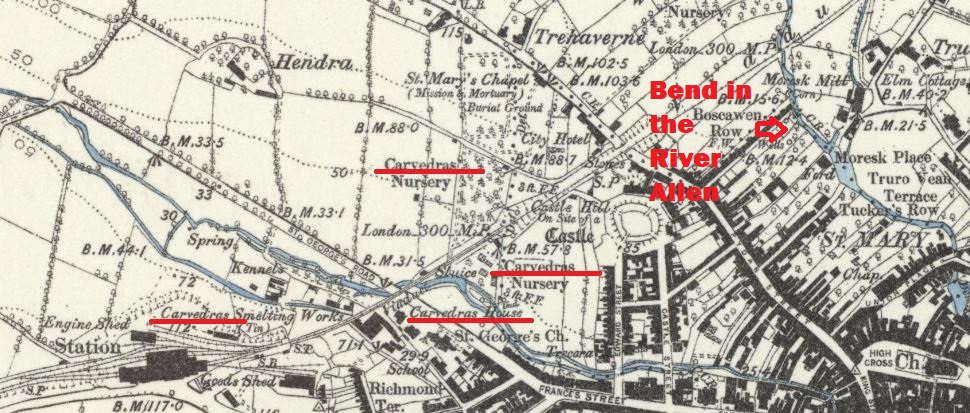
of these sites is especially interesting - Carvedras in Kenwyn, Truro. Please see the map posted at the head of this
article.
Is
it a coincidence that a place called 'the Fort of Modred' is situated quite
close to the River Allen? And that there
is a pronounced bend in this location?
The Cam(bo)- of Camlan, of course, means "crooked" and is
applied to a bend in a river-bank.
Could
an original British *Cambo-alauna have been replaced in the Welsh tradition by
known native examples of *Camboglanna?
Note that Wales has an river called the Afon Alun or Alyn, to be
properly derived from British *Alauna.
Might we allow for a Cornish Cam + Alan (1199) having become Camlan in
the Welsh tradition due to affinity with their own Camlan place-names?
I
think this possible. If this is where
Modred/Medrawd and Arthur died, we are dealing with some kind of internal
squabble - as indeed the tradition insists we should.
“History is Written By the Victors”
or Who Did Win the Arthurian Battles?
To
have to ask the question “Who won the Arthurian battles?” would seem a silly
exercise. But as I have shown above, at
least some of the sites listed in the HB are identical with those belonging to
Cerdic of Wessex. And as far as the
English sources are concerned, Cerdic was victorious in all his battles. How do we reconcile that claim with Arthur’s
much-heralded military success?
Well,
I tackled this question in a less direct fashion in my book CEREDIG SON OF
CUNEDDA AND THE FOUNDING OF WESSEX. With
the Gewessei, we have attacks from the south (Hampshire and adjacent regions)
and then, supposedly later (although archaeologists have questioned this!), a
movement up the Thames Valley.
Interestingly enough, these two areas essentially define the section of
southeastern England that was settled the earliest and heaviest by the Germanic
tribes. So, in a way, the battles show
approximate boundaries between the English and British controlled territories.
Cerdic
does not seem to have gone very far, and his victories must, therefore, be
questioned. He ends up, apparently,
retreating to the Isle of Wight, which some might instead interpret as a
consolidation of his hold of Hampshire.
Yet I have described above the marked failure of the Gewessei to
penetrate Wiltshire for over three decades.
It
is my guess that Arthur should be seen as the true victor in the battles
against Cerdic.