Friday, November 23, 2018

I HAVE, ONCE AND FOR ALL, SOLVED THE MYSTERY OF UTHER PENDRAGON'S IDENTITY

NOTE: Since writing this piece, I went back and looked at a previous blog post -


I also checked with the linguists on whether the 'kawell' of Uther's Pen Kawell could represent an attempt at Welsh cefyll (or Cornish kevyll).  Alas, Dr. Simon Rodway was quite adamant that "None of the horse-forms have -ell, so kawell cannot be for 'horse.'"  Thus Penkevel/St. Michael Penkevil in Cornwall is out, as is my proposed Pen Kefyll for the Ard Echde that is the Mull of Kintyre.

This brought me back to Kingscavil or Kincavel in what had been Manau Gododdin.  As Uther Pendragon seems to be Manannan mac Lir of the COMPERT MONGAIN (see below), and the name Manannan is related to that of the place-name Manau of Manau Gododdin, AND Manawydan son of Llyr is placed in Manau in the Welsh 'Pa Gur' poem, we must once again ask if Kingscavil = the PEN KAWELL where Uther is "transformed."

Assuming, of course, that Pen Kawell IS a place-name!  I will continue working on the problem... It may well be that my earlier translation of the line was correct and that it should read "Our Lord, chief of the sanctuary (pen cafell), transforms me."  The sanctuary (temple, etc.) might be a poetic reference to the sky, as the following line reads "It is I who's a second luminary (specifically the dragon comet?) in the gloom."  God, presumably, is the first luminary.  In this case, the transformation of Uther into Gorlois, i.e. Gorlassar the 'very green/blue', is a reference to his being symbolized by the intensely green/blue and would not have anything to do with Manannan's assuming the form of Fiachnae to beget Mongan.  

Castle Dunaverty, Kintyre, Scotland
Castle Tarbert, Kintyre

Many years ago, in essays that eventually came together in my book THE MYSTERIES OF AVALON, I showed that Arthur's mother, Eigr, was a personification of a headland.  In the same work I examined the parallel tales of Arthur's birth and that of the Irish king Mongan.  Lastly, I suggested that Uther Pendragon may, at least in part, owe his origin to the 'terrible warrior/terrible man' present in the COMPERT MONGAIN.  Fairly recently I proposed that this terrible man owed his designation to one of the variant spellings for Degastan, and that, therefore, the location of the battle in the COMPERT MONGAIN was Dawston in Liddesdale.

For those who would like more background details on these matters, please see

https://secretsavalon.blogspot.com/2016/07/the-mysteries-of-avalon-chapter-twelve.html

and

https://mistshadows.blogspot.com/2017/10/degsastan-and-origin-of-mil-uathmarfer.html

Unfortunately, I did not pursue these ideas any further.  Until now, that is.  I decided I needed to look more closely at the Irish sources, just in case I had missed something important that might pertain to the true identity of Uther Pendragon.   My readers are urged to consult the Irish texts and translations for the two versions of COMPERT MONGAIN.  These may be found in the following excellent edition by Kuno Meyers:

https://archive.org/stream/voyageofbransono01meye#page/44/mode/2up

The moment I re-read the longer tale of the conception of Mongan, I realized I had, indeed, failed to make obvious observation.  For in this last source, Manannan mac Lir, the magical, shapeshifting god and prototype for Merlin in Geoffrey of Monmouth's story, is described thusly:

aenoglach mor mileta

"a single tall [or great/big] warlike/martial young man/warrior"

This did not immediately excite me, although it was not far from the terrible warrior/terrible man of the shorter version of the COMPERT.  In the second, longer version, the terrible warrior is not present in the narrative.  It was the clothing worn by Manannan that set off alarm bells:

brat uaine aendatha

"a green cloak of one color"

We will recall that Uther calls hims "Gorlassar" in the Elegy of Uther Pen, a word that can mean either very blue or very green.  I'd offered various ideas to account for the epithet, and occasionally patted myself on the back for coming up with this or that ingenious solution to the riddle.  But here was a very prosaic and common-sense explanation for gorlassar.  Uther is very green because he is wrapped in a green cloak.

Everything then came down to the 'Pen Kawell' found in the Uther Elegy.  I now believe this to be an error for Pen Kafall/Keffyl, 'the Head/Headland of the Horse.'  If so, this is clearly a reference to Ard ("Promontory") Echde, a Gaelic rendering of Ptolemy's Epidion Akron, the Mull of Kintyre.  Kintyre, literally 'End of the Land', shows the Irish Q-Celtic cenn, cognate with the P-Celtic pen found in Welsh. The Epidii were the 'horse-people', inhabitants of the Kintyre peninsula prior to the arrival of the Irish Dalriadans.

Ard Echde is known from fairly early on, as is evinced by its presence in early Irish saga.  The following is from

https://books.google.com/books?id=j2QGAQAAIAAJ&pg=PA175&lpg=PA175&dq=Ard+echde%2BThe+Death+of+CuRoi&source=bl&ots=wM055tj0lv&sig=hXuCNn3NgBrg3ZlvbDM9M7EDYA8&hl=en&sa=X&ved=2ahUKEwjk5qKJ3PLeAhVrjlQKHbVtDbcQ6AEwCnoECAUQAQ#v=onepage&q=Ard%20echde%2BThe%20Death%20of%20CuRoi&f=false


Kintyre was also the home of Aedan son of Gabran, whose son was called Arthur. Aedan's son Conaing (an Irish borrowing of the English word cyning, 'king'), is also said to be the father of this particular Arthur, and I think what may have happened is that Aedan was the king/cyning/conaing in question, confused for a descendant in the genealogy.

Ultimately, then, Uther Pendragon/Gorlassar would be none other than Manannan Mac Lir.  His transformation, presumably into Fiachnae, is placed at Pen Kawell/Ard Echde/Epidion Akron/Mull of Kintyre.

The corollary to the Mongan birth story is that of his death at the hands of Arthur son of Bicoir the Briton.  I've elsewhere made my case for this being Arthur sonof Petuir/Petr/Pedr of Dyfed.  This Arthur is said to kill Mongan with a stone (identified as a 'dragon-stone' in one text).  I suspect this motif was introduced because Petr = Latin Petrus, 'stone, rock.'  Irish also has an obscure word art, 'stone.'

From the ANNALS OF TIGERNACH:

T627.6
Mongan son of Fiachna Lurgan, stricken with a stone by Artur son of Bicoir Britone died. Whence Bec Boirche said:

Cold is the wind over Islay;
There are warriors in Cantyre,
They will commit a cruel deed therefor,
They will kill Mongan son of Fiachna.

And from THE VOYAGE OF BRAN:

58. 'He will be-his time will be short--
Fifty years in this world:
A dragonstone from the sea will kill him
In the fight at Senlabor.

I find myself, as a result of this "revelation", both satisfied and, curiously, dissatisfied.  It has always been my goal to find a real-life Uther Pendragon.  Alas, there is no such man.  We have had an Irish god made into the father of the Arthur of the HISTORIA BRITTONUM.  While it is true that Aedan of Dalriada was of Kintyre, we are nowhere told that the tall, green-cloaked, warlike man who was Manannan sired Aedan's son Arthur.

The Arthur made famous in Nennius and the Welsh Annals is still, regrettably, fatherless.

I can say one thing, though, with a fair degree of certainty: Geoffrey of Monmouth substituted his Tintagel headland for that of the Mull of Kintye/Pen Kawell.  And as he has Arthur born at Tintagel, and it is reasonable to assume that Arthur son of Aedan was born on Kintyre, we are more or less forced to concede that the prototype for Geoffrey's Arthur, at any rate, was Arthur of Dalriada.

The good news in all this is that I no longer feel bound to find an Arthur who is in any real, historical sense associated with an Uther Pendragon.


Coming Soon: I HAVE, ONCE AND FOR ALL, SOLVED THE MYSTERY OF UTHER PENDRAGON'S IDENTITY

Dunaverty Castle, Kintyre, Scotland

Tarbert Castle, Kintyre

A big announcement coming up.  Should have it posted within a few days... 

Thursday, November 22, 2018

"I AM HE WHO IS CALLED GORLASSAR": UTHER AND THE LOCATION OF HIS TRANSFORMATION

Neu vi a elwir gorlassar:
It’s I who’s called 'the very blue/green'

- from the Elegy of Uther Pen

The translation offered would be the literal interpretation of the line.

I've discussed the possible significance of the term in the context of Uther here:

https://mistshadows.blogspot.com/2018/11/the-transformation-of-uther-pendragon.html

I also have worked on the following line -

a’m rithwy am dwy pen kawell.

- to produce a possible reading of "Our Lord, chief of the sanctuary, transforms me."

However, I've since taken another look at the very troublesome 'pen kawell' of this line.  While chief of the sanctuary was acceptable, what I wondered is whether Pen Kawell could actually be a place-name. I did not expect this line of inquiry to produce any results, but was surprised by what I found.

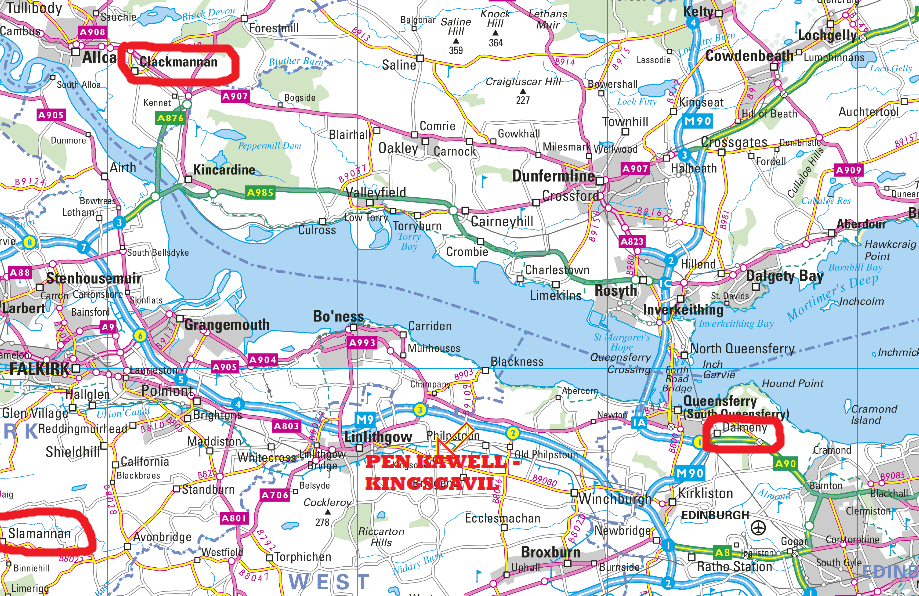
Kingscavil - Pen Kawell? - and Surrounding Manau Place-Names

In West Lothian, Scotland, there is a place called Kingscavil.  This place-name may well derive from an earlier British Pen Kawell!  Noted North British place-name expert Alan James, through private communication with colleague John Wilkinson, was kind enough to provide me with this information on the etymology for Kingscavil.  I've taken the liberty of highlighting the most important passage in this entry.

Cf Snowdonia’s Llyn Cwellyn (cawell + llyn) ‘creel lake’ (Jones 1998).

†*Hill of KINGSCAVIL, Linlithgow c450ft/137m (Hill of Kuikauil [sic = Kinkauil]
1630) An earlier name for the Parklycraigs ridge, tipped by Nancy’s Hill. It may be the feature which gave Kingscavil its original name [NT0276].

NANCY’S Hill, Linlithgow c450ft/137m (Hill of Kuikauil [sic = Kinkauil] 1636
Pont, sic OS1) Again presumably literal, with the sort of name (John and Ann) that could commemorate myth, legend or at least folklore. Along the Parkly Craigs ridge to the east of Jock’s Hill with which it makes a lovely couple of humps, even if quarried to the north. Perhaps earlier †*Hill of Kingscavil [NT024759]. Also tree-covered by Nancy’s Hill Plantation (sic OS1), really two but named as one, as OSNB insist on telling us.

KINGSCAVIL, Linlithgow (Kincauill 1307, Kyncaville 1315-21, Kyncawel 1325,
Kingcavill 1378, Kingscavill 1457, Kincawill 1531, Kincauil c1590, Kingcavell 1688 Ret ii, 265, Kingcavill 1690 Ret ii, 270, sic x 3 OS1; locally Kings-CAVE-ull /kɪŋz'ke:vl/) It may be nothing to do with kings or cavils (ie Sc cavil ‘allotment of land’) as some think (GTSS, 107-9), but perhaps ScG ceann ‘headland, bluff’ + ScG cabhuil ‘creel’: ‘fishing-creel-head, or end’ with reference to the former loch (see PNWL, 60). Yet this too may be from Welsh, W pen ‘head’+ W cawell ‘creel’ ie *Pen(n)kauell: ‘head of creel(-ridge)’ or perhaps W cefn/cein ‘ridge’ + W cawell, and referent to the humped ridge tipped by Nancy’s Hill (hil of kincauil c1590, Hill of Kuikauil [sic for Kinkauil] 1636): Macdonald records ‘several references to saxum de Kincavill’ L saxum ‘rock’ and Kincavill Quarry (sic 1986) provided stone for James VI’s reconstruction of Linlithgow Palace (DWL, 87): see WLQR. In the early sources it is often linked to Caldorcler: see East Calder.The first OS maps offer three locations, the second being today’s [NT028767; NT030764; NT031763]. Also †*Easter Kingscavil (Easter Kincavill 1691, Easter-Kinkavil 1710) Sc easter ‘east’ [lost], †*Wester Kingscavil (Wester Kingkavill 1647) Sc wester ‘west’ [lost], †Mains (Mains of Kincavill 1569) Sc mains ‘home farm’ [lost]. See Park.

If Kingscavil is Pen Kawell, I would revise my reading of the poem's line to read:

"Our Lord transforms me at Pen Kawell."

Why might this be significant?

Well, Kingscavil lies between Clackmannan, Slamannan and Dalmeny.  All three place-names are believed to contain the element designating Manau or Manau Gododdin.  Dalmeny is not certainly a Manau  place-name, but the chance it is can be considered fairly high:

303 Watson 1926, 354. Dalmeny WLO, Dunmanyn 1214. Watson 1926, 104, 354, 515 n104, Macdonald 1941, 3‒4, is a very puzzling name. Perhaps + *mejni, plural of *majn ‘stone’, but it does not show forms with -meny until 1587. Alternatively, perhaps it involves a saint’s or other personal name (Taylor’s discussion of Kilmany FIF, Taylor 2010, 456‒57, should be taken into consideration). The territorial name Manau cannot be ruled out: Watson’s and Macdonald’s rejection of this possibility implies greater certainty than seems justified regarding the boundaries of that territory  


Dalmeny WLo CPNS pp. 104 and 515 n104, PNWLo pp. 3-4 ? + -maɣn- (which see) ? + -īn, or else the territorial name -*Mannan , see *man- 

  *man- 
IE *mṇ- (zero-grade of *men- ‘jut, project’, see mönïδ, *mönju and *mönǭg) > eCelt *mon- > Br * Mon-, Man- (in p-ns), cf. (< IE participial *mṇ-t-) W mant ‘mouth, lip’; OIr Man- (in p-ns); cf. (< IE o-grade *mon-) O-MnIr, G moniu ‘upper back’; cf. (IE *men-) Latin mentum ‘chin’, prōmineō ‘I project’. The Indo-European status of this root is supported by Hittite and Avestan forms, see OIPrIE §18.5 at p. 298, but cf. Sims-Williams (2000) at pp 3-4. See also mönïδ. The root implies ‘projecting’, especially of facial and other bodily features: in place-names, the sense is presumably ‘outstanding, prominent, high’. With the suffix –awā-, it is seen in the North in the territorial name Manaw HB14.62, CT59(V) (and probably CT29(XI)), and in OIr forms at AU[582]583, AT[579]583, AU[710]711, AT[710]711, but see LHEB §47(1), pp. 375-6, YGod(KJ) pp. 69 – 75, and discussion of Clackmannan under *clog. Elsewhere, a similar form underlies the Isle of Man, Ellan Vannin (see PNRB pp. 410-11 and DMxPN p xi) and Ynys Môn, Anglesey (see PNRB pp. 419-20, DPNW p. 17). There are as many as fourteen related place-names in Ireland (Anglicised Mannin etc.: D MacG Easpaig at SNSBI Conference, Douglas IoM, 7.4.2001). Manaw, like Ynys Môn and some of the Irish places, is not outstandingly mountainous, and some other sense seems needed. A deity-name, perhaps associated with water, might be indicated – cf. the legendary personal name Manawydan/ Manannán (see PCB pp. 412 ets, DCML pp. 139-40, DCM pp. 285- 6) – or else an ethnic name: see Muhr (2002) at p. 41.  

http://spns.org.uk/wpcontent/uploads/2017/04/Alan_James_Brittonic_Language_in_the_Old_North_BLITON_Volume_II_Dictionary.pdf

As is well known to students of Dark Age Britain, the great Cunedda, whose son was the Ceredig/Cerdic of Wessex I have put forward as a good candidate for Arthur, is said to have hailed from Manau Gododdin.  In reality, as I have proven conclusively, Cunedda was from Drumanagh in Ireland, but the Welsh tradition about Cunedda's origin in the North persisted.  Yet regardless of where he came from, he is said to have brought Ceredig with him.

In Geoffrey of Monmouth's pseudo-history, the transformation of Uther into Gorlois (= the gorlassar description Uther claims for himself in the elegy) took place at Tintagel in Cornwall.  Many writers, including myself, have dealt rather exhaustively with the political motivation behind Geoffrey's selection of Tintagel as Arthur's birthplace.  It has always been my belief that Arthur was born elsewhere.

Could it be that at some point in the development of the legend of Cunedda it was thought that he had come from Kingcavil in Manau Gododdin?  And that, at least in terms of the revised history of the Cunedda clan, Ceredig/Cerdic/Arthur had been born at Kingscavil?

Sure, we could propose that the Uther Pen who was present at Pen Kawell/Kingscavil was Urien of Rheged, whose head is memorialized in the CANU LLYWARCH HEN.  But Kingscavil seems more than a bit outside of the expected range of Urien's victories.  Instead, it seems logical to see an Uther Pen[dragon] of Kingscavil as Cunedda of Gwynedd with its well-known dragon associations.  

Please bear in mind that I've not yet determined how to properly appraise an identification of 'pen kawell' with Kingscavil. I merely cite the possible equivalency of the elegy words with a known place-name in the far North.  Clearly, I will need to think on this matter some more...

NOTE: There is a St. Michael's Penkevil and Penkevel in Cornwall ('Sanctus Michael of Penkevel’ 1261, 1264).  According to Cornish place-name expert Professor Oliver Padel, this is the 'Headland of the Horse' (cf. Welsh ceffyl).  The place does not seem very significant, and there is no fort or other noteworthy ancient site in the vicinity.  


Wednesday, November 21, 2018

THE TEXT OF 'PEN URIEN' FROM CANU LLYWARCH HEN

Celtic Head From Burgh-By-Sands, Cumbria

https://archive.org/details/canullywarchhen00llyw/page/12

The only truly good modern translation is in Jenny Rowland's EARLY WELSH SAGA POETRY.  Alas, I've not been able to obtain a copy of this book.  Early translations, like those of Skene, are woefully inadequate.  I did find this one online, but cannot vouch for its accuracy:

http://www.ronnowpoetry.com/contents/hen/HeadUrien.html

Again, it is my opinion that Uther Pen was originally the Dreadful Head of Urien Rheged, speaking its own elegy.  The word gorlassar is used only three times in early Welsh literature - twice of Urien and once of Uther.  Etc. As the Elegy of Uther Pen contains the following line -

neu vi a ledeis cant pen,
it was I who cut off a hundred heads,

- it would be extremely ironic if the speaker of the poem were the head of Urien. 

To summarize, I'm here supplying a passage written by Professor John Koch in CELTIC CULTURE: A HISTORICAL ENCYCLOPEDIA:

"One possibility is that the strange and strangely named
yspyªawt urªawl benn (feast of the stately head) around
Brân’s living severed head in the Mabinogi represents
a garbling of a more appropriate ‘feast of the uncanny
head’ (uthr benn); the marwnad [of Uther Pen] would make
sense as the words of the living-dead Brân mourning himself.
For Geoffrey, the epithet Pendragon is ‘dragon’s head’,
an explanation of a celestial wonder by Merlin (see
Myrddin)."

On Urien's head, P.C. Bartram has this:

"It appears that Urien's head was cut off to save it from insult. Compare the case of Edwin after the battle of Haethfelth (Bede, Hist.Eccles., II.20). At any rate Llywarch Hen is represented carrying Urien's head by his side in the poem (Ifor Williams, ‘The Poems of Llywarch Hen’, Proc.Brit.Academy, 18 (1932) p.23)."

In my last post, I proposed that Gorlassar (the later romance Gorlois) was for the comet, metaphorically identified as Uther himself (see https://mistshadows.blogspot.com/2018/11/the-transformation-of-uther-pendragon.html).


UTHER AND THE GOD VETERES: MORE EVIDENCE FOR THE PENDRAGON IN THE NORTH?

Serpent on Veteres Altar

Boar on Veteres Altar

In my book THE MYSTERIES OF AVALON, I made an argument for the Gwythyr or Gwythur of Arthurian tradition being the god Veteres, worshipped in North Britain during the Roman period.  While it is true that strictly from a linguistic standpoint Gwythyr should be from Latin Victor, in this instance the name seems to have been substituted for that of the deity.

In the Elegy of Uther Pen, we are told

Neur ordyfneis-i waet am Wythur,
I was used to blood[shed] around Gwythur,

The following listing on Gwythyr is from P.C. Bartram's A CLASSICAL WELSH DICTIONARY:

"GWYTHYR ap GREIDIOL. (Legendary). He is mentioned in the tale of ‘Culhwch and Olwen’. Before Culhwch's story begins, Creiddylad ferch Lludd Llaw Ereint had been going with Gwythyr ap Greidiol, but before he had slept with her Gwyn ap Nudd came and carried her away by force. Gwythyr gathered a host and went to fight Gwyn, but Gwyn prevailed, took many prisoners and ill-treated them. When Arthur heard of this, he went to the North [emphasis mine], summoned Gwyn, set free the prisoners, and made peace between Gwyn and Gwythyr. This is the A WELSH CLASSICAL DICTIONARY 407 peace that was made: ‘the maiden to remain in her father's house, unmolested, and Gwyn and Gwythyr to do battle every calends of May for ever and ever till doomsday; and the one who should be victor on doomsday, let him have the maiden.’ (RM 134). It is perhaps not inconsistent with this that Gwythyr and Gwyn are both named among those at Arthur's Court when Culhwch arrived (WM 460, RM 106). It is later told that while Gwythyr ap Greidiol was walking across a mountain he heard a grievous lamentation, and saved an anthill from fire by smiting it off level with the ground with his sword. In gratitude for this good deed the ants helped Arthur to achieve one of the tasks set by Ysbaddaden Pencawr, namely to collect nine hestors of flax seed from a tilled field and resow it in new land (RM 132; WM 481, RM 121). The grave of Gwythur is mentioned in the Stanzas of the Graves in the Black Book of Carmarthen, but the site is not given (No 44 in SG p.126). The horse of Gwythur is mentioned in a poem in the Book of Taliesin (BT 48 l.6). See TYP p.c. In these two cases no patronymic is given to Gwythur. According to the triad of ‘Arthur's Three Great Queens’ all named Gwenhwyfar, Gwythyr ap Greidiol was the father of the second one listed (TYP no.56). His genealogy is given in the expanded ‘Hanesyn Hen’ tract. See Greidiol Galofydd. The name Gwythyr is equivalent to Latin Victor (John Rhys, Hib. Lect., p.561; TYP p.403)."

I've pasted below the entire section on the god Veteres from my book.  If I'm right about Gwythyr/Gwythur or 'Victor' being a substitute for the god name, then Uther's fighting alongside Gwythur would be yet more evidence for the former's presence in the North.

NOTE:  There is a Victor featured in the story of St. Paul of Leon.  He was a lord of Domnonia in Brittany and was of 5th-6th century date.  See the entry for Paul in P.C. Bartram's A CLASSICAL WELSH DICTIONARY, pp. 604-606.  We should also not forget Victor son of Magnus Maximus, yet another in a string of British usurpers.  

Vitiris

The god Veteres is found in North Britain, especially in the area of Hadrian’s Wall.  My interest in this deity stems from his being conflated with Mogons at Netherby, site of the Roman fort Castra Exploratum hard by Liddel Strength, the Arderydd fort of Myrddin/Merlin.  In an earlier version of this book, I attempted to relate this god’s name to an ancient British name for a willow branch.

While authorities have thought the name rather transparently drew upon the Latin veteres or veteris, meaning in this context something like “the Old One”, there is a significant problem with this interpretation.  Some of the spellings of this deity's name have an initial H-.  Now, the H- could be intrusive, i.e. merely something German-speaking worshippers of a Celtic god added to the beginning of the name.  If this is so, I thought it might be possible to derive the god’s name from a known Celtic root meaning ‘to hunt’.  My query on this possibility was answered by Dr. Simon Rodway of The University of Wales as follows:

“Welsh gwid derives from a participle *wi-to- 'hunted, desired' or *wi-ti- 'the hunt, enjoyment (of food)' according to GPC. The second form looks compatible with the forms in Viti-, but does not explain those in *Vete- (unless these are examples of Vulgar Latin <e> for <i>). As for the ending -ris, it could be from -ri:x 'king'. Kenneth Jackson (LHEB 535, 625) states that -x (i.e. /xs/) had become -s in Brittonic 'by the fifth century'. This is rather late, and at any rate it has been challenged by Patrick Sims-Williams. However, one might compare a 3rd century inscription from Housesteads on Hadrian's Wall: CVNARIS < *Cunori:x 'hound-like king'. Here the change of composition vowel /o/ > /a/ suggests this is probably an Irish name. So, Irish influence could account for -x > -s in your name too. Alternatively, there are Vulgar Latin examples of -s for -x, e.g. felis for felix.”

If this is so, we might suppose Veteres to be something like “Hunter-king”. 

However, attractive as this idea is, I think there is a better etymology for this particular god-name.  Recent correspondence with Professor Ranko Matasovic, a leading Celticist, helped open the way to this more attractive meaning.

The H- spellings of Veteris are listed in Guy de la Bedoyere’s “Gods and Goddesses of Roman Britain”:

Hveterus/Hviteres, and variants.

Carrawburgh: altar to the Hviteres. RIB 1549
Hadrian's Wall (exact location unknown): altar to the Hvitires. RIB 2069
Housesteads: altar to Hveteris by Superstes and Regulus. RIB 1602
Housesteads: altar to Hvitris by Aspuanis. RIB 1603
Netherby: altars to Hveterus and Hvetirus. RIB 969 and 973

The other forms/spellings, and distribution of the dedications (from the same source), are as follows:

Veter/Veteres/Vheteris/Viter/Vitiris/Votris, variously male or female, singular or plural, and numerous other variants.

Benwell: altar to Vetris. RIB 1335
Benwell: altar to the Vitires. RIB 1336
Carrawburgh: altar to Veteris by Uccus. RIB 1548
Carvoran: altar to Veteris by Necalames. RIB 1793
Carvoran: altar to Veteris by Necalames. RIB 1794
Carvoran: altar to Vetiris by Julius Pastor, imaginifer of cohors II Delmatarum. RIB 1795
Carvoran: altar to Vetiris by Andiatis. RIB 1796
Carvoran: altar to Veteris. RIB 1797
Carvoran: altar to Viteris. RIB 1798
Carvoran: altar to Vitiris by Menius Dada. RIB 1799
Carvoran: altar to Vitiris by Milus and Aurides. RIB 1800
Carvoran: altar to Vitiris by Ne[ca]limes (sic, but see 1793-4 above). RIB 1801
Carvoran: altars to the Veteres. RIB 1802-4
Carvoran: altar to the Vitires by Deccius. RIB 1805
Catterick: altar to Vheteris by Aurelius Mucianus. RIB 727
Chester-le-Street: altar to Vitiris by Duihno. RIB 1046
Chester-le-Street: altar to the goddesses the Vitires by Vitalis. RIB 1047
Chester-le-Street: altar to the goddesses the Vit(ires). RIB 1048
Chesters: altar to Vitiris by Tertulus. RIB 1455
Chesters: altar to the Veteres. RIB 1456
Chesters: altar to Vitiris. RIB 1457
Chesters: altar to Votris. RIB 1458
Corbridge: altar to Vetiris. RIB 1139
Corbridge: altar to Vitiris. RIB 1140
Corbridge: altar to Vit(iris) by Mitius. RIB 1141
Ebchester: altar to Vitiris by Maximus. RIB 1103
Ebchester: altar to Vitiris. RIB 1104
Greatchesters: altar to Vetiris. RIB 1728
Greatchesters: altar to the Veteres by Romana. RIB 1729
Greatchesters: altar to the Veteres. RIB 1730
Hadrian's Wall (exact location unknown): altar to Veteris. RIB 2068
Housesteads: altar to the Veteres. RIB 1604
Housesteads: altar to the Veteres. RIB 1605
Housesteads: altar to the Veteres by Aurelius Victor. RIB 1606
Lanchester: altar to Vit(iris). RIB 1087
Lanchester: altar to Vitiris by [....], princeps. RIB 1088
Piercebridge: altar to Veteris. Brit. v (1974), 461, no. 3
South Shields: altar to Vitiris by Cr[...]. Brit. xviii (1987), 368, no. 7
Thistleton: silver plaque to Vete[ris] by Mocux[s]oma. RIB 2431.3
Vindolanda: altar to [V]ete[r]is. RIB 1697
Vindolanda: altar to Veteris. RIB 1698
Vindolanda: altar to the Veteres by Senaculus. RIB 1699
Vindolanda: altar to the Veteres by Longinus. Brit. iv (1973), 329, no. 11
Vindolanda: altar to the Veteres by Senilis. Brit. iv (1973), 329, no. 12
Vindolanda: altar to Vetir. Brit. vi (1975), 285, no. 6
Vindolanda: altar to Ve[ter]. Brit. vi (1975), 285, no. 7
Vindolanda: altar to the Vitirum. Brit. x (1979), 346, no. 8
York: altar to Veter by Primulus. RIB 660

This is the inscription with the conflation with Mogons at Netherby:

971 (altar)

DEO
MOGONT
VITIRE SAN
AEL SECUND
V S L M

And the dedications at Netherby to Hveterus and Hvetirus, alluded to already above:

969 (altar; secondary inscription)

D[EO] HV[E}TER[I]

973 (altar)

DEO HVETIRI

When I looked at the initial H-, I first thought of an aspirate, such as the H- we now use conventionally for the Greek name Hekate, originally ‘ekata.  I also thought about the Irish H-prothesis.  Neither of these ideas seemed very helpful, but I did have one last possibility come to mind: what about something akin to Old English hwyttre, hwitere, forms of the word hwit, meaning “white”? I thought of this because the Chesterholm Roman fort was called Vindolanda, the ‘White Moor/Heath’.  This fort has the second highest concentration of dedications to Veteris; only Carvoran has more.  And this means Vindolanda could, conceivably, be the cult center of Veteres.  Netherby, where we find Mogons Veteres, is hard by the ‘White Dales’ (Gwenddolau) of Myrddin.  His sister was named Gwenddydd, and Gwythyr was the father of one of the Gwenhyfars.  Gwen-, of course, is the feminine form of Gwyn, 'White.'

Old English hwīt (comparative hwītra, superlative hwītost),  “white”

Proto-Germanic *hwītaz, from Proto-Indo-European *kweit-. Cognate with Old High German wīz (German weiß), Old Norse hvítr (Swedish vit).

Spellings in declension such as hwitre, etc.

When I wrote to Professor Matasovic about this, he responded thusly:

“OE hwitere is a good formal match to Viteris. But the word for 'white' is inherited in Germanic, of course (cf. its correspondent in Lith. kviečiai 'wheat'); it is not a borrowing from Celtic. Irish h-prothesis is much older, and in Greek h- is from *s- or *sw-, so the spelling hv- in Vitires probably indicates that the name is not Celtic. The connection with Vindolanda seems attractive, if this god was really worshipped there, but the etymology will work only if the name is Germanic. Were there Germanic mercenaries or auxiliary troops in Vindolanda and other places where Vitires is attested? If so, the connection of Vitiris with 'white' is quite convincing, as far as etymologies of proper names go.”

The answer to his question about Germanic units being present at Vindolanda, etc., could be answered with a resounding YES.

Here is a nice summary regarding the Germanic Tungri and Batavii at Vindolanda (from ‘Archaeological and Historical Aspects of West-European Societies”, ed. Marc Lodewuckx, 1996):

“… from AD 90 at the latest the cohors I Tungrorum was stationed in the fort at Vindolanda.  The unit remained there, with only a brief interruption, most likely until 122 or possibly even until AD 140… It was originally assumed that very soon after AD 90 the Cohors I Tungrorum was relieved from Vindolanda by the Cohors IX Batavorum under the command of Flavius Cerialis… It was not clear, however, exactly where the Cohors I Tungrorum was stationed.  A. K. Bowman and J.D. Thomas do not rule out the possibility that the Cohors I Tungrorum and the Cohors VIIII Batavorum were partially stationed together at Vindolanda.”

Other sources confirm the long-term presence of these two Germanic units at Vindolanda.  The excellent Website roman-britain.org has considerable information on these Germanic tribes and their connection with Vindolanda:

“Timber Fort 2 - Built hastily and with poor quality timber upon the site of Timber Fort 1 which was demolished in preparation, this new fort extended more to the west and covered an area of just over 5 acres (c.2ha); possibly garrisoned by Cohors IX Batavorum.  …from the period AD 97-103, when the fort was occupied by IX Batavorum and its sister unit III Batavorum, both 'quingenary' units approximately 500 strong.

Cohors Primae Tungrorum - The First Cohort of Tungri

The original garrison of Vindolanda is not known, and the earliest identified unit at the site has only recently been revealed on one of the Vindolanda writing tablets. The garrison of the mid-second century was Cohors I Tungrorum, an infantry unit from the Tungri tribe who inhabited the north-western fringes of the Arduenna Silva in Gallia Belgica (the Ardennes Forest on the border between Belgium and Germany). This unit had been active in the campaigns of Agricola in Central Scotland, and saw action in the final battle at Mons Graupius which resulted in the near-total destruction of the Caledonian tribes. During this time the First Cohort of Tungrians was known to be a cohors quingenaria peditata, a five-hundred strong infantry unit, but by the mid-second century the complement had been increased by half again to a total strength of over 750 men (vide supra).

Cohors Primae Tungrorum [milliaria]
The First Cohort of Tungri, (one-thousand strong)
This was a regiment of tribesmen from the Tungri tribe of eastern Belgica who inhabited the western fringes of the Arduinna Silva, in the Brabant and Hainailt districts of Belgium south-east of Brussels. Their capital was Atuatuca, now Tongres or Tongeren near Maastricht in Belgium. They are mentioned on four military diplomata dating to the beginning of the second century and are first attested on stone at the Carrawburgh fort on Hadrian's Wall in the period AD122-138 also nearby at Chesterholm/Vindolanda on the Stanegate, and it appears likely that the unit was split between these two forts during Hadrianic times. They are next recorded on the Antonine Wall in the Central region of Scotland between AD139-161, seemingly again split between the forts at Cramond and Castlecary. They are finally recorded back on Hadrian's frontier at Housesteads on a building inscription dated to AD205-208, and were to remain there until the end of the fourth century as recorded in the Notitia Dignitatum.

Evidence for the Cohort in Britain

CIL XIII.3606; Ager Nerviorum - Diploma, dated c.AD98.
Burn 95; CIL XVI.48; military diploma dated January 19th AD103.
Burn 100; CIL XVI.65; military diploma dated July 17th AD122.
CIL VII.1195 privilegia militvm, dated September 16th AD124.
L'Année Épigraphique 1997.1779b diploma dated c.AD126.
Chesterholm (Vindolanda writing tablet; Hadrianic).
Carrawburgh (RIB 1563b AD122-138).
Castlecary (RIB 2155 AD139-161).
Cramond (RIB 2135 altar).
Housesteads (RIB 1578-1580, 1584-1586, 1591, 1598, all altars; 1618/1619 tombstones; 1631b AD205-208; Notitia Dignitatum).”

An important inscription occurs at Vindolanda, and this may be significant for the Mogont Vitire dedication found at Netherby:

DEO MOGVNTI ET GENIO LOCI LVPVL V S M

"For the god Moguns and the Guardian Spirit of This Place, Lupulus deservedly fulfils his vow." (RIB 1722d; altarstone; Britannia iv (1973), p.329, no.10)

The Romans portrayed the “Guardian Spirit” of a place IN SERPENT FORM.  I have proposed that the Arthurian period northern hero Gwythyr, who fights an eternal May Day battle with Gwyn (from Celtic Vindo, ‘White’), may not be from the Latin name Victor, as is usually claimed.  Instead, I chose to see in Gwythyr a late Welsh form of the god Vitires.  As the battle between Gwythyr and Gwyn matched that of the battle of the Red and White Dragons/pigs as found in the story of “Lludd and Llevelys”, and the altars to Vitires/Veteres show a serpent and a boar (and perhaps a serpent and a bird; see Chesters 829/CH309/CSIR 280), I quite naturally identified Gwythyr/Vitires with the Red Dragon. 

However, if Hviteres is the “White One”, and was associated with the Vindo- of Vindolanda as the Genius of the Place, then it is tempting to identify the White Serpent/Dragon with the the White Dragon/Genius of the Saxons found in Welsh tradition. 

NOTE:  Further research on the Batavians has brought to light their connection with a town called "Castra Vetera" on the Continent.  The name of this fort suggests another possible origin of Veteris/Vitiris, who otherwise seems to have been associated with Vindolanda in Britain.

Civilis and the Batavians initiated the siege of Castra Vetera in September of 69 A.D. The siege was abandoned for a short period, and Civilis threatened to attack Mogontiacum. He then besieged Castra Vetera once more and the town surrendered to him in AD 70.

Some of the Batavians who ended up at Vindolanda may have brought with them the genius of Castra Vetera, whom they immediately identified with that of the British fort.    


Tuesday, November 20, 2018

THE TRANSFORMATION OF UTHER PENDRAGON: 'GORLASSAR' AND GEOFFREY OF MONMOUTH'S COMET

A "Two-Tailed' Comet

A little while ago I presented a new reading for some key lines in the Elegy of Uther Pendragon.  Here I wish to somewhat revise that material, including what I feel to be a significant discovery when it comes to interpreting this difficult poem.

***

Below I have given the Welsh text and English, as well as relevant notes from Haycock's commentary.  The two lines I will be dealing with here are highlighted.


Neu vi luossawc yn trydar:

It is I who commands hosts in battle:

ny pheidwn rwg deu lu heb wyar.

I’d not give up between two forces without bloodshed.

Neu vi a elwir gorlassar:

It’s I who’s styled ‘Armed in Blue’:

vy gwrys bu enuys y’m hescar.

my ferocity snared my enemy.

5 Neu vi tywyssawc yn tywyll:

It is I who’s a leader in darkness:

a’m rithwy am dwy pen kawell.

. . . . .

Neu vi eil Sawyl yn ardu:

It’s I who’s a second Sawyl in the gloom:

ny pheidwn heb wyar rwg deu lu.

I’d not give up without bloodshed [the fight] between two forces.


6 a’m rithwy am dwy pen kawell G emends am dwy > an Dwy(w) ‘our Lord’,

understood as the subject of 3sg. subjunct. rithwy ‘transform’ etc., but yn adwy

‘in the breach’ or yn ardwy ‘as a defence’ would give a more regular three

syllables in the central section. Kawell ‘basket, pannier; cradle; fish-trap; creel,

cage; quiver; belly, breast’ (GPC) seems unlikely, as do cowyll ‘maidenhood-fee;

clothing, covering’ (with G s.v. coŵyll), sawell ‘chimney, kiln’ (see on §4.246),

or nawell ‘nine times better’. Cannwyll is sometimes a rhyme partner for tywyll

(e.g. AP line 88 cannwyll yn tywyll; CC 18.13; R1056.15), and would yield full

rhyme. ‘May our Lord, the guiding/chief light, transform me’ is a possibility; or

(with yn adwy) ‘May the guiding/chief light (i.e. God) transform me in the

breach’. Or is pen kawell a basket to collect up the heads he cuts off (line 18)? If

Uthr is the speaker, is vb rithaw to be connected with his transformation through

disguise (see introduction)? Obscure.


7 eil kawyl yn ardu G emends kawyl > Sawyl, the personal name (from Samuelis

via *Safwyl). Sawyl Ben Uchel is named with Pasgen and Rhun as one of the

Three Arrogant Men, Triad 23, as a combative tyrant in Vita Cadoci (VSB 58);

and in CO 344-5. Samuil Pennissel in genealogies, EWGT 12 (later Benuchel),

Irish sources, and in Geoffrey of Monmouth. Other Sawyls include a son of

Llywarch, and the saint commemorated in Llansawel: see further TYP3 496,

WCD 581 and CO 104. Ardu ‘darkness, gloom; dark, dreadful (GPC), sometimes

collocated with afyrdwl ‘sad; sadness’ (see G, GPC).

The first line in question seems, to me, to be fairly straight-forward - if we allow for kawell (cawell), 'basket', being for cafell, 'sanctuary, temple, chancel, choir, cell, chamber.'  As it happens cawell and cafell are related, both being derivatives of Latin cauella. 

"Our Lord, chief of the sanctuary, transforms me."

The second line is probably

"It's I who's a second light (cannwyll - often found in its earliest attestations with one /n/) in the darkness."  I have no doubt this is correct, because cannwyll also has a figurative sense of 'leader', which would match Line 6's 'leader in darkness.'

This motif of transformation apparently provided Geoffrey of Monmouth with his excuse to have Merlin turn Uther into Gorlois (Gorlois = Uther himself as gorlassar).  In reality, Uther is transformed into the second light (or 'candle, luminary, transf. of star, sun, moon, lamp').  We are reminded immediately of Geoffrey of Monmouth's star, which Uther witnesses:

"On his way to the battle, Uther saw a most remarkable spectacle in the skies. There appeared a star of such magnitude and brilliance that it was seen both day and night. The star emitted a single ray of light that created a fiery mass resembling the body and head of a dragon. Shining from the mouth of the dragon came two rays of light. One extended out across the skies of Britain and over Gaul. The other extended out over the Irish Sea culminating in seven lesser beams of light. Such was its magnitude, it could be seen all across Britain and beyond, and filled the people with fear and dread not knowing what it might portend."

Merlin tells the king this about the star:

"For the star, and the fiery dragon under it, signifies yourself, and the ray extending towards the Gallic coast, portends that you shall have a most potent son, to whose power all those kingdoms shall be subject over which the ray reaches. But the other ray signifies a daughter, whose sons and grandsons shall successively enjoy the kingdom of Britain.”

Thus the transformation in the poem refers to Uther's becoming, metaphorically speaking, like a star lighting up the night.  Geoffrey of Monmouth or his source took this motif and ran with it.

Even more importantly, I now can explain why Uther calls himself Gorlassar, the 'very green/blue.'  This has mystified scholars, and I myself have been guilty of making several rather implausible guesses as to its meaning.  Now, though, I would propose that Gorlassar is a description of the color of a comet - which, as it happens, often appear with a distinct bluish-green hue.  Simply put, Uther is referring to himself as a bright blue-green comet lighting up the night sky, a true symbol of a leader of his people.  

Sunday, November 18, 2018

URIEN, PEN AND DRAGON: A REPOST OF "UDD DRAGONAWL: The Head of Urien, 'Dragon-like Lord'"

In light of my recent identification of Uther Pen/'the Terrible Head' with the decapitated head of Urien Rheged, I though I would repost the following article.  Again, I now am fairly certain Urien was the original Uther Pen[dragon].  Geoffrey of Monmouth or his source took this title and applied it to St. Illtud, who was called terribilis miles, magister militum and the like in his Life.  For a more detailed description of this process, please see me last few articles here on the blog site.

In the scenario first presented in my book THE ARTHUR OF HISTORY, Ceidio brother of Eliffer of York is the Arthur.  Urien's sister Efrddyl was Eliffer's queen.

The placement of Mabon servant of Uther Pendragon in the Ely River valley (where Illtud's Dinas Powys is to be found, and where Llanfabon, the Church of Mabon, is not far distant up the River Taff) is a reflection of the fact that Mabon's center of worship was in Urien's kingdom.  And, indeed, Welsh tradition tells us that Urien's wife was none other than Modron, the name of the mother of Mabon.  The poetry appears to allude to Urien's son Owain as Mabon.

Everything is pointing to Uther, i.e. Urien, being relocated to Wales, probably by a misidentification of his title with Latin descriptors given to Illtud.  This might seem an improbable development to some, but P.C. Bartram in his A CLASSICAL WELSH DICTIONARY demonstrates that Urien under his real name and territorial designation was relocated to Wales:

URIEN IN WALES

The first hint of some association between the family of Urien and South Wales is in certain genealogies which make Henninni the sister of Urien ancestress of the kings of Glywysing (Vita
Cadoci §46b, JC 5 + 9 in EWGT pp.25, 44, 45). These are somewhat corrupt and seem to be chronologically impossible as they stand. See s.n. Enynny. Later we find the following statement from Ieuan Brechfa (c.1500) in Peniarth MS.131 p.295 where he is giving the ancestry of Sir Rhys ap Thomas, who claimed descent from Pasgen ab Urien Rheged:

Urien Rheged, earl of Rheged, and after that he was king in Scotland, and he ossessed Cedweli and Carnwyllion and Is Cennen and the whole of Gower and its appurtenances and he made all the castles within those boundaries.

This is copied in later MSS. See PP §24(1). The places are all in Ystrad Tywi. Iolo Morganwg expanded on this theme. See e.g. Iolo MSS. pp.70, 71, 77-79. Meanwhile another legend associated Urien Rheged with Mid-Wales. In Llanstephan MS.56 p.1 by Dr.John David Rhys (d.1609?) we find:

C[astell] Tinbod a wnaeth Vryen Rheged
‘Urien Rheged made Castell Tinbod’

This is Castell Dinbod in the parish of Llananno, Maelienydd, Radnorshire (WATU) which enters into
the legend of Urien and his bard Tristfardd (q.v.).

http://mistshadows.blogspot.com/2017/09/udd-dragonawl-head-of-urien-dragon-like.html

Celtic Stone Head, St. Michael's Church, Burgh By Sands

In some MSS. of the CANU LLYWARCH HEN (see note on page 122 of Sir Ifor Williams' edition), the following strophe is found in the 'Pen Urien' section of 'Marwnad Urien Reged':

Pen a borthav o du pawl,

Pen Urien, udd dragonawl;

A chyd dêl dydd brawd, ni'm tawr.


Translated by Dr. Simon Rodway, this reads:


‘I bear a head beside a stake/ the head of Urien, a dragon-like lord/ and although Doomsday come, it is not important to me [beside the death of Urien]’.


Professor Jenny Rowlands wrote to me with details on this strophe:


"Information on this can be found in Early Welsh Saga Poetry, 557.  Since it's not readily available I'll summarize. The verse comes from NLW 4973, an early modern ms. of John Davies, Mallwyd. It includes two copies of the englynion. One is a copy of the Red Book of Hergest, the other an independent copy of part of the englynion which was not noticed before I checked it. This is closer to the White Book copies, but has independent readings. Corrections and marginalia were added to the RB copy from this earlier copy, and that is probably the source for the Myvyrian verse. Since Ifor Williams did not have a reliable source it was put in the notes. O du means 'from around, beside', so probably not on a stake."


Dragonol can be translated as Dr. Rodway renders it, although more metaphorical meanings are offered by the GPC:


dragonol

[dragon+-ol]

a. a hefyd fel eg.

Ffyrnig, dewr, gwrol; rhyfelwr, ymladdwr dewr:

ferocious, brave, valiant; warrior, brave fighter. 

And udd in the GPC:


udd

[< *iudd (cf. e. prs. H. Gym. Iudhail (> Ithel), Gripiud (> Gruffudd), e. prs. H. Grn. Iudprost, Bleidiud, e. prs. H. Lyd. Iudcant) ?< *i̯oudh-, ?cf. Llad. iubeō ‘gorchmynnaf’]

eg. ll. (prin) uddydd, a hefyd gyda grym ansoddeiriol.

Arglwydd, pennaeth, brenin, hefyd am Dduw ac yn ffig.:

lord, chief, king, also of God and fig. 

What we have in 'udd dragonawl', then, is an honorific very much like Pendragon.  The strophe in question is also interesting in that the head of a dragon-like lord on a pole is eerily reminiscent of the dragon-head carried by Uther in Geoffrey of Monmouth's HISTORIA REGUM BRITANNIAE.


I've not been able to find Welsh uthr or aruthr being applied to Urien.  However, there is the epithet 'oruchel wledig' for Urien (see http://testunau.org/testunau/taliesin/llt57_urien_vrechwydd.htm).  The GPC has aruchel as meaning "(very) high, tall, lofty, elevated; exalted, supreme, splendid, majestic; lofty (of language, style, feeling, &c.), sublime, noble."  According to John Koch, "uthr means ‘awful’ or ‘awesome’, originally something ‘high, lofty’; cf. Old Irish úachtar ‘height’ < Celtic *ouctro-, Modern Irish meanings include ‘cream’ (note also uachtarán ‘president’)."  With uchel being Welsh for 'high, tall', etc., it may be that Uthr as a name should be seen as a rough equivalent of aruchel.


In fact, the root for uchel and uthr may be the same:


higher *ouxtero-, SEMANTIC CLASS: measure, Early Irish óchtar, úachtar ‘higher part’, Welsh uthr ‘fearful, dreadful, awful, terrible, tremendous, mighty, overbearing, cruel; wonderful, wondrous, astonishing, excellent’, Cornish euth (??) (Pok.: not cogn.) ‘dread, horror, terror’, Breton euz (Middle Breton), euzh ‘abomination, atrocity, horror’


high *ouxselo-, SEMANTIC CLASS: measure, British Uxel(l)a ‘high place’, Gaulish Uxello- ‘high’, Early Irish úasal ‘high, noble’, Scottish Gaelic uasal ‘noble, proud’, Welsh uchel ‘high, tall; high(-ranking), exalted, important, solemn, sublime, splendid, excellent, noble, stately, respectable, commendable’, Cornish huhel- (Old Cornish), ughel ‘high’, Breton uchel, uhel (Old Breton), uhel ‘high’


over *ouxs(V) (?), SEMANTIC CLASS: measure, Early Irish ós, úas ‘over’, Scottish Gaelic os ‘above’, Welsh uwch ‘above, on top of, over, on, beyond, also fig., ?after, in front of; above, more than; higher, farther up, taller, higher(-ranking), better, greater’, Cornish a-ugh ‘over’, Breton a-uc’h ‘above’